SIMETRIUM .COM APR · APY · APRC
24 % APR = 26.82 % APY
EN|36 languages
Letter case
A percent sign is separated from the number by a space, like any unit symbol: 24 %, not 24%. The abbreviations APR, APY and APRC are written in capital Latin letters without full stops, and the Russian PSK is written in Russian capitals. Next to a rate there should always be a word that says which rate it is: annual, monthly, effective or total.
Do not confuse
APR is the monthly rate multiplied by twelve, with no interest on interest, while APY shows how much the money really grows over a year. A bank prefers to advertise a deposit by its APY, because that number is larger, and a loan by its APR, because that number is smaller, although it is the same money in both cases.
The percent sign on the slab is built from real money. Its slash is a bundle of banknotes in bank bands, the upper circle is the silver coin of a deposit of a hundred units at twenty-four percent per year, and the lower one is the gold coin the deposit turns into after a year. Every second a month passes, and a small coin of accrued interest rolls down the bundle as down a chute. Look closely: each next coin is a little bigger than the one before, because interest is now charged on the earlier interest too. By the end of the year the display reads 26.82 % instead of 24 %.
Quantity passport · finance · the price of money over time

Percent per year

% per year · APR · APY · PSK · APRC · (1 + r/n)ⁿ − 1

Imagine you have borrowed money and pay two percent for it every month. How much is that per year? Almost anyone will answer without thinking: twenty-four. But the interest you did not pay in January is added to the debt in February, and interest starts to accrue on it as well. By December the total will be not twenty-four but nearly twenty-seven percent. Neither number is false: the first answers the question of what the rate is, and the second how much you will actually pay.

Percent per year is the price of money over time, converted to one year, and the same deal can have several such prices. The nominal rate APR simply multiplies the monthly rate by the number of months. The effective rate APY takes interest on interest into account. The total cost of credit adds fees and insurance to the interest, and then the rate can no longer be computed by a formula, it can only be found by trying numbers until the money received balances all the future payments. The real rate subtracts the rise in prices as well and answers the most important question: have you become richer.

What it is
the ratio of the fee for using money to its amount, converted to one year
Symbols
% per year; APR, APY, EAR; PSK; APRC, TAEG, TAE; CET; CAT; 年化利率
Dimension
T⁻¹: a dimensionless fraction per unit of time
Link
APY = (1 + APR/n)ⁿ − 1; with continuous compounding eᴬᴾᴿ − 1
Reference numbers
2 % a month is 26.82 % a year; doubling in 72/r years; the growth limit is e = 2.718
Laws
TILA and Reg Z (USA), 2008/48/EC (EU), 353-FZ (Russia), Resolução CMN (Brazil), ISO 4217 for currencies
Work out your rate To the conversion
Conversion

A rate for any period, converted to a yearly rate

Enter the rate the way you were quoted it: per year, per month, per two weeks or per day. On the left you will see all its annual and periodic forms, and on the right how long it takes at this rate for money to double and to grow tenfold. Notice how quickly simple multiplication and honest conversion drift apart when the period gets short and the rate high.

%
COMMON CASES
the same rate
what follows from it

Etymology

For a hundred, between, and on trust

Three words without which no contract can do came from Latin, but each took its own road. One names the count, another the reason for the payment, and the third reminds us that every debt begins with trust.

percentItaly, XV century
Lat. pro centum · for a hundred→Ital. per cento→Ger. Prozent → percent
Italian merchants and moneychangers counted profit on every hundred and said just that: per cento, “for a hundred”. In account books these words were shortened to “p c°”, and then to a small circle above a line and a circle below it, and by the XVII century this shorthand had settled into the sign %. The word came into Russian under Peter the Great through the German Prozent.
interestRoman law
Lat. inter esse · to be between→id quod interest · damage→Eng. interest
The medieval Church forbade charging for the loan itself, since that was usurious profiteering. But it allowed compensation for damage if a debt was repaid after the due date, and lawyers called it id quod interest, “that which lies between” what was promised and what was done. So compensation for delay became the English word interest, while in old Russian people said “rost” and “likhva”.
creditLat. credere
Lat. credere · to believe→creditum · entrusted→credit
Credit literally means “what was given on trust”. In Arabic the fee for a loan is called ribā, “increase”, and Islamic banks do without it: instead of interest they buy goods and resell them to the client at a markup in instalments, under a murābaḥa contract. The name changes, but the yearly cost of such a deal is computed by the same formula.
What it is called in other languages and laws
年利率 · 年化利率 nián lìlǜ — Chinese: “annual rate” and “rate converted to a year”; since 2021 the second term has been mandatory in loan advertising
実質年率 jisshitsu nenritsu — Japanese: “effective annual rate”, fees included
نسبة الفائدة السنوية — Arabic: “annual share of the increase”; ربا ribā — the forbidden interest
TAE · CAT — Spanish: tasa anual equivalente in Spain, costo anual total in Mexico
CET · TAEG — Portuguese in Brazil, custo efetivo total; French and Italian, taux annuel effectif global
ब्याज दर byāj dar — Hindi; жилийн хүү — Mongolian; yıllık faiz — Turkish; bunga per tahun — Indonesian
APR
annual percentage rate — the yearly rate; in the USA, the rate per period multiplied by the number of periods
APY · EAR
annual percentage yield, effective annual rate — the yearly return with compound interest
APRC
annual percentage rate of charge — the yearly rate of all costs of a loan in the European Union
PSK
total cost of credit — in Russia it is printed in a square frame in the upper right corner of the contract
01 · Definition

One deal, four rates

Percent per year shows what share of the sum has to be paid for having used the money for a whole year. If interest is added once at the end of the year, everything is simple, and the rate in the contract matches the growth of the debt. But banks add it monthly or even daily, and every portion of accrued interest immediately becomes part of the sum. Then we have to tell apart the nominal rate, which is divided by the number of periods, and the effective one, which shows the result of the year with all the interest on interest.

The gap between them grows with the rate. At five percent per year monthly compounding adds only twelve hundredths of a percent, but at twenty-four it adds almost three full points. And when fees are added to the interest, and payments of different sizes fall on different days, no simple formula is left. The total cost of credit is found as the root of an equation: it is the one rate at which the money received exactly equals all the future payments, discounted to today. That is how a financial calculator works, and so does the regulator's program that checks the bank.

r — nominal rate per year · n — compoundings per year · i — yield · π — inflation · S — amount · j — monthly rate · N — number of payments · CF — payments of the deal · X — the rate sought
Interactive · Bernoulli's problem

A hundred percent, cut into pieces

Put one rouble at a hundred percent per year and let us add interest more and more often: once a year, every half-year, monthly, every day, every hour. It seems you could get as rich as you like. Choose into how many parts to cut the year and see what the rouble turns into.

APY
2.002.36e = 2.718

Reference · benchmark values
26.82 %that is what two percent a month gives in a year, not twenty-four at all 391 %APR of a loan “fifteen per hundred for two weeks” 72 / ryears to doubling; at six percent that is twelve years ¹⁄₈ ppthe tolerance within which an APR printed in the USA is considered correct
Interactive · true-rate calculator

Deposit, borrow, check the advert

Enter your own amount and choose a currency, and the canvas lays it out in real bundles of banknotes in bank bands. In the Deposit experiment change the rate, the compounding frequency, the tax and the inflation: you will see which part of the interest grows on interest and which part is eaten by prices. In the Loan experiment add a fee and insurance and watch how the rate in the contract turns into the total cost. And in the Trap experiment take apart the eight tricks that are used all over the world today to hide the true price of money.

Amount and currency
Bank rate
Interest is added to the deposit
Term
Price rise
Tax
Rate in the contract
Term
Arrangement fee
Insurance and servicing

Chart · compounding frequency
The more often, the more, but not without limit
The golden curve shows what the annual yield becomes at the same nominal rate if interest is added once a year, once a quarter, monthly, daily or hourly. It rises more and more slowly and presses against the violet dotted line, the limit of continuous compounding. The red mark is your deposit, your loan or the rate from the advert.
how often it is addedAPY per year
Chart · money over time
What grows and what melts
For a deposit the violet line is the sum on the account, the golden one is what simple interest would give, and the red one is the purchasing power of the money. For a loan the turquoise line is the remaining debt and the golden one is everything you have already paid. For a trap the curve shows the true rate at any position of the slider, and the blue dotted line is the promised number.
time or parameteramount or rate
02 · Laws of different countries

One loan, eight numbers in a frame

In 1968 the American Truth in Lending law was the first to require that the cost of credit be printed as one large number, and since then almost every country has introduced its own. All of them look for the same rate at which the money received balances the future payments, but they differ in details: whether to multiply the monthly rate by twelve or raise it to a power, which fees to include, whether to count tax. Set a loan of a hundred thousand and see what is printed in the contract in different parts of the world.

Rate
Term
Fee
Charge
Why the numbers differ

The rules are shown here in simplified form. Every country has detailed lists of which payments go into the total cost and which do not, its own rate ceilings and its own rounding tolerances. The fairest way to compare offers from different countries is by the same formula, best of all by the effective rate of all your own payments.

03 · Rate scale

From below zero to thousands of percent

Rates around the world differ a millionfold: from fractions of a percent on deposits in countries where prices stand still for years, to thousands of percent on loans taken for two weeks. At the lower end of the scale APR and APY almost coincide, at the upper end they differ by tens of times, and the higher the rate, the more important it is to ask which of them you were quoted. The bar here is logarithmic, otherwise everything but the last rows would shrink to a point.

04 · Rule of 72

Doubling in your head

Back in 1494 the Italian monk Luca Pacioli, a friend of Leonardo da Vinci, wrote down in his “Summa de arithmetica” a clever rule: divide seventy-two by the rate in percent and you will learn in how many years money doubles. He did not explain where the number came from. The answer lies in the natural logarithm of two, which equals 0.693, and seventy-two was chosen because it is slightly larger and divides without remainder by 2, 3, 4, 6, 8, 9 and 12. Move the rate and check how long the rule stays accurate.

Rate, APY
doublings that manage to happen in forty years

05 · Writing rules
Correct
Separate the rate from the sign with a space and name its kind: 24 % per year, compounded monthly.
Label the effective rate: 26.82 % APY or effective rate 26.82 %.
State the total cost together with fees: PSK 27.9 %, APRC 27.9 %.
Describe a change of rate in points: the rate was raised by 0.25 pp, or by 25 basis points.
For a deposit state how the days of the year are counted: 5 % per year, 365-day basis.
Incorrect
Writing 24% with no space and without saying which rate it is.
Claiming that 2 % a month is 24 % a year: that is true only for APR, while over a year it adds up to 26.82 %.
Saying “the rate rose by 0.25 %” when you mean points: a rise from 4 to 4.25 % is six and a quarter percent of the former rate.
Calling a credit card rate a yield of APY.
Writing “only 15 %” without saying for what period.
06 · Neighbouring units
07 · Historical section
p c°⁰⁄₀%
from per cento to %
Note

The percent per year has no standard kept under a glass dome, as the kilogram once was. But it does have a verification procedure. The regulator takes the payment schedule from the contract, solves the equation again, looking for the rate at which the money issued equals all the payments, and compares the result with the printed number. In the USA a discrepancy of more than one eighth of a percentage point is already considered an error, and the bank must return the overpayment to its customers.

The mistakes found in such a check are almost always the same. A fee withheld on the day of issue was forgotten. The annual rate was divided by 360 days instead of 365, which quietly added to it almost one and a half percent of its own size. The monthly rate was multiplied by twelve where the law required raising it to the twelfth power. Each such trifle costs borrowers millions, and that is why the laws on rate disclosure are so detailed.

compoundsimpleyears
gap between simple and compound
Catalogue of quantities
the whole index →
the foundation · 7 units

The seven SI base units

on the topic of the sheet · money, shares and exchange
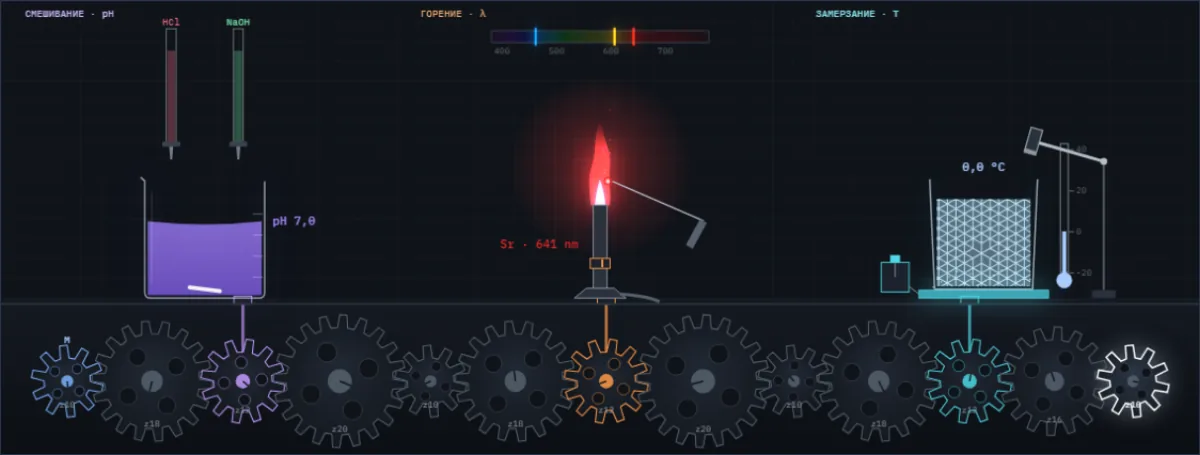
The index lab: a glass of cabbage juice, a burner, a glass of water on a cold plate and a gear train
Index · all quantities on one page
The lab at the entrance to the index

A drop of acid changes the colour of the juice, salt colours the flame, water freezes at a tap. Below them are all Simetrium sheets, by discipline and alphabetically.

Open the index →
08 · Your language
every link is a real page in that locale

Read it in your own language

translated and checkeddraft translationqueued