p·min
A short clip was watched a million times in a day, while a twelve-minute video lesson was watched only fifty thousand times. Which of them took more of people's time? It seems the clip: it has twenty times as many views. But a third of viewers scroll past the clip in a couple of seconds, and on average people spend eight seconds on it, while many watch the lesson almost to the end. Add up the minutes of all viewers and the lesson comes out twice as far ahead. That is exactly the sum the attention minute measures.
One person-minute of attention is a minute that one person really spent with a clip, an article or a site. Twenty people for three minutes each make sixty person-minutes, and exactly the same comes from one person who read for a whole hour. A view counter answers the question of how many times the page was opened, while minutes of attention show how much time people gave it. They are counted per hour, per day, per month or per year, and the period is always written next to the number, just as "per hour" is written with a speed.
Etymology
Take inside, draw the bowstring and cut off a small part
Three words meet in the name of the unit, and each has its own long history. The Russian "vnimanie" and the Latin attention describe the same act with different pictures: one says that a person takes a thought inside, the other that they reach toward it like a drawn bowstring. And "minute" goes back to the Babylonian counting in sixties, by which the degree and the hour were later divided into sixty parts too.
Attention and memory
How many minutes it takes to remember
Recall a clip you scrolled past yesterday in a couple of seconds. Most likely you cannot retell a word of it. It is not absent-mindedness; memory is built that way. Everything seen first lands in a short-term store, which holds the impression for a matter of seconds, and only a small part moves on into long-term memory.
Psychologists have studied this path for more than a hundred years, and their conclusions agree. Within a second only a momentary imprint of the picture remains. Without repetition almost everything is forgotten within half a minute. And what was studied for several minutes and then repeated with breaks lasts for weeks. So not every minute of attention is worth the same: ten scrolls of six seconds each make the same person-minute as a minute of focused reading, but leave far less in memory.
01 · Definition
The area under the viewers' curve
Imagine that each viewer is a strip whose length equals the time spent on the page. The attention minute is the sum of the lengths of all the strips. If you line them up by size, you get the curve analysts call the retention curve: at the start everyone is watching, then viewers leave one by one. The area under this curve is the number of person-minutes.
The same area can be folded into a rectangle. Its height is the number of visitors, and its width is the average time per person. That is why attention minutes are most often counted by simple multiplication, and the curve is needed to understand where exactly people leave.
Compare, check the counter, walk through the day
In the "Comparison" experiment choose two kinds of content and set how many people opened them: the wall of screens shows how viewers leave, and the beakers show whose area of attention is larger. In the "Counter" experiment switch on forgotten tabs and bots and see how many extra minutes each measuring method counts. And in the "Day" experiment choose where your readers live and find out at what hour of server time the peak comes and how many person-minutes add up over a day, a month and a year.
02 · Conversion
Visitors and minutes, in hours, years and lives
Enter how many people came and the average time of one visit in minutes, then choose the period over which these numbers were collected. Below you will see how many person-minutes and person-hours this is, how many years of one person's life, and what share of the waking time of all humanity over the same span your content took.
The same count in the words of television
Television has counted attention for a long time, it just calls it something else. Reach is how many different people tuned in to a program at least once, ATS is how long on average each of them watched, and ATV is how many minutes fall to each resident, including those who did not watch at all. Enter these numbers and they turn into person-minutes and an average rating.
The average rating of a program is ATV divided by its length: the share of the population that would have watched it from start to finish if all the attention were gathered in the same people. So the rating too measures minutes of attention, only in percent.
03 · Orders of magnitude
04 · How it is measured
Eight counters, eight rules
Attention time is counted today by TV devices, site counters and video platforms alike. All of them add up minutes, but they decide differently when a person has stopped watching. One counter waits for a touch or a scroll, another is content with the tab being open, a third asks the viewer to press a button on the remote, and a fourth measures nothing at all and calculates the time in advance, from the length of the text. As a result the same page gets different times in different systems, and their numbers cannot be compared directly.
Where reading minutes come from
Above many articles there is a label "≈ 12 min read". Nobody timed this figure: it is calculated in advance, before the first reader. The number of words is divided by an average reading speed, and a few seconds are added for each picture. Set the length of the text and the speed and you will see how the label comes about and how much time people actually spend on such a page.
The speeds are taken from Marc Brysbaert's 2019 review, which pooled almost two hundred studies: adults silently read popular-science English text at about 238 words per minute and fiction at about 260. Pictures are counted by the Medium rule: twelve seconds for the first, one second less for each following one, and three seconds each from the tenth on. In languages where words are longer or written in characters, time is counted by characters, not by words.
05 · Writing rules
06 · Neighbouring units
07 · Historical section
Person-minutes were invented not for screens but for factories. At the start of the twentieth century engineers with stopwatches in hand wrote down how many minutes a worker spent on each operation and added them up into person-hours. That was how they measured the labor a person gives to a task. Half a century later the economist Herbert Simon noticed that an abundance of information creates a scarcity of whatever it consumes, namely people's attention.
Television was the first to measure attention with a device: a people meter stands by the TV, and every family member presses their own button on the remote when they sit down to watch. Websites learned to count time themselves, by scrolling and touches, and in the 2010s video platforms stopped valuing clips for clicks alone and began to value them for watch hours. The attention minute joins these counts into one unit, since each of them measures the same thing: people's time.
Catalogue of quantities
the whole index →The seven SI base units
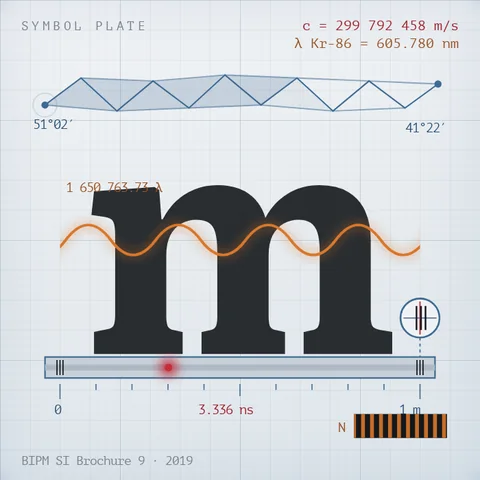
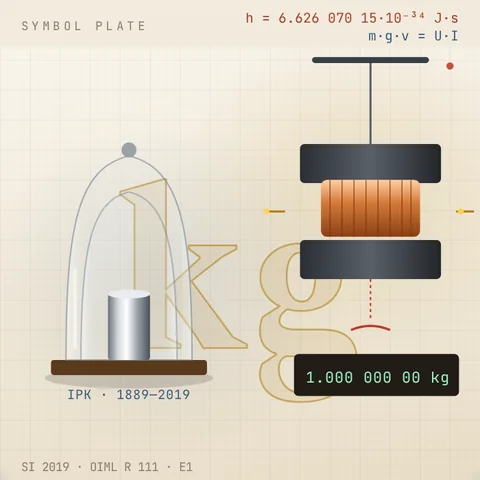
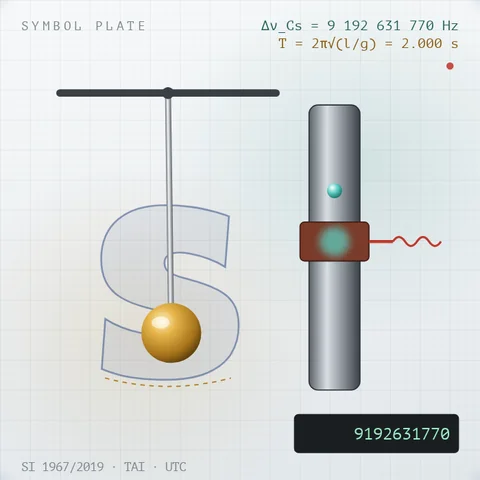
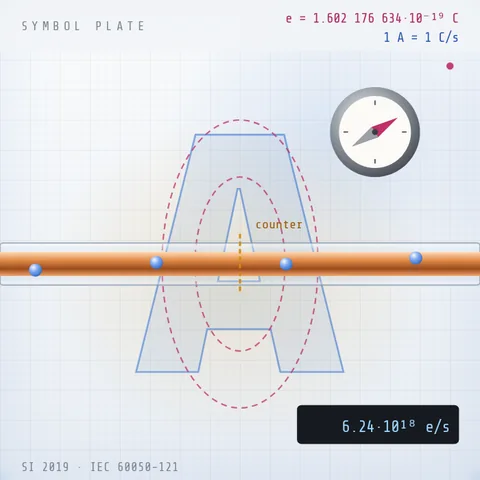
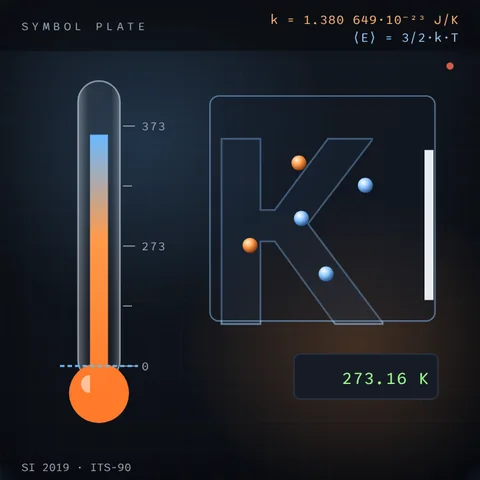
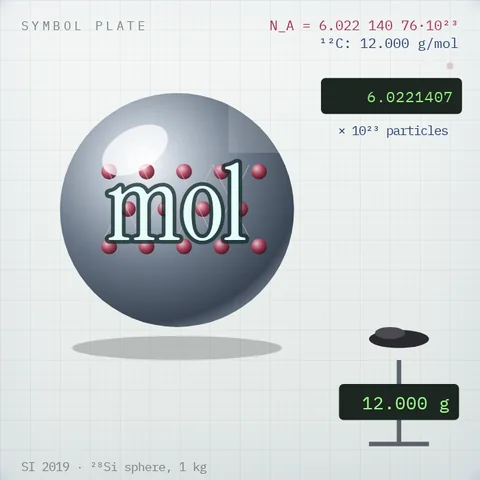
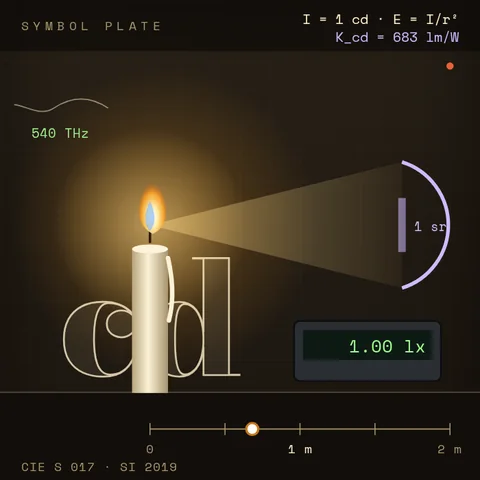
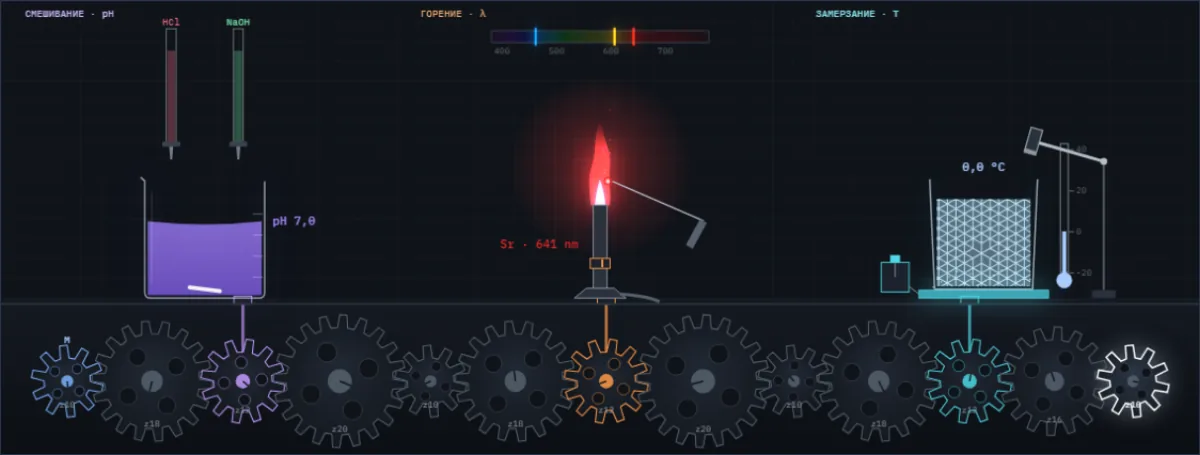
A drop of acid changes the colour of the juice, salt colours the flame, water freezes at a tap. Below them are all Simetrium sheets, by discipline and alphabetically.
Open the index →