The symbol for the degree Celsius is the degree sign and a capital Latin C, joined to each other but separated from the number by a space: 36.6 °C. A capital T means thermodynamic temperature in kelvins, a lowercase t means Celsius temperature, and medical documents almost always use the latter.
Body temperature is the temperature of the core: the blood, brain and internal organs, which the body keeps almost constant. The skin and the armpit lie in the shell, which cools and warms along with the room, so their readings are lower and depend on how long the thermometer was held and how tightly the arm was pressed.
Mercury in a glass tube rises from a reservoir pulsing with heat to the amber mark of Wunderlich’s 37.0, pauses there and settles to the blue dashed line at 36.6, after which the thermometer is shaken down. A haze of heat rises above the tube, a snowflake of chills slowly turns below, and a red marker moves along the dashed daily curve under the symbol, from the morning minimum to the evening maximum.
Quantity data sheet
core body temperature sheet 1/1 · rev. 2026-09Body temperature t · °C
Derived SI unit · quantity: core temperature of the human body, degree Celsius
Thirty-seven degrees that cooled
In 1868 Carl Wunderlich, a professor in Leipzig, published a book in which fever became a number for the first time. For years he had placed a thermometer almost a foot long in the armpits of patients, waited a quarter of an hour each time and written down the readings, so that by the time the book came out, by his own account, he had about twenty-five thousand patients and more than a million measurements, and from them came a norm of 37 °C with a spread from 36.2 to 37.5.
For a century and a half this number lived in textbooks unchecked, until it was recalculated. In 1992, healthy volunteers measured under the tongue gave 36.8; in 2017, thirty-five thousand patients gave 36.6; and in 2020 researchers at Stanford, comparing the records of Civil War veterans with present-day clinics, concluded that Americans are cooling by roughly 0.03 °C for every decade of birth.
The sheet shows that the body has no single norm: it depends on where the thermometer is placed, at what hour and in whom, and it explains why the old 37 °C and today’s 36.6 can both be right at the same time.
01 · Definition
core · site · hour · ageBody temperature is the temperature of its core, that is, of the blood, brain and internal organs, expressed in degrees Celsius. The body keeps it in a narrow corridor around 37 °C because enzymes work best there, and the hypothalamus serves as a thermostat that switches on shivering, sweating and constriction of the blood vessels when the core strays from the set point.
The set point, however, does not stand still. Over a day it traces a wave about half a degree wide, with a minimum towards morning and a maximum closer to evening; it drifts down a little with age, and in women it rises by a few tenths in the second half of the cycle. So the norm is not one number but a band, with a middle and a width.
A thermometer, meanwhile, measures not the core but the place where it was put. The rectum is closest to the core and reads a few tenths higher than the mouth, the ear sits somewhere between them, and the armpit, open to the room’s air, reads half a degree lower, which is why every site has its own fever threshold.
For some 37 is fever, for others it is normal
On the left is a thermometer whose mercury rises to the reading at the speed at which the chosen site warms up: slowly in the armpit, in a second in the ear. On the right the blue dots are two hundred and forty healthy people measured in the same way, at the same hour and of the same age; they fall onto the scale one by one and build up today’s norm. The filled amber hill is Wunderlich’s norm with its middle at 37.0, the blue dashed line is the middle of the present-day crowd, the red dashed line is the fever threshold for this site, and the solid red needle is your reading.
Fever as a rise, not as a threshold
With age the usual temperature falls and the response to infection weakens, so in an older person with pneumonia the thermometer may never reach 37.8. That is why the Infectious Diseases Society of America, IDSA, counts as fever in nursing-home residents not only a single oral reading above 37.8 but also a repeated one above 37.2, a rectal one above 37.5, or a rise of more than 1.1 °C above that person’s usual temperature. On the stage you can see it by setting the age to eighty: the crowd shifts to the left, and the same reading ends up much farther from its middle.
02 · Conversion
scales · old scales · measurement siteThe same fever in five scales
Enter a temperature in any scale, and the sheet will convert it to degrees Celsius, kelvins and Fahrenheit, show how it would have been written in Réaumur or Rømer, and what a thermometer would read at another place on the body, if this number was taken in the mouth.
A rule to remember: a degree Celsius equals 1.8 degrees Fahrenheit, so a tenth of a degree on our thermometer is almost two tenths on the American one.
The famous 98.6 °F is simply Wunderlich’s 37 °C converted to the nearest tenth. Wunderlich himself rounded to a whole degree, and in conversion the rounding vanished, so the number came to look more precise than it was measured, and American textbooks taught for half a century a “normal” tenth of a degree that was not in the data.
| {k} | {v} | {note} |
{text}
04 · Measuring instruments
mercury · thermistor · infrared · capsuleFour ways to reach the core
A column that does not want to go back
In 1867 Thomas Allbutt made a clinical thermometer six inches long that needed only five minutes, and the constriction of the capillary above the reservoir made it a maximum thermometer: as it cools, the mercury breaks at the narrow spot, and the column stays at the highest mark until the thermometer is shaken down. The Minamata Convention of 2013 banned the manufacture of mercury thermometers from 2020, and today galinstan and electronics have taken their place.
A beep before it has warmed up
In the tip of an electronic thermometer sits a thermistor whose resistance falls as the temperature rises, and the device could honestly wait until the sensor has warmed through. Most models do not: they record the first seconds of heating, the blue curve, extend it by calculation to the peak and beep, although the sensor itself, the amber dashed line, has not yet reached the red line. The ISO 80601-2-56 standard allows this mode but requires of it the same laboratory accuracy of ±0.3 °C as of the direct one.
Temperature taken by light
The eardrum is fed by the same artery as the hypothalamus, and its infrared radiation speaks of the core almost without delay, so an ear thermometer shows a number in a second. It errs because of geometry: if the ear canal has not been straightened and the sensor looks at the cold wall, the reading drops by half a degree, while non-contact forehead devices, which measure skin, err even more and depend on wind and sweat.
A thermometer you swallow
The capsule with a quartz sensor was devised at NASA in the 1980s to monitor overheating in astronauts, and it is now swallowed by marathon runners, firefighters and soldiers before training in the heat. It passes through the gut in a day or two and all that time transmits the core temperature, so the daily wave and the rise under exertion can be seen in full, not as a single point in the morning.
05 · Writing rules
sign · space · siteWithout the measurement site a number is incomplete
Body temperature is written with a decimal point and one digit after it, with °C after a space, and in a medical record the place where the thermometer stood is noted next to it, because the threshold depends on it.
The first line on the right glues the number to the sign, the second names neither a scale nor a site, and the third breaks the °C designation with a space. The kelvin has been written without a degree sign since 1967, a household thermometer does not distinguish hundredths of a degree, and a bare 98.6 without a scale will be taken by a reader in Europe for a deadly fever.
06 · Neighbouring units
kelvin · Fahrenheit · RéaumurBody temperature is surrounded by the kelvin, through which the degree Celsius is defined in the SI, the degree Fahrenheit, in which it is measured in the USA and therefore written in half of the medical literature, and the degree Réaumur, which stood on the household thermometers of Europe until the end of the nineteenth century.
The SI base unit; a difference of one kelvin equals a difference of one degree Celsius.
The scale of 1724, whose second reference point was precisely human temperature.
Eighty degrees between ice and boiling; it was used to measure the bathhouse and the sick in the nineteenth century.
07 · Historical section
archive · from the thermoscope to StanfordHow fever became a number, and the number cooled
{title}
{text}
A great-grandfather was half a degree warmer
The blue line is the mean temperature of men by decade of birth in the 2020 work of Protsiv and Parsonnet: a fall of about 0.03 °C per decade, so that those born in the early nineteenth century were 0.59 °C above today’s level. The amber dashed line is the 37.0 norm, and the red marker runs along the line from great-grandfather to great-grandson.
The authors link the cooling to people suffering less from chronic infections, living in warmth and spending less energy on heating, which means Wunderlich could have measured honestly, just a different population.
Where the 37 degrees actually came from
Wunderlich measured in the armpit with thermometers about twenty-two centimetres long, held for fifteen to twenty minutes, and combined the records into averages, publishing neither the original tables nor the hour at which each reading was taken. So the figure of 37 °C cannot be recalculated from his data: only the result is known, while the spread, the time of day and the make-up of the patients stayed in the clinical logbooks of Leipzig.
In the 1990s Philip Mackowiak found one of Wunderlich’s thermometers in the Mütter Museum in Philadelphia and tested it: the instrument read 1.4–2.2 °C high against a modern reference. Whether it was in fact the clinic’s working instrument is unknown, but the find itself showed that thermometers of that time were verified against one another and not against a common standard, and the scale error could easily have been larger than the difference between 37.0 and 36.6.
Yet the 2020 study relied not on one instrument but on three huge bodies of data — the army records of veterans, a national survey of the 1970s and half a million measurements from a Stanford clinic — and the trend held within each body separately, where the thermometers were of one generation. A similar cooling was found among the Tsimane people of Bolivia, whose mean fell by almost half a degree over sixteen years of observation, so instrument error does not explain everything: the body really is cooling.
The seven SI base units
Catalogue of quantities
Medicine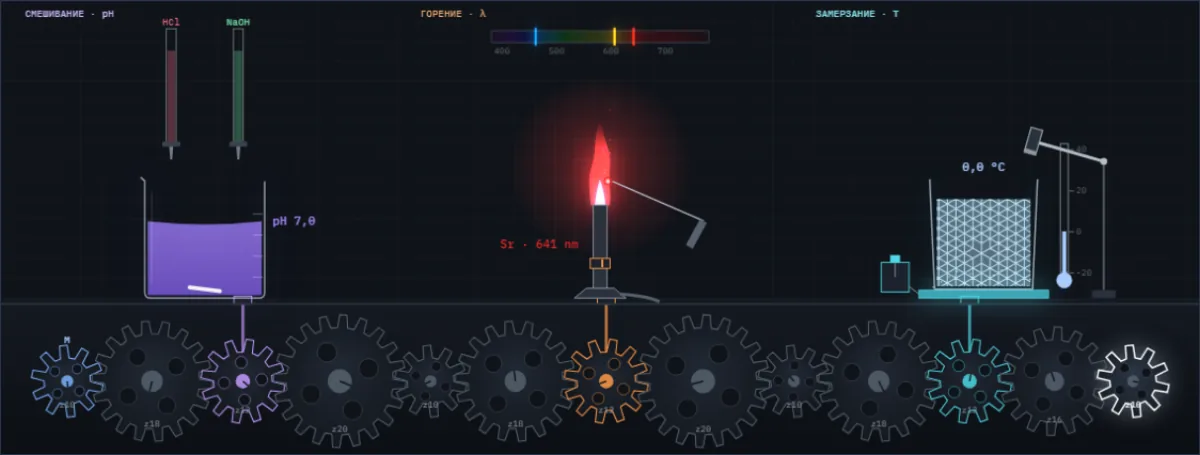
A drop of acid changes the colour of the juice, salt colours the flame, water freezes at a tap. Below them are all Simetrium sheets, by discipline and alphabetically.
Open the index →