Caloric
Munich, 1798. Count Rumford watches cannon barrels being bored in the arsenal and asks a question of arithmetic. If heat is a substance poured into the metal, its store is finite, and boring must one day stop producing heat. He takes a blunt borer, puts the barrel in a box of water and after two and a half hours has boiling water. He changes the water — boiling again.
Caloric was a weightless matter that Lavoisier entered in his table of simple substances. It was thought to flow from hot to cold and to be conserved as it did. Its amount was measured in calories: a calorie warms a gram of water by a degree. The theory produced correct tables of heat capacities and even Carnot’s theory of heat engines. But Rumford’s experiment showed that heat could be produced without end, as long as work was done.
| Notation | caloric · calorique · measure cal |
| How it was measured | by the mass of melted ice and the warming of water · Q = c·m·ΔT |
| What was assumed | conservation: what left one body arrived in another |
| Introduced and withdrawn | calorique — Lavoisier, 1789 · Rumford’s experiment — 1798 · mechanical equivalent — Joule, 1843—1850 |
| Today’s notation | heat is a form of energy, in joules · 1 cal = 4.184 J · ISO 80000-5 |
| Typical values | 79.7 cal — to melt a gram of ice · 540 cal — to evaporate a gram of water · 2000 kcal — a day’s ration |
01 · Definition
The weightless fluid of heat
In the system of the late 18th century, caloric is contained in bodies and flows from warm ones to cold ones. Its particles repel each other — that is why heat spreads out and bodies expand when heated. Different substances hold caloric differently: iron needs ten times less than water to warm by a degree.
Black’s latent heat was explained too: melting ice takes in caloric but does not get warmer, so the caloric must enter in a bound form. All the arithmetic of the system rested on one assumption — that caloric is conserved. That is exactly what had to be abandoned. The heat-capacity formulas stayed valid; only heat is now counted as energy.
Heat on the scales, without a thermometer
In the centre is a hot sample in a chamber of ice; its colour depends on its temperature. Teal shows the ice and the meltwater, which drains into the cup below — its mass gives the heat. The outer jacket is ice too; it shields the experiment from the warmth of the room. Amber dots are caloric as it was imagined: it leaves the sample for the ice until the sample cools to zero.
How caloric explained everything — until the boring began
Here caloric is drawn the way it was imagined: 260 amber particles of a weightless fluid. In the first three experiments their number does not change; they only flow across, push the body apart or hide in melting ice. Hollow circles are bound caloric, the teal layer is ice. In the fourth experiment the borer creates new particles, white ones, out of nothing — and the count stops adding up. The slider drives the experiment; the numbers under the scene are counted in calories, as in those years.
The barrel that never cooled
In the centre is the arsenal’s boring machine. Horses walk in a circle; their capstan turns a bronze barrel through a large wheel and a pinion. The barrel stands in a box of water, and a blunt borer presses into its bore. Lilac shows mechanical work: the gearing, the shaft, the horses’ power. Amber is heat, born at the point of friction: particles rise from the borer through the water. Teal is the water and its temperature. On the right a screen records the warming of the water, with the caloric account below it. By the theory, the store of caloric in the barrel is finite. The bar shows how much of that store should already have gone. Time runs 120 times faster: one second is two minutes. If you leave it alone for 20 s, the experiments run by themselves.
—
02 · Conversion
| {n} | {v} | {note} |
There are several calories. The thermochemical one is exactly 4.184 J, the international one 4.1868 J, the 15-degree one 4.1855 J. The difference is tenths of a percent. In precise work the kind of calorie is stated — or, better, joules are written straight away.
Grams of ice and boiling water were the measures of that era: that is how heat was seen. Melting a gram of ice takes 79.7 cal, evaporating a gram of water at 100 °C about 540 cal. Steam scalds worse than boiling water precisely because of those 540.
03 · Orders of magnitude
04 · Measuring instruments
05 · Writing rules
06 · Neighbouring units
Caloric is gone, but it left an inheritance. Carnot derived the limit of heat engines while treating caloric as conserved — and the formula holds to this day. Work and heat turned out to be a single quantity, and entropy grew out of the ratio of heat to temperature.
07 · Historical section
The caloric theory did not spoil a single measurement: the calorimeter measured transferred heat, not a substance. That is why Lavoisier and Laplace’s tables of heat capacities outlived the theory. Only the assumption of conservation was dropped; the measure — the calorie — was kept.
The calorie was defined through water and had several versions: at 15 °C, averaged from 0 to 100 °C, international. In 1948 the General Conference on Weights and Measures recommended expressing heat in joules. The calorie stayed on food packaging and in old handbooks.
Catalogue of quantities
the whole index →The seven SI base units
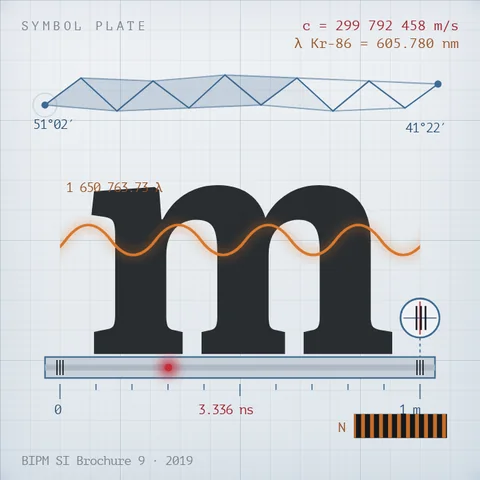
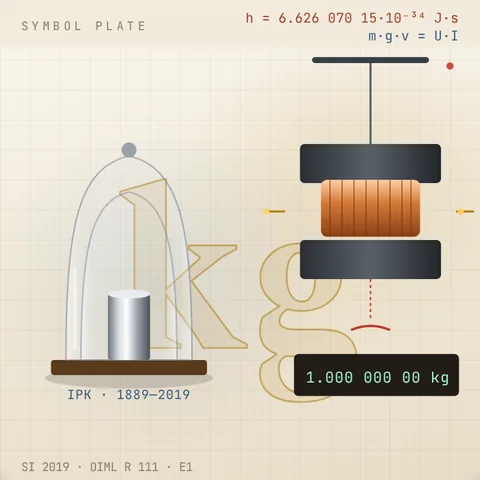
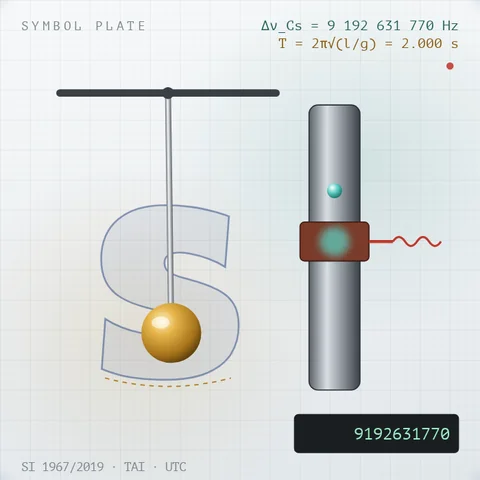
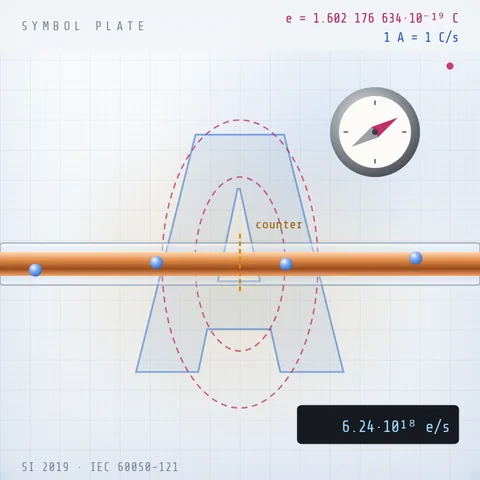
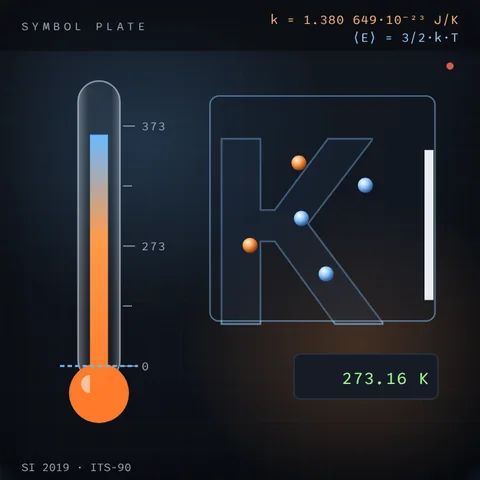
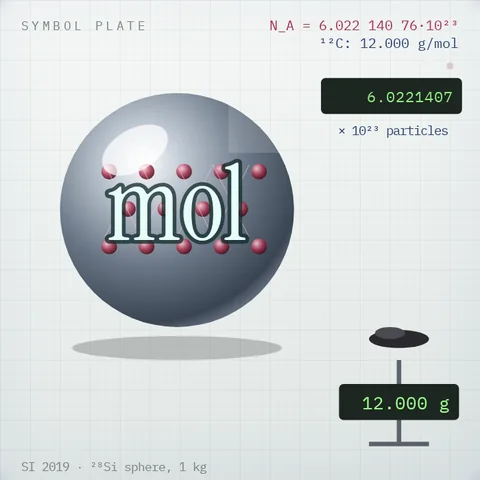
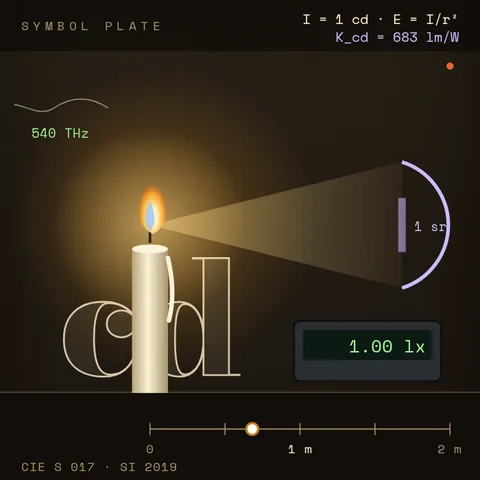
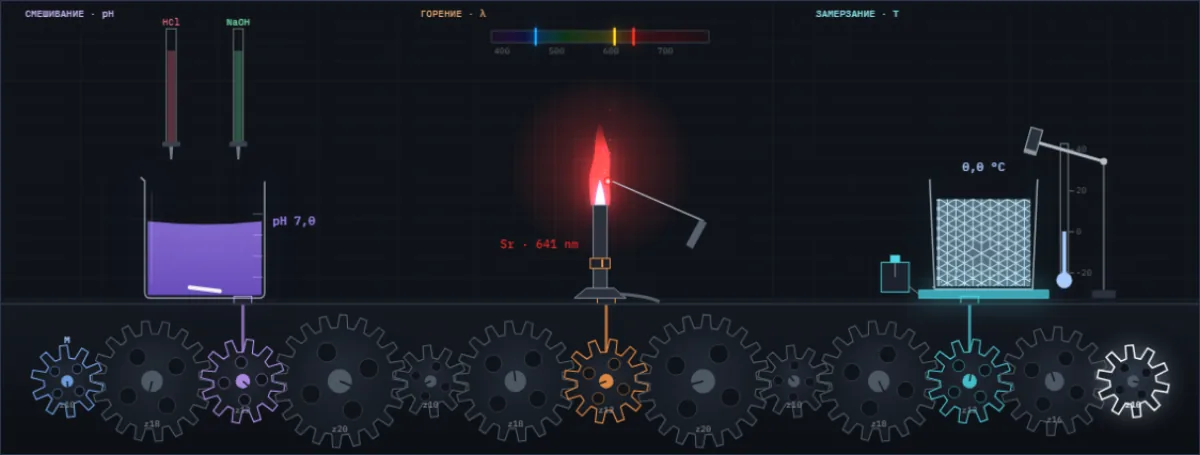
A drop of acid changes the colour of the juice, salt colours the flame, water freezes at a tap. Below them are all Simetrium sheets, by discipline and alphabetically.
Open the index →