Scale names are written as proper nouns: Apgar with a capital, as the author's surname, GCS and NEWS2 in capital Latin letters, and the Glasgow components in capitals with a digit and no space, E3 V4 M6. The points have no unit, and the word “point” after the number is optional, but the name of the scale is not: without it the number means nothing.
Scale points are not a measurement but a rank: eight on the Glasgow scale is worse than nine, but nobody knows by how much, and certainly not by one ninth. The direction differs between scales too — for Apgar and Glasgow lower means worse, for NEWS2 and pain higher means worse — so the very same number 8 may describe a perfectly healthy newborn or a person in a coma.
On the left is an Apgar card of five rows, each lighting up zero, one or two points, with single dots drifting out of it into a big sigma where the points are added up. On the right three Glasgow bars — eyes, speech, movement — change height each at its own rhythm, NEWS2 alarm lamps take turns above them, and at the bottom the slider of the visual analogue scale travels along the hundred-millimetre line to the 72 mark and flashes.
Quantity data sheet
ordinal scales · points sheet 1/1 · rev. 2026-09Clinical scales Apgar · GCS · NEWS2 · VAS
Off-system dimensionless quantity · ordinal scale: a sum of points over signs of the patient's condition
A number that replaces a conversation
In the early 1950s the anaesthetist Virginia Apgar, who worked in the maternity ward of a New York hospital, was asked by a student how to assess a newborn quickly, and wrote down on the back of a form, on the spot, five signs: skin colour, pulse, response to stimulation, muscle tone and breathing, each worth zero, one or two points. The sum one minute after birth, and again five minutes later, became the first number in the life of almost every person on Earth.
The Glasgow Coma Scale, which has described consciousness after injury since 1974, is built in the same way, as are the British early warning score NEWS2, by which a nurse decides whether to call a doctor, and the visual analogue scale, on which the patient makes a mark on a line one hundred millimetres long. None of them measures a physical quantity: the points have no unit, no zero and no equal steps, only an order — better or worse.
This is a companion to the pages on the credit score and the credit rating: there too a number stands in for a complex judgement. The page shows why such numbers are useful at the bedside and why they cannot be handled like metres and kilograms.
01 · Definition
sign · point · sum · thresholdA clinical scale is an agreement by which several signs of a patient's condition are turned into points and added up, so that a decision can be made from the sum. Each sign is divided into steps, each step is given a whole number, and the result is an ordinal quantity: it says which state is more severe, but not how many times.
In 1946 the psychologist Stanley Smith Stevens divided scales into four kinds — nominal, ordinal, interval and ratio — and showed that each kind permits its own operations. Metres and kilograms are ratio scales and can be divided; degrees Celsius are interval scales and can be subtracted; Glasgow and Apgar points are only an order, and all that can honestly be done with them is to compare them and find the median.
The sum of points behaves treacherously, however. The steps within a sign are not equal to each other, the signs are not of equal weight, and the same sum can be reached in different ways, which is why NEWS2 requires looking not only at the total but at every parameter, and why Glasgow is recorded by its components. The visual analogue scale stands apart: a mark on a line gives millimetres, and one is tempted to treat them as an interval quantity, but it remains a measure of pain only in the eyes of one person.
When a nurse calls the doctor
On the left is a bedside monitor: the green trace is the heart, the blue one is the pulse wave of the finger, the red one is breathing, and all three run at the rate you set. On the right is a NEWS2 chart of seven parameters: each row is cut into bands, and the deeper the red of a band, the more points it carries, while a pale green band is zero; a white marker slides into the band of your value. Below is a tape of rounds: every three seconds the nurse takes the readings again, with the usual scatter of instruments, and the column shows the sum of that round.
The threshold is needed not by nature but by the shift
A respiratory rate of 20 and 21 per minute hardly differs for the body, but for NEWS2 it is zero and two points, because the scale was invented not to describe physiology but so that a tired nurse at four in the morning and the doctor on call would understand in the same way whether it is time to act. Hence its price: right at the edge of a band one extra breath per minute changes the sum, and the tape of rounds on the stage shows how often this happens with the usual scatter of measurements.
02 · Conversion
interpretation · composition · why notA scale can be read but cannot be converted
Enter a score and choose a scale, and the page will say what this score means at the bedside and which signs make it up. The third tab does what must not be done — it converts the score into other scales by its share of the range — so that you can see how the same share means a completely different state there.
A rule to remember: for Apgar and Glasgow worse is down, for NEWS2 and pain worse is up, and eight points in the first two are opposite news.
When pain has “decreased from eight to four”, it is tempting to say it halved, but an ordinal scale does not allow this: for different people an eight and a four stand in different places, and the difference itself depends on where you count it from. Pain research therefore speaks of the minimal clinically important difference — about two points out of ten or 30 % of the baseline — and not of “half the pain”.
| {k} | {v} | {note} |
{text}
04 · Measuring instruments
clock · torch · monitor · rulerThe instrument here is a person, and the rest only helps
The minute by which the first score is given
The only real instrument of the Apgar score is a stopwatch on the resuscitation table: the score is given one and five minutes after birth, and if the sum at five minutes is below seven, it is repeated every five minutes up to the twentieth. The signs themselves are assessed by the midwife with eyes and hands, and the heart rate is counted with a stethoscope over six seconds and multiplied by ten.
Voice, pain and light
For the Glasgow scale the doctor first calls the patient by name, then asks them to obey a command, and only then presses on the nail bed or the brow, recording the best response of eyes, speech and movement. The torch does not belong to the scale itself, but since 2018 the pupil reaction has been added to the sum in the GCS-P variant, subtracting up to two points, because two fixed pupils change the prognosis more than any step of speech.
Five numbers, oxygen and one word
Five of the seven NEWS2 parameters are numbers: the respiratory rate is counted by the clock, the rest are taken with a monitor, a blood pressure cuff, a pulse oximeter and a thermometer; the sixth is whether the patient breathes air or receives oxygen, and the seventh, consciousness on the ACVPU scale, is assessed by the nurse in words: alert, confused, responds to voice, to pain, or does not respond at all. In British hospitals the chart has become electronic and colours the bands and calls the doctor on call by itself, but the lowest parameter is still filled in by a person.
A hundred millimetres without divisions
The visual analogue scale is a line of exactly one hundred millimetres with labels at the ends, “no pain” and “worst pain imaginable”, on which the patient makes a mark or moves a slider. There are deliberately no divisions on the patient's side, so that they do not cling to round numbers, and the doctor reads the millimetres on the back; when a form is photocopied the line may shorten, which is why its length is checked before the study.
05 · Writing rules
scale name · components · whole numbersA sum without its components loses half its meaning
A score is written as a whole number next to the name of the scale; for Glasgow, together with the breakdown into eyes, speech and movement; for NEWS2, with a note of the parameter that gave three points; and pain on the VAS in millimetres.
The first line on the right invents half-points that the Apgar card does not have, the second hides which of the seventeen ways was used to collect ten Glasgow points, and the third turns a sum into a share of the maximum, although no scale has “a hundred percent of severity”. The number 6.4 without the name of a scale cannot be read — it is either VAS centimetres or a wrongly recorded numeric scale; “halved” requires a ratio scale, and a mean with hundredths ascribes to ranks a precision and an arithmetic they do not have.
06 · Neighbouring units
credit score · rating · Mohs scaleThe closest relatives of clinical scales live outside medicine: a credit score also adds up signs into a number for the sake of a decision, a rating letter also marks a step and not a quantity, and the Mohs hardness scale is the oldest example of an order without equal steps, in which diamond stands at ten although it is several times harder than corundum at nine.
A sum of weighted features of a borrower, by which a bank decides whether to lend money.
Steps of an issuer's reliability; behind the letter stands a probability of default, but the letter itself is a rank.
Ten minerals in the order of “who scratches whom”, without equal gaps.
07 · Historical section
archive · from Stevens to NEWS2How judgement came to be written as a digit
{title}
{text}
In how many ways one Glasgow sum is reached
The height of a column is the number of combinations of eyes, speech and movement that give this sum: there are 120 in all, and the middle of the scale is reached in eighteen different ways, the ends in only one. The red frame passes over the columns in turn.
A patient who opens the eyes and is silent and a patient who mumbles with eyes closed can score the same nine points, yet their prognosis differs, which is why Teasdale has asked for half a century that the components be recorded.
Points that have no reference but do have a check
With an ordinal scale accuracy cannot be checked the way a balance is checked: there is no weight that weighs exactly nine Glasgow points. Instead of a reference it has agreement between observers — two doctors independently score the same patients, and the match is expressed by Cohen's kappa, which shows how much better the agreement is than random guessing. For Glasgow it is high among experienced raters and noticeably falls among novices, especially on the verbal component.
The second check is prognostic: a scale is accepted as fit if its sum separates well those who got worse from those who did not, and this ability is measured by the area under the ROC curve. NEWS2 was tested on hundreds of thousands of admissions before it was made common to British hospitals, and its thresholds 5 and 7 were chosen not from physiology but from where the alarms become numerous enough not to miss trouble, and not yet so numerous that staff stop responding to them.
Rules of statistics follow from this too. Comparing groups by the median and by the share of patients above a threshold is honest, but by the mean score and the standard deviation only with reservations, because arithmetic assumes equal steps, which the scale does not promise. The visual analogue scale is sometimes called an exception, since its millimetres are equal, but the equality of millimetres does not yet make equal the sensations they depict.
The seven SI base units
Catalogue of quantities
Medicine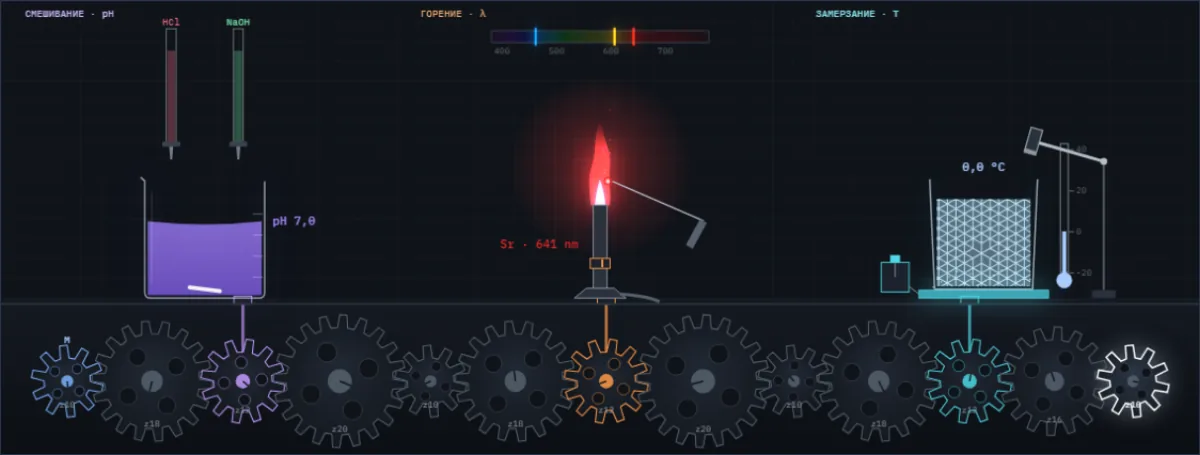
A drop of acid changes the colour of the juice, salt colours the flame, water freezes at a tap. Below them are all Simetrium sheets, by discipline and alphabetically.
Open the index →