Distributed load
Snow has settled on a warehouse roof: 2.1 kN/m² by design, plus 0.5 for the roofing itself. That is a load per square metre. A purlin made of channel 20P carries a strip of roof 1.5 m wide — the distance to the neighbouring purlins. Each metre of purlin takes 2.6 × 1.5 = 3.9 kN plus its own weight: q = 4.08 kN/m. Put 2.6 into the deflection formula as kN/m, and on paper the purlin deflects by 15 mm, while in reality — by 22 against an allowable 24.
A distributed load is a force spread over a length or over an area. On a floor it acts in kN/m², on a beam — in kN/m. There is one conversion: multiply by the tributary width, that is, by the beam spacing. Slabs and decking collect load from an area, beams — from strips, columns — from tributary areas. A mistake in this multiplication cannot be seen in the units if you do not write them: both 2.6 and 3.9 are «just a load».
| Notation | q — line load, kN/m; p, g, s — area loads, kN/m² = kPa |
| Link | q = p · a, where a is the tributary width of the beam, m; 1 kN/m = 1 N/mm |
| Reference figures | 1 kN/m² ≈ 102 kgf/m² · a metre of water — 9.81 kN/m² · flat 1.5 · snow region III 1.5 |
| Beam on two supports | M = qL²/8, R = qL/2, f = 5qL⁴/384EI |
| Cantilever | M = qL²/2, R = qL, f = qL⁴/8EI |
| Where | load take-down, design of beams and purlins, load diagrams on KM and KZh drawings (steel and concrete structures) |
01 · Definition
Area, strip, beam
Loads are collected from the top down. Snow, people and equipment press on the floor in kN/m². The decking passes it to the beams, and each beam gets a strip reaching to the middle of the spans between it and its neighbours. If the beams are 3 m apart, the strip is 3 m, and every square metre turns into 3 kN per metre of beam. Hence q = p · a: the area load multiplied by the tributary width.
From there the line load determines everything in the beam. The bending moment grows as the square of the span, the deflection — as the fourth power. So spacing the beams one and a half times wider is the same as one and a half times more snow, and making the span one and a half times longer increases the deflection fivefold. In units it is obvious at once: kN/m² · m = kN/m, kN/m · m² = kN·m.
Seven loads on one strip
The rows are area loads. The bar is what a beam with the chosen tributary width receives, the figure on the right — in kN/m. On the left — the original kN/m².
Five structures, one strip, one deflection
The main action is the «Start loading» button. First the load settles on the floor — snow, people, pallets or water — and the sensor shows it in kN/m². Then the tributary strip of one beam, as wide as the beam spacing, is highlighted, and the load from the strip is gathered into a line: q = p · a. Next the view moves to the beam itself: the line-load arrows, the bending moment diagram, the support reactions, and the deflection gauge at midspan. The last step is the check for strength and for deflection. Below the scene you choose the structure — a warehouse roof, a balcony, a warehouse, a footbridge or a pool — and the beam spacing. The «kN/m² as kN/m» button shows a calculation in which someone forgot to multiply by the spacing.
—
02 · Conversion
Old codes and handbooks write loads in kgf/m²: 150 kgf/m² is 1.47 kN/m², almost exactly 1.5. For a rough estimate, 1 kN/m² ≈ 100 kgf/m², an error of 2 %.
American codes use psf, pounds per square foot: 40 psf for housing is 1.92 kN/m². Line loads are in plf or klf: 1 klf = 14.6 kN/m.
| load | kN/m² | kgf/m² | kN/m at 3 m | source |
| {k} | {v} | {h} | {a} | {n} |
03 · Orders of magnitude
04 · Measuring instruments
05 · Writing rules
Series · Drafting and CAD
desk tips for every sheet06 · Neighbouring units
07 · Historical section
An area load is almost never measured directly. Snow is weighed in samples, while people and furniture are taken from the codes as statistics: a value that will be exceeded during the service life only with a small probability. So the characteristic load is a convention, and the partial safety factor γf adds a margin for the uncertainty.
How a structure carries load can be checked by testing: the floor is loaded in steps with a test load — sacks, water in film-lined pools, concrete blocks — and the deflection is measured at every step. If the deflection grows linearly and returns after unloading, the material works elastically, and the calculation is confirmed.
Catalogue of quantities
the whole index →The seven SI base units
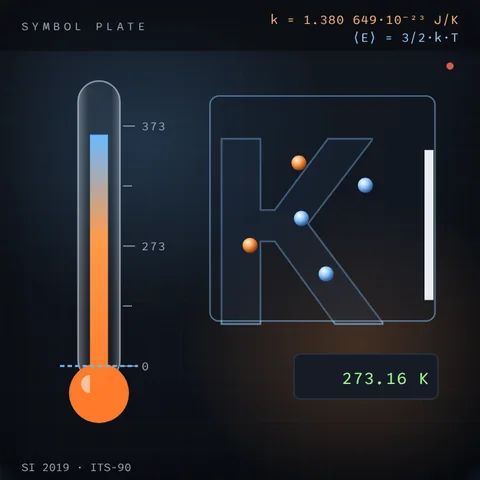
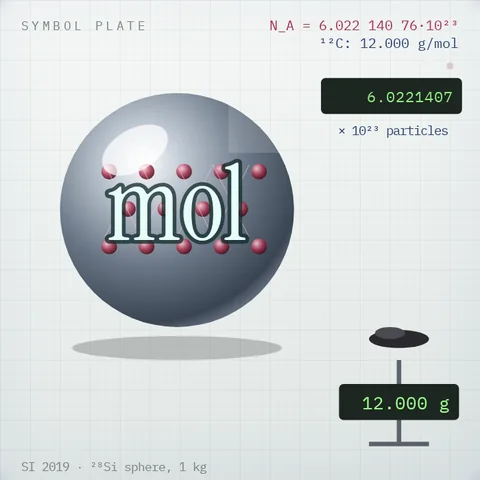
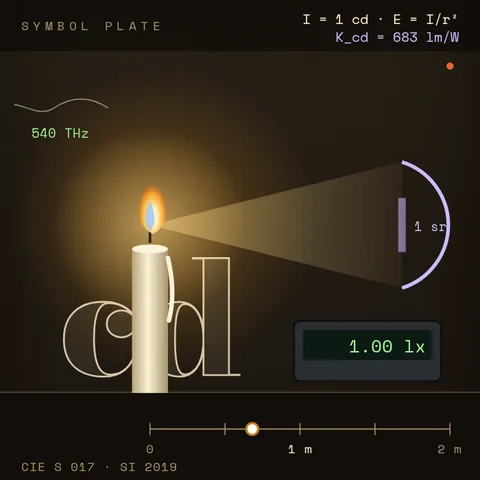
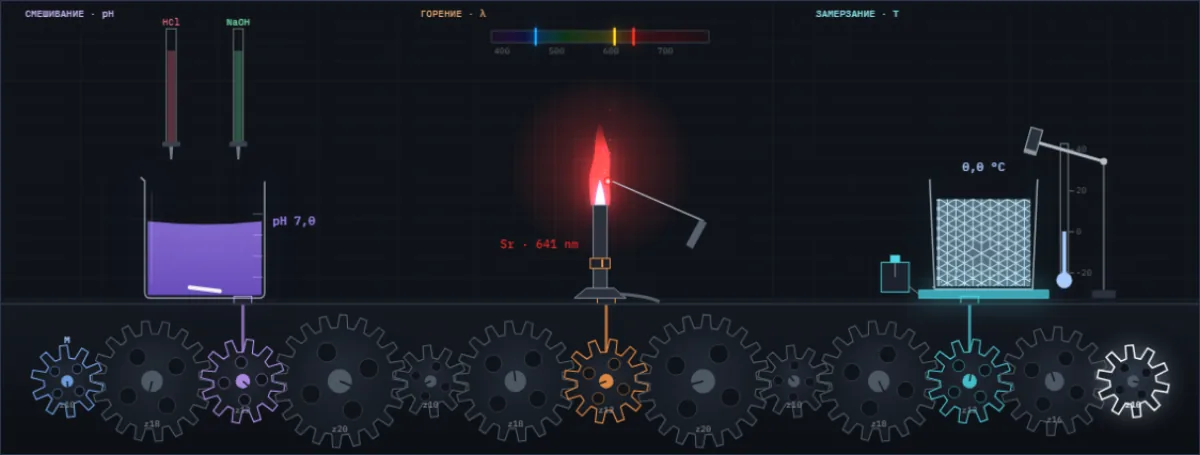
A drop of acid changes the colour of the juice, salt colours the flame, water freezes at a tap. Below them are all Simetrium sheets, by discipline and alphabetically.
Open the index →