On prescriptions and in instructions the drop is abbreviated with lowercase Latin gtt, from gutta, and in the plural sometimes gtts; the rate is written gtt/min, and the drop factor of a giving set gtt/mL. The volumetric infusion rate is written mL/h, with a lowercase m and a capital L, as is usual for the litre.
A drop is not a unit of volume but a counting unit to which a volume has been assigned: twenty drops per millilitre holds for water from a standard set, a paediatric micro-drip set gives sixty, a blood set fifteen, and a drop of oil, alcohol or a viscous solution from the same tube will come out different.
In a glass drip chamber with highlights, a drop breaks away from the drop-forming needle, falls through the letter g and spreads in a ring across a gently rippling surface. On the right a measuring cylinder under its own tube slowly collects twenty drops up to the red 1 mL mark and flashes, on the left a second hand sweeps round a fifteen-second count, and at the bottom the wheel of a roller clamp turns.
Quantity data sheet
drop counting · volume flow sheet 1/1 · rev. 2026-09Drop and millilitre per hour gtt · gtt/min · mL/h
A non-SI counting unit · quantities: the volume of a drop by the standard and the volumetric infusion rate
An instrument that counts gravity
At night on the ward a nurse raises her wristwatch to the drip chamber and counts drops for fifteen seconds. If there are ten and the set is a standard one, that is forty a minute, or a hundred and twenty millilitres an hour, and the patient will have his litre of saline by morning; if there are eight, she will turn the clamp wheel a little and count again.
All of this arithmetic rests on a single convention: the ISO standard for infusion sets requires that twenty drops of distilled water from the drop-forming needle weigh one gram, that is, make up a millilitre, within a tolerance of a tenth. The drop is thus not a measure but a consequence: weight tears it off once the weight exceeds the surface tension at the edge of the tube, and so the same tube always makes drops of almost the same size.
The second half of the instrument is the height of the bag. Fluid flows into the vein only because it stands higher than the vein, so a raised arm, a lowered pole or a pinched tube changes the rate without any intervention by the nurse; this is what the page is about, with a drip assembled on the screen.
01 · Definition
drop · factor · flow · heightA drop in infusion therapy is a portion of fluid torn from the drop-forming needle by its own weight; its volume is set by the drop factor of the giving set, the number of drops per millilitre printed on the packaging. The infusion rate in drops per minute is linked to the rate in millilitres per hour through this factor: millilitres per hour multiplied by the number of drops in a millilitre and divided by sixty.
From this comes a convenient coincidence that nurses know by heart: with a sixty-drop micro-drip set the number of drops per minute equals the number of millilitres per hour, while with a standard twenty-drop set it is three times smaller. Forty-two drops per minute through an ordinary set is a hundred and twenty-six millilitres per hour, a litre in eight hours.
The size of a drop obeys Tate's law, derived in 1864: a drop breaks away when its weight equals the force of surface tension around the circumference of the edge. This is why the calibration is valid only for liquids that resemble water, and the flow is set not by the drops but by the pressure difference between the bag and the vein, divided by the resistance of the needle and the roller clamp.
Fifteen seconds at the chamber
On the left is the drip at its real pace: a bag on a pole, a drip chamber in which drops fall, a roller clamp and a vein at heart level, while the blue scale at the side shows how far the bag is raised above it. At the top right is the nurse's stopwatch: the red arc measures off fifteen seconds, the number in the centre is the drops counted in that interval, and below it is the result of the previous count multiplied by four. Below that is the flow bar: the green mark is the prescription, the blue marker is the actual flow, and the deviation is shaded red.
The wheel holds a resistance, not a rate
A roller clamp knows nothing about millilitres: it only squeezes the tube and sets its resistance, while the flow comes from the pressure created by the column of fluid above the vein. That is why a drip set in the evening can be running a third slower by morning: the bag empties and the column gets shorter, the plastic tube under the roller gradually flattens, and the patient, asleep, puts an arm under his head and raises the vein by twenty centimetres.
02 · Conversion
drops · prescription · apothecary measuresFrom the prescription to drops and back
Enter the rate in millilitres per hour or in drops per minute, and the page will convert it for all four drop factors and show how many drops the nurse should count in fifteen seconds. The second tab turns a prescription of the form "so many millilitres over so many hours" into a rate, and the third turns old apothecary measures into drops and millilitres.
A rule to remember: with a 20-drop set, divide mL/h by three; with a 60-drop set, mL/h and drops per minute coincide.
Drops in the instructions for eye or oral medicines are quite different drops: the dropper of a bottle is not standardised the way an infusion set is, and depending on the manufacturer a millilitre of solution gives from fifteen to forty drops. That is why the dose of such medicines for children is increasingly given in millilitres, with a dosing syringe supplied with the bottle.
| {k} | {v} | {note} |
{text}
04 · Measuring instruments
chamber · clamp · infusion pump · syringe pumpFrom gravity to the stepper motor
A gauge hidden in the plastic
The drip chamber is a transparent cylinder under the bag into which the fluid enters through the drop-forming needle: in a standard set this is a wider tube, in a paediatric set a thin metal needle that gives drops three times smaller. The chamber is filled to a third so that the drops can be seen and air does not slip into the tube, and the calibration itself is checked at the release of each batch by weighing twenty drops of water.
A tap made of a single wheel
A roller clamp is a body with a sloping groove along which a wheel rolls: the lower it goes, the harder it presses the tube against the floor and the narrower the lumen becomes. Resistance grows roughly as the fourth power of the narrowing, so the last millimetre of the wheel's travel changes the rate more than all the previous ones, and the soft plastic creeps, so the set rate gradually drifts away.
A pump that does not count drops
An infusion pump is placed across the tube: a row of metal fingers pinches it in turn in a wave and pushes out a known volume with each turn of the shaft, so the rate is set directly in millilitres per hour and does not depend on the height of the bag. The standard for such pumps requires the mean error to be kept within a few percent and an alarm to sound if the tube is blocked, while the drop sensor on the chamber in many models serves only to notice an empty bag.
A tenth of a millilitre per hour
For very low rates a drop is too big: at 0.5 mL/h a micro-drip set would let fall a drop every two minutes, and the medicine would arrive in jerks. A syringe pump drives the plunger with a screw on a stepper motor and delivers tenths of a millilitre per hour evenly, which is why drips are almost never seen in neonatal and cardiac intensive care units.
05 · Writing rules
volume · time · drop factor of the setDrops without a factor are not a rate
A prescription is written in millilitres per hour or as a volume over a time, and drops per minute only together with the drop factor of the set.
"By drip" without a rate leaves the decision to the nurse, in the second line the rate in millilitres and the drops are mixed into one unit, and "42 dr" says nothing about either the minute or the set. Organisations for medication safety ask that the abbreviation cc not be used instead of mL, because it is mistaken for two zeros, and the equality of twenty drops to a millilitre is true only for water and a standard set, so it must not be written as an identity.
06 · Neighbouring units
litre · minute · surface tensionA drop stands between the litre, by which volume is measured, the minute, in which it is counted, and surface tension in newtons per metre, which determines its size.
Twenty thousand standard drops, one bag of saline.
Drops are counted per minute but prescribed per hour, hence the division by sixty.
The force per metre of edge that holds a drop until gravity outweighs it.
07 · Historical section
archive · from cholera to pumpsHow the vein was taught to drink by the drop
{title}
{text}
A rate that melts away by morning
The blue curve is the flow of a drip set to 125 mL/h as the column above the vein shortens while the litre bag empties and the tube under the roller creeps; the green dashed line is the prescription, and the red marker follows the curve from evening to morning.
That is why the nurse recounts the drops at every round, and it is precisely why, for medicines with a narrow window, the gravity drip has been replaced by a pump.
A unit held up by surface tension
The drop has no reference standard, but it does have a verification procedure that every factory uses: at a set rate, twenty drops of distilled water at twenty-three degrees are counted out of the drop-forming needle and weighed, and the mass must fall within 0.9 to 1.1 grams. Thus the unit of volume is verified through mass, like the millilitre in the old definition of the litre, and the standard describes not the liquid but the tube.
By Tate's law the mass of a drop is proportional to the radius of the edge and to the surface tension, so solutions with protein, fat or alcohol give smaller drops, while with fast dripping the drop has no time to reach equilibrium and comes out larger. For centuries physicists used the same phenomenon in reverse: Traube's stalagmometer counted the drops of a liquid from a calibrated tube and from their number determined the surface tension.
Hence an honest estimate of accuracy: a gravity drip set by drops holds the prescribed rate with an error of tens of percent, and a volumetric pump with an error of a few percent. The drop has stayed in medicine not as a precise unit but as a quick check by eye that needs neither electricity nor a battery.
The seven SI base units
Catalogue of quantities
Medicine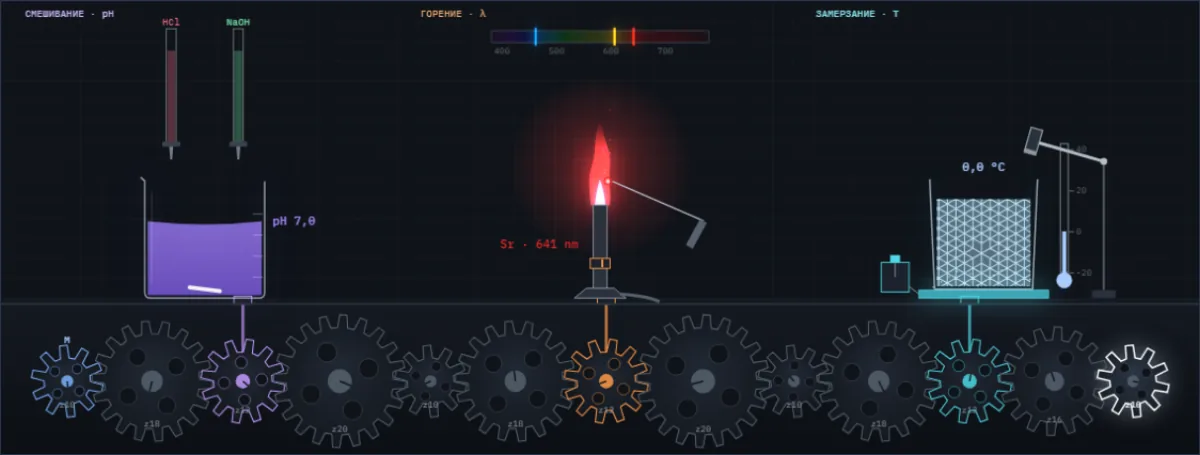
A drop of acid changes the colour of the juice, salt colours the flame, water freezes at a tap. Below them are all Simetrium sheets, by discipline and alphabetically.
Open the index →