Electric fluid
Leiden, 1746. Pieter van Musschenbroek charges water in a bottle from an electrical machine, takes hold of the bottle and the wire, and receives a shock so violent that he writes he would not take a second one for the whole kingdom of France. Electricity, it turns out, can be stored in a jar like a liquid.
In Philadelphia, Franklin explained this with a single fluid. It is present in all bodies. A body that holds more than its normal share is charged positively, one that holds less negatively. Rubbing does not create the fluid, it only moves it from one body to another. The fluid as a substance vanished with the discovery of the electron, but the plus and minus signs and the conservation of charge remained for good.
| Notation | fluid · electric fire · measure Fr |
| How it was estimated | by the length of the spark, the force of the shock, the spread of the electroscope leaves |
| What was assumed | one weightless liquid · excess is plus, deficit is minus · conserved |
| Introduced and withdrawn | Du Fay's two fluids, 1733 · Franklin's one fluid, 1747 · Thomson's electron, 1897 |
| Today’s notation | charge Q, coulombs · e = 1.602 176 634·10⁻¹⁹ C exactly |
| Typical values | 15 µC — a Leyden jar · 15 C — lightning · 1 Fr = 2.08·10⁹ electrons |
01 · Definition
Plus is excess, minus is deficit
Rub a glass rod with silk. According to Franklin, the fluid flowed from the silk into the glass: the glass gained an excess, plus, and the silk a deficit, minus. Whatever one body gained, the other lost. The sum does not change.
Franklin chose the sign at random, and chose badly: what actually runs in wires is electrons, and they carry minus. That is why, by the textbook, current flows from plus to minus, while the electrons go the other way. But the main rule of the fluid holds: charge is conserved in every experiment.
How much flowed over
Two vessels, glass and silk; the dashed line is the normal fluid level. The slider sets how many times the silk has been drawn across the glass. Blue above the dashed line is excess, plus. Red below the dashed line is deficit, minus. The bar at the bottom is the sum of the charges, and it always stays at zero. Below the vessels is how it is written today: electrons moved from the glass to the silk.
Charge the jar and wait for the spark
The main action is the «Turn the machine» button. On the left a glass globe rubs against a cushion, and blue drops of fluid run along the wire to the inner coating of the jar. The more fluid, the higher the voltage. On the right is the spark gap: two brass balls, with the gap set by the slider. When the voltage grows to the breakdown of air, about 3 kV per millimetre, a yellow spark leaps across and the jar empties. The screen on the right records voltage against time. The time is real.
—
02 · Conversion
| {n} | {v} | {note} |
The franklin is the charge that repels an equal charge at a distance of 1 cm with a force of 1 dyne. That is 3.335 64·10⁻¹⁰ C, about two billion electrons. The unit was named after Franklin in 1941.
An ampere-hour is the charge that passes in an hour at a current of 1 A: 3600 C. A phone battery of 4000 mA·h holds 14 400 C — almost a thousand lightning bolts in charge, but at a voltage of only 4 V.
03 · Orders of magnitude
04 · Measuring instruments
05 · Writing rules
06 · Neighbouring units
07 · Historical section
Fluid was measured by whatever was at hand: the length of a spark, the force of a shock, the number of jars in a battery. In 1785 Coulomb first gave a law of force, and charge became a quantity with a unit. In the CGS system the unit became the franklin, in SI the coulomb, through the ampere and the second.
Since 2019 everything has converged on the «drop of fluid»: the elementary charge e is fixed exactly, 1.602 176 634·10⁻¹⁹ C. A coulomb is about 6 241 509 074 460 762 607.776 elementary charges, and the digits can be counted on as far as you like. The fluid turned out to be grainy.
Catalogue of quantities
the whole index →The seven SI base units
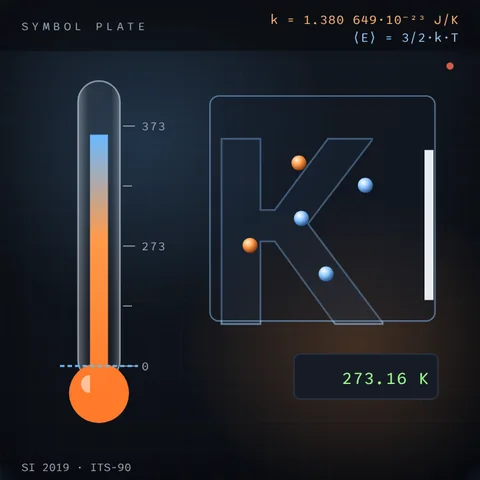
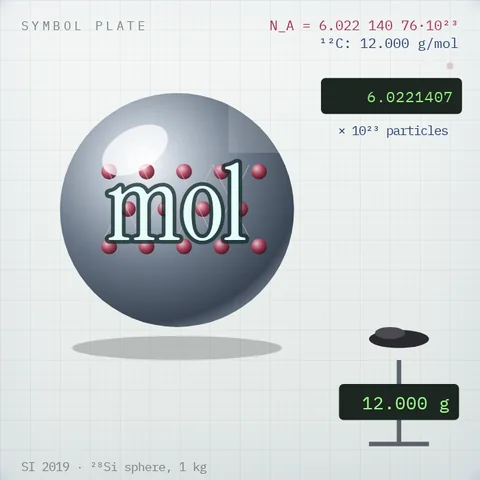
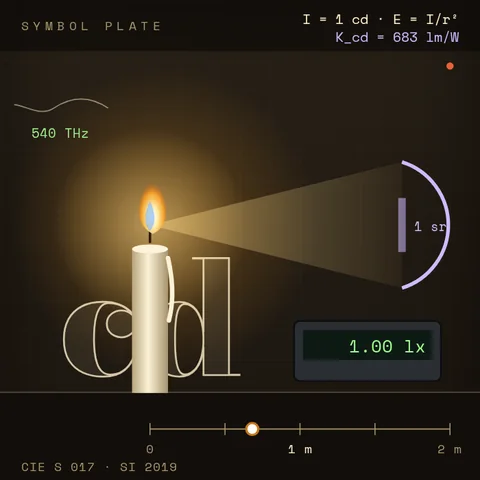
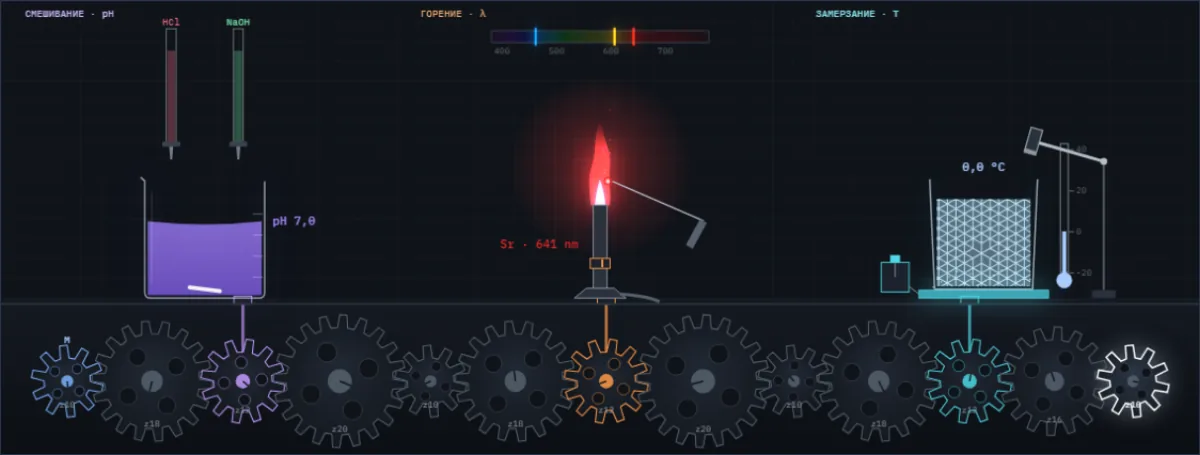
A drop of acid changes the colour of the juice, salt colours the flame, water freezes at a tap. Below them are all Simetrium sheets, by discipline and alphabetically.
Open the index →