SIMETRIUM .COM Wh · J/tok · PUE
EN|36 languages
WhSYMBOL PLATE0.24 Wh · request= 864 JWhWh0000.000000.240000.480000.720000.96Wh1000 imp/kWh230 V · 50 HzIEC 62053-21 · class 1GPU · 700 W10 W · 86 s00.250.50.751 WhSI · 3600 J — 1 Wh · 3.6 MJ — 1 kWhAAAWgmp1bWIAAAAeanVtZGMycGEAEQAQgAAAqgA4m3EDYzJwYQAAABZcanVtYgAAAEdqdW1kYzJtYQARABCAAACqADibcQN1cm46YzJwYTowY2YwZmQzYi0yODY3LTQ1ZjYtOGJkYy1jYWQzMzgwYjYyNjQAAAADl2p1bWIAAAApanVtZGMyYXMAEQAQgAAAqgA4m3EDYzJwYS5hc3NlcnRpb25zAAAAALxqdW1iAAAARGp1bWRjYm9yABEAEIAAAKoAOJtxE2MycGEuaW5ncmVkaWVudC52MwAAAAAYYzJzaOd/zWT4PCuCYu6PoNvm7ysAAABwY2JvcqNpZGM6Zm9ybWF0bWltYWdlL3N2Zyt4bWxqaW5zdGFuY2VJRHgseG1wOmlpZDpiZjRmMGY3MS04ZTFiLTQ3ZTItYmMxNS01YWU1ZjZhODcwZDRscmVsYXRpb25zaGlwaHBhcmVudE9mAAAB4mp1bWIAAABBanVtZGNib3IAEQAQgAAAqgA4m3ETYzJwYS5hY3Rpb25zLnYyAAAAABhjMnNo4O3PBWvXnOPdIB0d7RLtMQAAAZljYm9yomdhY3Rpb25zgqJmYWN0aW9ua2MycGEub3BlbmVkanBhcmFtZXRlcnOha2luZ3JlZGllbnRzgaJjdXJseC1zZWxmI2p1bWJmPWMycGEuYXNzZXJ0aW9ucy9jMnBhLmluZ3JlZGllbnQudjNkaGFzaFggB9xPM9nIVBmTwlloo483+ubeVD1K8w28we3dZttexv6kZmFjdGlvbngdY29tLmFudGhyb3BpYy5jbGF1ZGUucHJvdmlkZWRqcGFyYW1ldGVyc6F4H2NvbS5hbnRocm9waWMub3JpZ2luLWNvbmZpZGVuY2VndW5rbm93bmtkZXNjcmlwdGlvbnhmQ2xhdWRlIHByb3ZpZGVkIHRoaXMgZmlsZSBhdCB0aGUgcmVxdWVzdCBvZiBhIHVzZXIgYW5kIG1heSBoYXZlIGNyZWF0ZWQgb3IgbW9kaWZpZWQgdGhlIGZpbGUgY29udGVudHMubXNvZnR3YXJlQWdlbnShZG5hbWVmQ2xhdWRlcmFsbEFjdGlvbnNJbmNsdWRlZPUAAADIanVtYgAAAEBqdW1kY2JvcgARABCAAACqADibcRNjMnBhLmhhc2guZGF0YQAAAAAYYzJzaAil/NNaNVZGrDLnHRGfS7kAAACAY2JvcqVjYWxnZnNoYTI1NmNwYWRMAAAAAAAAAAAAAAAAZGhhc2hYINQoW8DYhCeJB5UUTdxhqJ3dp9m7t/S0hlTMolhWntuWZG5hbWVuanVtYmYgbWFuaWZlc3RqZXhjbHVzaW9uc4GiZXN0YXJ0GRo5Zmxlbmd0aBkeBAAAAj5qdW1iAAAAJ2p1bWRjMmNsABEAEIAAAKoAOJtxA2MycGEuY2xhaW0udjIAAAACD2Nib3KlY2FsZ2ZzaGEyNTZpc2lnbmF0dXJleE1zZWxmI2p1bWJmPS9jMnBhL3VybjpjMnBhOjBjZjBmZDNiLTI4NjctNDVmNi04YmRjLWNhZDMzODBiNjI2NC9jMnBhLnNpZ25hdHVyZWppbnN0YW5jZUlEeCx4bXA6aWlkOmE5YjBhOTZmLWM3YTItNDI5Zi05NjgxLWI3ZmM5MTNjOWVhYXJjcmVhdGVkX2Fzc2VydGlvbnODomN1cmx4LXNlbGYjanVtYmY9YzJwYS5hc3NlcnRpb25zL2MycGEuaW5ncmVkaWVudC52M2RoYXNoWCAH3E8z2chUGZPCWWijjzf65t5UPUrzDbzB7d1m217G/qJjdXJseCpzZWxmI2p1bWJmPWMycGEuYXNzZXJ0aW9ucy9jMnBhLmFjdGlvbnMudjJkaGFzaFggDUM/mcbdp1A55I/LpEYyN2bJUgbScZaOFunRDLxE3Q2iY3VybHgpc2VsZiNqdW1iZj1jMnBhLmFzc2VydGlvbnMvYzJwYS5oYXNoLmRhdGFkaGFzaFgg8I7hofWQ/ZPKo2d+Mguq6N5J+1t95u9Sx3ppnJNhMhp0Y2xhaW1fZ2VuZXJhdG9yX2luZm+jZG5hbWVvQW50aHJvcGljIEZpbGVzZ3ZlcnNpb25lMS4wLjBrc3BlY1ZlcnNpb25lMi40LjAAABA4anVtYgAAAChqdW1kYzJjcwARABCAAACqADibcQNjMnBhLnNpZ25hdHVyZQAAABAIY2JvctKEWQISogEmGCFZAgowggIGMIIBjaADAgECAhRA5aAK7sI50L64g/oGQgU9Z1UTADAKBggqhkjOPQQDAzBJMRcwFQYDVQQKEw5BbnRocm9waWMsIFBCQzEuMCwGA1UEAxMlQW50aHJvcGljIENvbnRlbnQgQ3JlZGVudGlhbHMgUm9vdCBDQTAeFw0yNjA4MDcxODQzNTZaFw0yODA4MDYxOTQzNTZaMEQxFzAVBgNVBAoTDkFudGhyb3BpYywgUEJDMSkwJwYDVQQDEyBBbnRocm9waWMgQ2xhdWRlIENvbnRlbnQgU2lnbmluZzBZMBMGByqGSM49AgEGCCqGSM49AwEHA0IABJh6CmvLUBgFFNU0vUKlOVtE6djd17L5SuwX0LemFisBM3dkd/3cyjxFA3Qo5S46fX0/ihY0VZ7mfb9KF703t5OjWDBWMA4GA1UdDwEB/wQEAwIHgDAVBgNVHSUEDjAMBgorBgEEAYPoXgIBMAwGA1UdEwEB/wQCMAAwHwYDVR0jBBgwFoAUzlHiBIFOZFsj+OPEz5o+nMHXXMIwCgYIKoZIzj0EAwMDZwAwZAIwMXMdFJ4BetLLVY7ORuE9noqbbAZOZn/aArXyTwFAZfKrPzxF2vPoJNf1+UCdg1XGAjBwX1zd9WGqYkqmL5SFqw1QySjr1zJfpJM9+1rdDwSPLMOPOjKuiXjoU/pUUeG9RwmhY3BhZFkNngAAAAAAAAAAAAAAAAAAAAAAAAAAAAAAAAAAAAAAAAAAAAAAAAAAAAAAAAAAAAAAAAAAAAAAAAAAAAAAAAAAAAAAAAAAAAAAAAAAAAAAAAAAAAAAAAAAAAAAAAAAAAAAAAAAAAAAAAAAAAAAAAAAAAAAAAAAAAAAAAAAAAAAAAAAAAAAAAAAAAAAAAAAAAAAAAAAAAAAAAAAAAAAAAAAAAAAAAAAAAAAAAAAAAAAAAAAAAAAAAAAAAAAAAAAAAAAAAAAAAAAAAAAAAAAAAAAAAAAAAAAAAAAAAAAAAAAAAAAAAAAAAAAAAAAAAAAAAAAAAAAAAAAAAAAAAAAAAAAAAAAAAAAAAAAAAAAAAAAAAAAAAAAAAAAAAAAAAAAAAAAAAAAAAAAAAAAAAAAAAAAAAAAAAAAAAAAAAAAAAAAAAAAAAAAAAAAAAAAAAAAAAAAAAAAAAAAAAAAAAAAAAAAAAAAAAAAAAAAAAAAAAAAAAAAAAAAAAAAAAAAAAAAAAAAAAAAAAAAAAAAAAAAAAAAAAAAAAAAAAAAAAAAAAAAAAAAAAAAAAAAAAAAAAAAAAAAAAAAAAAAAAAAAAAAAAAAAAAAAAAAAAAAAAAAAAAAAAAAAAAAAAAAAAAAAAAAAAAAAAAAAAAAAAAAAAAAAAAAAAAAAAAAAAAAAAAAAAAAAAAAAAAAAAAAAAAAAAAAAAAAAAAAAAAAAAAAAAAAAAAAAAAAAAAAAAAAAAAAAAAAAAAAAAAAAAAAAAAAAAAAAAAAAAAAAAAAAAAAAAAAAAAAAAAAAAAAAAAAAAAAAAAAAAAAAAAAAAAAAAAAAAAAAAAAAAAAAAAAAAAAAAAAAAAAAAAAAAAAAAAAAAAAAAAAAAAAAAAAAAAAAAAAAAAAAAAAAAAAAAAAAAAAAAAAAAAAAAAAAAAAAAAAAAAAAAAAAAAAAAAAAAAAAAAAAAAAAAAAAAAAAAAAAAAAAAAAAAAAAAAAAAAAAAAAAAAAAAAAAAAAAAAAAAAAAAAAAAAAAAAAAAAAAAAAAAAAAAAAAAAAAAAAAAAAAAAAAAAAAAAAAAAAAAAAAAAAAAAAAAAAAAAAAAAAAAAAAAAAAAAAAAAAAAAAAAAAAAAAAAAAAAAAAAAAAAAAAAAAAAAAAAAAAAAAAAAAAAAAAAAAAAAAAAAAAAAAAAAAAAAAAAAAAAAAAAAAAAAAAAAAAAAAAAAAAAAAAAAAAAAAAAAAAAAAAAAAAAAAAAAAAAAAAAAAAAAAAAAAAAAAAAAAAAAAAAAAAAAAAAAAAAAAAAAAAAAAAAAAAAAAAAAAAAAAAAAAAAAAAAAAAAAAAAAAAAAAAAAAAAAAAAAAAAAAAAAAAAAAAAAAAAAAAAAAAAAAAAAAAAAAAAAAAAAAAAAAAAAAAAAAAAAAAAAAAAAAAAAAAAAAAAAAAAAAAAAAAAAAAAAAAAAAAAAAAAAAAAAAAAAAAAAAAAAAAAAAAAAAAAAAAAAAAAAAAAAAAAAAAAAAAAAAAAAAAAAAAAAAAAAAAAAAAAAAAAAAAAAAAAAAAAAAAAAAAAAAAAAAAAAAAAAAAAAAAAAAAAAAAAAAAAAAAAAAAAAAAAAAAAAAAAAAAAAAAAAAAAAAAAAAAAAAAAAAAAAAAAAAAAAAAAAAAAAAAAAAAAAAAAAAAAAAAAAAAAAAAAAAAAAAAAAAAAAAAAAAAAAAAAAAAAAAAAAAAAAAAAAAAAAAAAAAAAAAAAAAAAAAAAAAAAAAAAAAAAAAAAAAAAAAAAAAAAAAAAAAAAAAAAAAAAAAAAAAAAAAAAAAAAAAAAAAAAAAAAAAAAAAAAAAAAAAAAAAAAAAAAAAAAAAAAAAAAAAAAAAAAAAAAAAAAAAAAAAAAAAAAAAAAAAAAAAAAAAAAAAAAAAAAAAAAAAAAAAAAAAAAAAAAAAAAAAAAAAAAAAAAAAAAAAAAAAAAAAAAAAAAAAAAAAAAAAAAAAAAAAAAAAAAAAAAAAAAAAAAAAAAAAAAAAAAAAAAAAAAAAAAAAAAAAAAAAAAAAAAAAAAAAAAAAAAAAAAAAAAAAAAAAAAAAAAAAAAAAAAAAAAAAAAAAAAAAAAAAAAAAAAAAAAAAAAAAAAAAAAAAAAAAAAAAAAAAAAAAAAAAAAAAAAAAAAAAAAAAAAAAAAAAAAAAAAAAAAAAAAAAAAAAAAAAAAAAAAAAAAAAAAAAAAAAAAAAAAAAAAAAAAAAAAAAAAAAAAAAAAAAAAAAAAAAAAAAAAAAAAAAAAAAAAAAAAAAAAAAAAAAAAAAAAAAAAAAAAAAAAAAAAAAAAAAAAAAAAAAAAAAAAAAAAAAAAAAAAAAAAAAAAAAAAAAAAAAAAAAAAAAAAAAAAAAAAAAAAAAAAAAAAAAAAAAAAAAAAAAAAAAAAAAAAAAAAAAAAAAAAAAAAAAAAAAAAAAAAAAAAAAAAAAAAAAAAAAAAAAAAAAAAAAAAAAAAAAAAAAAAAAAAAAAAAAAAAAAAAAAAAAAAAAAAAAAAAAAAAAAAAAAAAAAAAAAAAAAAAAAAAAAAAAAAAAAAAAAAAAAAAAAAAAAAAAAAAAAAAAAAAAAAAAAAAAAAAAAAAAAAAAAAAAAAAAAAAAAAAAAAAAAAAAAAAAAAAAAAAAAAAAAAAAAAAAAAAAAAAAAAAAAAAAAAAAAAAAAAAAAAAAAAAAAAAAAAAAAAAAAAAAAAAAAAAAAAAAAAAAAAAAAAAAAAAAAAAAAAAAAAAAAAAAAAAAAAAAAAAAAAAAAAAAAAAAAAAAAAAAAAAAAAAAAAAAAAAAAAAAAAAAAAAAAAAAAAAAAAAAAAAAAAAAAAAAAAAAAAAAAAAAAAAAAAAAAAAAAAAAAAAAAAAAAAAAAAAAAAAAAAAAAAAAAAAAAAAAAAAAAAAAAAAAAAAAAAAAAAAAAAAAAAAAAAAAAAAAAAAAAAAAAAAAAAAAAAAAAAAAAAAAAAAAAAAAAAAAAAAAAAAAAAAAAAAAAAAAAAAAAAAAAAAAAAAAAAAAAAAAAAAAAAAAAAAAAAAAAAAAAAAAAAAAAAAAAAAAAAAAAAAAAAAAAAAAAAAAAAAAAAAAAAAAAAAAAAAAAAAAAAAAAAAAAAAAAAAAAAAAAAAAAAAAAAAAAAAAAAAAAAAAAAAAAAAAAAAAAAAAAAAAAAAAAAAAAAAAAAAAAAAAAAAAAAAAAAAAAAAAAAAAAAAAAAAAAAAAAAAAAAAAAAAAAAAAAAAAAAAAAAAAAAAAAAAAAAAAAAAAAAAAAAAAAAAAAAAAAAAAAAAAAAAAAAAAAAAAAAAAAAAAAAAAAAAAAAAAAAAAAAAAAAAAAAAAAAAAAAAAAAAAAAAAAAAAAAAAAAAAAAAAAAAAAAAAAAAAAAAAAAAAAAAAAAAAAAAAAAAAAAAAAAAAAAAAAAAAAAAAAAAAAAAAAAAAAAAAAAAAAAAAAAAAAAAAAAAAAAAAAAAAAAAAAAAAAAAAAAAAAAAAAAAAAAAAAAAAAAAAAAAAAAAAAAAAAAAAAAAAAAAAAAAAAAAAAAAAAAAAAAAAAAAAAAAAAAAAAAAAAAAAAAAAAAAAAAAAAAAAAAAAAAAAAAAAAAAAAAAAAAAAAAAAAAAAAAAAAAAAAAAAAAAAAAAAAAAAAAAAAAAAAAAAAAAAAAAAAAAAAAAAAAAAAAAAAAAAAAAAAAAAAAAAAAAAAAAAAAAAAAAAAAAAAAAAAAAAAAAAAAAAAAAAAAAAAAAAAAAAAAAAAAAAAAAAAAAAAAAAAAAAAAAAAAAAAAAAAAAAAAAAAAAAAAAAAAAAAAAAAAAAAAAAAAAAAAAAAAAAAAAAAAAAAAAAAAAAAAAAAAAAAAAAAAAAAAAAAAAAAAAAAAAAAAAAAAAAAAAAAAAAAAAAAAAAAAAAAAAAAAAAAAAAAAAAAAAAAAAAAAAAAAAAAAAAAAAAAAAAAAAAAAAAAAAAAAAAAAAAAAAAAAAAAAAAAAAAAAAAAAAAAAAAAAAAAAAAAAAAAAAAAAAAAAAAAAAAAAAAAAAAAAAAAAAAAAAAAAAAAAAAAAAAAAAAAAAAAAAAAAAAAAAAAAAAAAAAAAAAAAAAAAAAAAAAAAAAAAAAAAAAAAAAAAAAAAAAAAAAAAAAAAAAAAAAAAAAAAAAAAAAAAAAAAAAAAAAAAAAAAAAAAAAAAAAAAAAAAAAAAAAAAAAAAAAAAAAAAAAAAAAAAAAAAAAAAAAAAAAAAAAAAAAAAAAAAAAAAAAAAAAAAAAAAAAAAAAAAAAAAAAAAAAAAAAAAAAAAAAAAAAAAAAAAAAAAAAAAAAAAAAAAAAAAAAAAAAAAAAAAAAAAAAAAAAAAAAAAAAAAAAAAAAAAAAAAAAAAAAAAAAAAAAAAAAAAAAAAAAAAAAAAAAAAAAAAAAAAAAAAAAAAAAAAAAAAAAAAAAAAAAAAAAAAAAAAAAAAAAAAAAAAAAAAAAAAAAAAAAAAAAAAAAAAAAAAAAAAAAAAAAAAAAAAAAAAAAAAAAAAAAAAAAAAAAAAAAAAAAAAAAAAAAAAAAAAAAAAAAAAAAAAAAAAAAAAAAAAAAAAAAAAAAAAAAAAAAAAAAAAAAAAAAAAAAAAAAAAAAAAAAAAAAAAAAAAAAAAAAAAAAAAAAAAAAAAAAAAAAAAAAAAAAAAAAAAAAAPZYQJac0MZTSHC9TSGbN+BZCck70mSQWKfTlnLrnckXxZarmYNDQ4A9hdVML9wPt5zCdyqeJPxGgMupUnkwPqI4GWM=
Letter case
It is written Wh (in Russian, Vt·ch); a thousand of them is kWh (kVt·ch). On an electricity bill in China the word is 度 (du), in India and Pakistan it is unit: both mean the kilowatt-hour. The energy a model spends per token is easier to measure in joules: 1 Wh = 3600 J.
Do not confuse
A watt is power, a watt-hour is energy. “A 700 W graphics card” tells you how fast it spends, while “0.24 Wh per request” tells you how much was spent in total. Writing W/h is wrong: that is watts per hour, a different quantity.
Cast letters Wh stand above an electricity meter. Current runs to it from a pole of the power line, and from the meter on to a rack of GPUs. The display counts off portions of 0.24 Wh, a pulse lamp blinks, and a disc with a red mark spins. On the right is a 10 W bulb: one request powers it for a minute and a half. At the bottom the mark stops at 0.24 and 0.34 Wh, the two published estimates of 2025.
Unit passport · AI series · electricity per answer

Wh

Energy of an answer · watt-hour
E = tokens × J/token ÷ 3600 · 1 Wh = 3600 J = 1 W for one hour

In 2023 the researcher Alex de Vries estimated a ChatGPT request at about 3 Wh, ten times a Google search. The figure went round every newspaper. In 2025 Google published a full account for its Gemini model: 0.24 Wh for a median text request, while Sam Altman gave 0.34 Wh for ChatGPT. Who was wrong? Possibly nobody: the estimates differ in what they count, only the GPU or also the CPUs, idle time and cooling of the building, and in how many users share one card. Check it in the calculator and in the section “Billing boundary”.

The energy of an answer is how much electricity one request uses, from the socket of the data centre to the last token. It is counted in watt-hours: the amount a device of one watt uses in an hour. This sheet has a calculator of request energy by model, GPU and load, with emissions for eight countries and cooling water; comparisons with a kettle, a phone charge and an electric car; a server the current flows through; a day when the grid is cleaner; the scale of a whole service; and ways to measure energy yourself.

What it is
electricity spent on one model answer, including the share of idle time and the building
Notation
Wh, Vt·ch; in Chinese 瓦时, on the bill 度 (= kWh)
Dimension
energy: 1 Wh = 3600 J = 3600 kg·m²/s²; a non-SI unit accepted for use with the SI
What it consists of
GPUs · CPUs and memory · standby machines · cooling and losses of the building (PUE)
Typical values
0.24 — Gemini text · 0.34 — ChatGPT · ≈ 3 — image · ≈ 944 — 5 seconds of video
References
Google, August 2025 · Epoch AI, 2025 · IEA “Energy and AI”, 2025 · de Vries, Joule, 2023
Work out your request Why the estimates differ Measure it yourself
Calculator
Tool · request energy

How many watt-hours your answer takes

Choose a model, a weight format, the GPUs it runs on, and how many users the server serves at once. Load is the share of time the cards are busy with real work: the rest of the time they use current too. PUE is how many times more the building consumes than the servers alone. Below are the tokens of one request.

Grid, g CO₂ per kWh · approximate, Ember 2024
energy per answer

Etymology

A Scot, a season and an activity

The watt-hour is glued together from the surname of the mechanic who taught the steam engine to work twice as economically, and from a Greek word that meant a season. And energy is a word of Aristotle: “that which is at work”.

wattJames Watt
Watt · 1736–1819→Siemens · 1882→W
The Scottish mechanic James Watt added a separate condenser to the steam engine, and it began to burn several times less coal. He also introduced horsepower. In 1882 William Siemens proposed naming the unit of power after him, and in 1889 an international congress of electricians adopted it.
hour · timeGk. hōra
hōra · season of the year→Lat. hora→h
Greek hōra means “a season, time of year”, later “an hour of the day”; through Latin and French it became English hour and the symbol h. The Russian word for hour, chas, is a different one, the Proto-Slavic *časŭ, “time, season”. They coincide in meaning, not in origin.
energyGk. energeia
en + ergon · at work→Young · 1807→E
For Aristotle energeia is “actuality, activity”, from ergon, “deed, work”. The word was brought into physics by the Englishman Thomas Young in 1807. The SI unit of energy is the joule, named after the Salford brewer James Joule, who measured how much work heat gives.
What it is called in other languages
瓦时 wǎshí, kilowatt-hour — 千瓦时 or simply 度 — Chinese; ワット時 — Japanese; 와트시 — Korean
vatio-hora, watt-hora, wattheure, Wattstunde
واط ساعة — Arabic; वाट-घंटा — Hindi; ватт-цаг — Mongolian
In India, Pakistan and Bangladesh the electricity bill says units: these are kilowatt-hours.
Abbreviations nearby
PUEPower Usage Effectiveness: whole building ÷ servers; 1.0 is the idealWUElitres of water per kWh used for coolingCO₂eall greenhouse gases converted to carbon dioxideTDPthermal design power: the chip's peak power, for the H100 it is 700 WJ/tokjoules per token: a handy measure for comparing models
01 · Definition and everyday yardsticks

Power multiplied by time

A graphics card under load draws hundreds of watts from the grid. While it writes an answer the meter spins, and the energy of the answer is the power of the whole machine multiplied by the time the answer took to write, divided by the number of users the machine served at the same time. Hence the main rule: the more people share one card, the less falls to each, exactly as with the price of a token.

For comparing models, joules per token are handier, and for people, watt-hours per answer: a short text answer is a quarter of a watt-hour, an image is a few watt-hours, and a five-second clip is almost a kilowatt-hour. On the right you can see how many answers fit into ordinary chores: a litre of boiling water, an hour of video, a kilometre in an electric car.

P — power, W · t — time · B — users in the batch · v — server tok/s · PUE — building multiplier · c — g CO₂ per kWh
Interactive · how many answers in everyday things
Answers per day

Lab · three experiments with current

Server, day and a whole service

In “Server” you see where the current goes from the socket: into the cooling of the building, the CPUs, the idle GPUs and, finally, into tokens. In “Day” the same night batch of requests gives different emissions depending on the hour: by day the grid gets sun, at night coal or wind. In “Scale” one request turns into megawatts when it is repeated billions of times a day.

Batch, users
Building, PUE
Which grid
Batch start
Requests per day
Energy of one request

Chart · published estimates
A request, an image and a clip
Watt-hours per action from different sources, logarithmic scale: each division is ten times. Green are full company reports, amber are independent estimates, purple are images and video on open models.
Chart · joules per token
The batch matters more than the GPU
Energy per answer token for the model and format from the calculator on four GPUs, by the number of users in the batch. Both scales are logarithmic. The line breaks off when the cache no longer fits in memory. Calculated from memory bandwidth, PUE 1.2.
02 · Orders of magnitude · energy, Wh

Wh, logarithmic scale

03 · Billing boundary

What is inside 0.24 watt-hours

In August 2025 Google broke down the energy of a median Gemini text request into parts. Counting only the chips running without a break gives 0.10 Wh, as many earlier estimates did. The full account is two and a half times more. Tap a row to add a layer.

What is missing even from the full account
The energy for training the model and for making the GPUs and buildings. In 2025 Mistral was the first to publish the full life cycle of its Large 2 model: by its estimate, a 400-token answer comes to about 1.14 g CO₂e and 45 ml of water once all this is counted. Companies count differently, so figures can only be compared within one methodology.
04 · Measure it yourself

Eight ways to find your watt-hours

You can measure the energy of a model on your own hardware exactly: NVIDIA GPUs count it themselves, and Intel and AMD processors hand their counters to the system. A cloud service cannot be measured from inside: what is left is to rely on company reports and rankings such as ML.ENERGY and AI Energy Score. Tap a row to read the details.

toolwhat it measureswhere used

For work · three snippets
05 · Writing rules
06 · Neighbouring units
07 · Historical section

From the steam engine to the bill for a request

3.0 Whestimate 2023
de Vries, Joule
Note

In October 2023 the Dutch economist Alex de Vries published in the journal Joule an estimate: if every Google search went through a language model, it would use as much electricity as Ireland consumes. For one request he took about 3 Wh, by the estimate of the SemiAnalysis analysts, based on the number of NVIDIA servers such a service would need. The figure “ten times more than a search” became a catchphrase.

A year and a half later Epoch AI recalculated a GPT-4o request on modern cards and with a realistic answer length: it came to about 0.3 Wh, and Google published 0.24 Wh for Gemini with a full account. Models became more economical, cards more powerful, batches larger. But there are also hundreds of times more requests, and reasoning and video use tens and thousands of times more than text. So the total consumption of data centres grows even though every answer gets cheaper.

0.24 Whfull account 2025
Google, Gemini
Series · AI
units of language models

How a neural network is measured

The energy of an answer is made up of all the neighbouring sheets: the number of tokens multiplied by the joules of each; the joules fall with server speed and with the number of bits per weight, and rise with context length and reasoning; and in the price of a token electricity is a noticeable but not the main part. On the left is the information about one request, where every row leads to its own sheet; on the right are the sheets of the series.

nvidia-smi + usage · one request
Catalogue of quantities
the whole index →
the foundation · 7 units

The seven SI base units

on the sheet’s topic · model training and AI
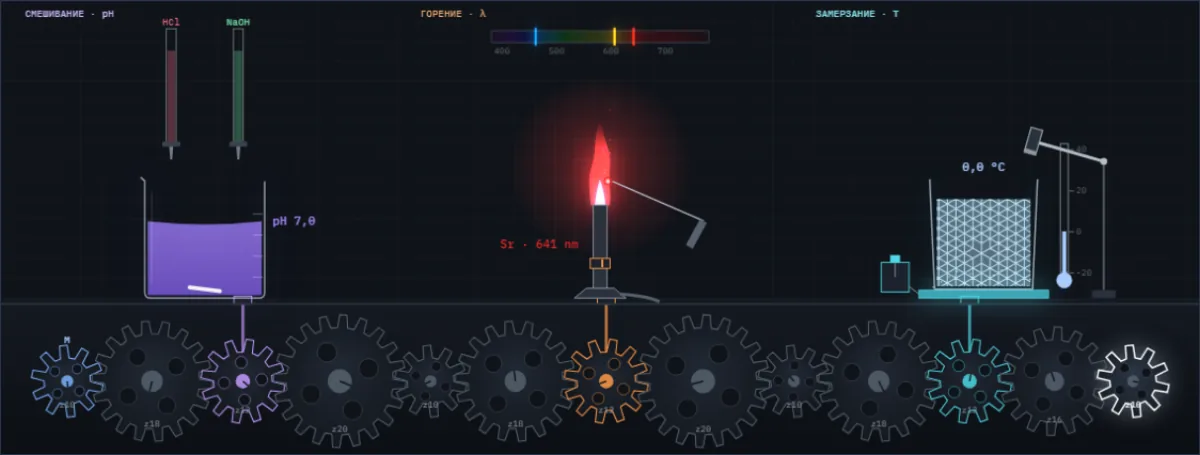
The index lab: a glass of cabbage juice, a burner, a glass of water on a cold plate and a gear train
Index · all quantities on one page
The lab at the entrance to the index

A drop of acid changes the colour of the juice, salt colours the flame, water freezes at a tap. Below them are all Simetrium sheets, by discipline and alphabetically.

Open the index →
08 · Your language
every link is a real page in that locale

Read it in your own language

translated and checkeddraft translationqueued