Equivalent
A US blood test reads “K 4.2 mEq/L”, a European one “K 4.2 mmol/L”. The numbers match because potassium carries one charge. For calcium they differ by a factor of two: 2.5 mmol/L is 5 mEq/L. The equivalent counts not the particles themselves but their work: how many hydrogen ions they replace or how many charges they carry.
Chemists used equivalents long before the mole. Acids and alkalis were compared by how much of one neutralises the other, hence the normality of solutions: 1 N = 1 Eq/L. IUPAC has long advised against this notation. But equivalents have stayed in medicine, water treatment and soil science.
| Notation | Eq · in practice mEq/L |
| Definition | 1 Eq = 1 mol / z — the amount of substance that reacts with 1 mol of H⁺ or carries 1 mol of charge |
| Reference values | 1 mEq Ca²⁺ = 0.5 mmol = 20.04 mg · 1 mEq Na⁺ = 22.99 mg · 1 Eq carries 96 485 C |
| Introduced | equivalent weights — Richter, 1792 · normal solutions — 19th century · not part of the SI |
| Standards | ISO 80000-9 · IUPAC Green Book · ISO 6059 · ISO 11260 |
| Typical values | 140 mEq/L — Na⁺ in plasma · 5 mEq/L — Ca²⁺ · 546 mEq/L — Cl⁻ in seawater |
01 · Definition
A mole divided by the charge
One mole of hydrochloric acid gives up one mole of hydrogen ions. One mole of sulfuric acid gives up two. To neutralise them you need different amounts of alkali. The equivalent evens them out in advance: 1 mol HCl is 1 Eq, 1 mol H₂SO₄ is 2 Eq.
Ions work the same way. The number z is the charge of the ion or the number of hydrogen ions in the reaction. The amount of equivalents equals the amount of substance multiplied by z. The sum of equivalents of cations in a solution always equals that of anions: the solution is electrically neutral. That is what the blood ionogram on the right rests on.
Pluses and minuses in the blood balance out
The left column is plasma cations, the right one anions; the height of each block is its concentration. Teal blocks are positive ions, violet ones negative. The magenta block is the anions the laboratory does not measure: proteins, phosphates, organic acids. Its height equals the anion gap. In mEq/L the columns are always the same height. Switch to mmol/L, and calcium and magnesium shrink by half and the balance disappears.
How much hydrogen a molecule gives up
Each cell holds a structural formula. Violet marks the hydrogen atoms the acid gives up to the alkali; their number is z. Pink marks oxygen. Under the formula is the number of equivalents in one mole. Citric acid has eight hydrogen atoms but gives up only three — the ones in the COOH groups.
One millimole, a different number of equivalents
The flask holds 25 mL of water and exactly 1 mmol of acid; the burette holds NaOH alkali at 0.100 mol/L. Open the tap: drops fall into the flask, the stirrer mixes, the electrode measures pH. Teal shows the alkali and everything to do with it: the level in the burette, the equivalents added. Violet is the acid and its hydrogen ions. Magenta is the indicator and the equivalence points. On the right a screen records the titration curve. Its dashed lines stand where exactly 1, 2 and 3 equivalents of alkali per mole of acid have been added. Under the screen are two bars: how many equivalents of acid are in the flask and how much alkali has been added. Time is real. If you leave it alone for 20 s, the experiments run by themselves.
—
02 · Conversion
| {n} | {v} | {note} |
For monovalent ions — Na⁺, K⁺, Cl⁻, HCO₃⁻ — mEq/L and mmol/L are the same. For divalent ions mEq/L is twice as large, for trivalent three times. That is why, when lab forms switch from mEq to mmol, only the numbers for calcium, magnesium and phosphate change.
Water hardness is counted in equivalents too. The German degree °dH is 10 mg CaO per litre, the French °fH is 10 mg CaCO₃. Both convert through mEq: 1 mEq/L = 2.8 °dH = 5.0 °fH = 50 mg/L CaCO₃.
03 · Orders of magnitude
04 · Measuring instruments
05 · Writing rules
06 · Neighbouring units
07 · Historical section
The equivalent is not part of the SI and never was. IUPAC suggests using the mole and stating what is counted: n(½Ca²⁺) = 2 mmol means the same as 2 mEq of calcium. The notation is longer, but no separate unit is needed and the particle is visible at once.
The main danger of the equivalent is that one substance can have a different number of them. Phosphoric acid gives up two hydrogen ions with phenolphthalein and one with methyl orange. That is why a solution's label always states, next to the normality, the reaction it was calculated for.
Catalogue of quantities
the whole index →The seven SI base units
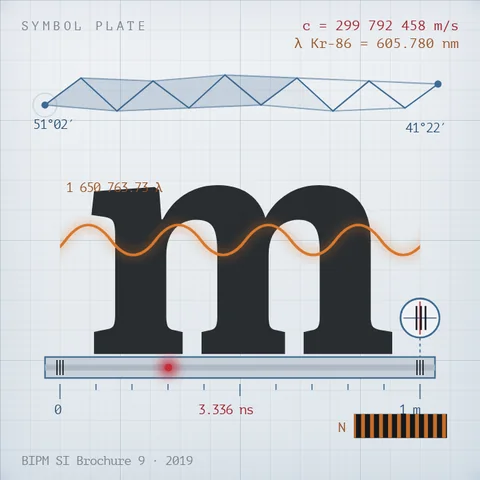
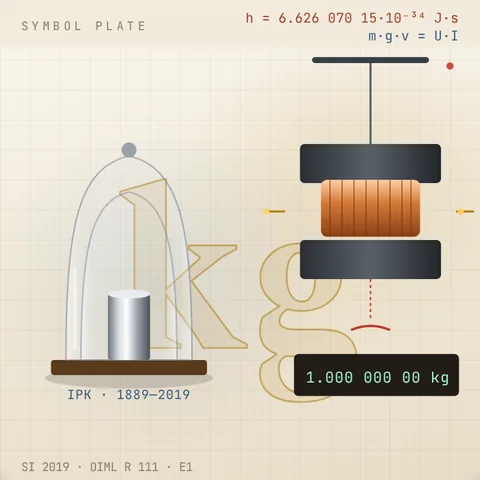
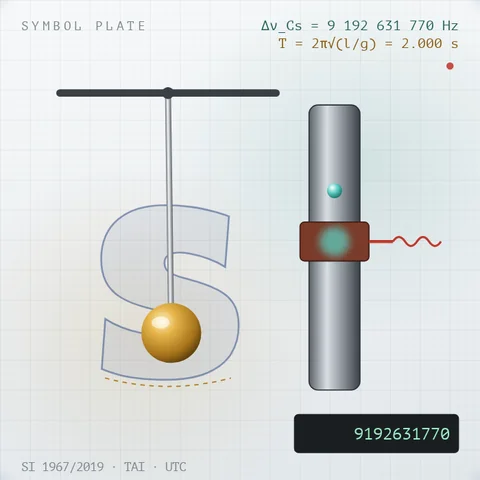
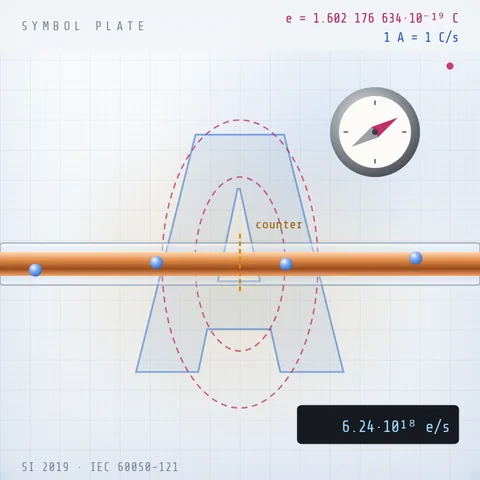
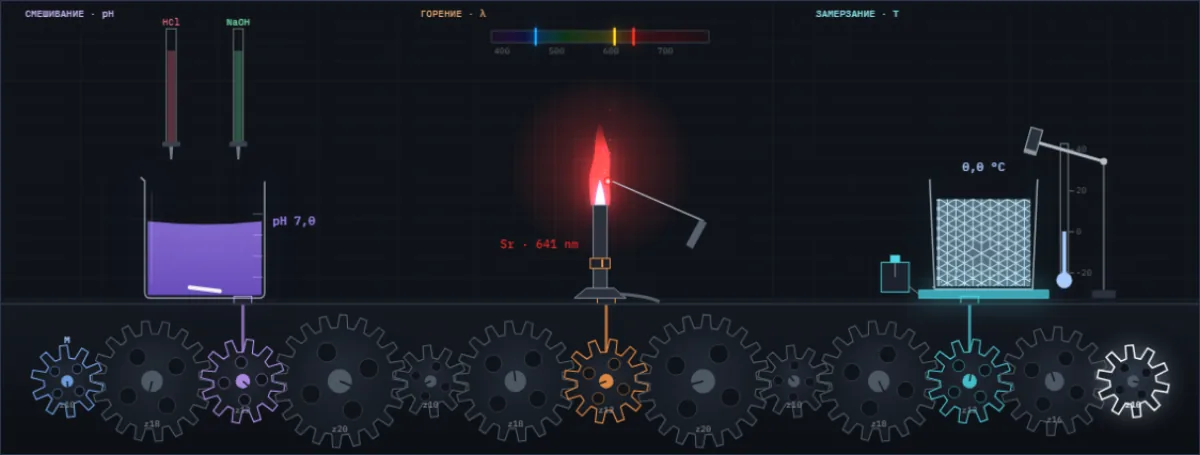
A drop of acid changes the colour of the juice, salt colours the flame, water freezes at a tap. Below them are all Simetrium sheets, by discipline and alphabetically.
Open the index →