Gon
Two total stations sight the same prism pole. One reads 137.4250, the other 123°40′57″. The first counts in gons: 400 to a full turn, 100 to a right angle. The five angles of a closed traverse in gons add up to exactly 600, and the field book is checked in your head. Enter the same numbers into software set to degrees, and the traverse misses closure by hundreds of metres.
The gon is one hundredth of a right angle. It was introduced together with the metre: a quarter of the meridian is 100 gons and 10 000 kilometres, so a centigon of meridian arc is about a kilometre. In everyday life the gon never caught on, but in surveying it stayed. In Germany, Austria, Switzerland and Scandinavia angles are measured in gons, total stations ship with gons in the menu, and on a calculator the mode is called GRAD.
| Notation | gon; in the old notation ᵍ, hundredths ᶜ, ten-thousandths ᶜᶜ; on calculators — GRAD |
| Definition | 1 gon = π/200 rad = 0.9° = 54′; right angle — 100 gon, full turn — 400 gon |
| Submultiples | 1 gon = 100 cgon = 1000 mgon; 1 mgon = 3.24″ |
| Shift on the ground | an error of 1 mgon over 1 km moves the point 15.7 mm across the line |
| Traverse check | Σβ = (n − 2) · 200 gon: 400 for a quadrilateral, 600 for a pentagon |
| Where | surveying and cadastre in Germany, Austria, Switzerland, Scandinavia; total stations, GIS, the GRAD mode of calculators |
01 · Definition
One hundredth of a right angle
A full turn is divided into 400 gons, a right angle into 100. The quadrants start at 0, 100, 200 and 300, and a single digit tells which quadrant a direction lies in. Parts of a gon are decimal: a centigon is a hundredth, a milligon a thousandth. Adding and subtracting angles in gons is ordinary decimal arithmetic, with no carrying of minutes and seconds.
In surveying a direction on the plan is given by the grid bearing α — measured clockwise from the north direction of the X axis. At each station of the traverse the total station measures the angle β between the back point and the forward point. The next bearing is obtained by addition: the previous one plus 200 plus β. From the angle and the distance the coordinate differences ΔX and ΔY are computed, and the traverse runs from point to point.
Angle and distance
The rows are angle errors from one ten-thousandth of a gon to a whole gon. The bar is how far the point moves across the line at the chosen distance, on a logarithmic scale. The line is 10 mm, the usual tolerance for setting out axes on a building site.
Where the grid bearing points
In gons the quadrant shows in the first digit: up to 100 — northeast (NE), up to 200 — southeast (SE). The quadrant sets the signs of ΔX and ΔY, and the reduced bearing is the acute angle to the nearest end of the X axis. Traverse leg — 100 m.
Closed traverse: five sites, three instruments, three scales
The main action is the «Start traverse» button. The total station is moved from point to point. At each station it is sighted on the backsight pole and the circle is set to zero, then it is turned to the foresight pole, the angle β is read and the distance is measured by laser. Every angle and every distance goes into the field book. When the traverse has gone round the site, the grid bearings and coordinates are computed from the field book. The last point must come back to the first, and the miss is the misclosure. It is compared with the tolerance and distributed along the traverse. Below the scene you choose the site — a plot, a city block, a quarry, a lake or a bridge alignment — the instrument and the scale on the total station display. The «Gons as degrees» button shows what happens if a field book in gons is computed by software set to degrees.
—
02 · Conversion
Quick reckoning: degrees = gons × 0.9, gons = degrees × 10/9. Round degrees are fractional in gons: 30° — 33.3333 gon, 45° — 50 gon, 60° — 66.6667 gon.
The NATO mil is 1/6400 of a turn, 1 gon = 16 mil. In Russian artillery the mil is 1/6000 of a turn, and 1 gon = 15 mils.
| gon | degrees | NATO mil | what it is |
| {k} | {v} | {h} | {n} |
03 · Orders of magnitude
04 · Measuring instruments
05 · Writing rules
Series · Drafting and CAD
desk tips for every sheet06 · Neighbouring units
07 · Historical section
The metre was conceived as one ten-millionth of a quarter of the meridian, and the quarter of the meridian as 100 gons. Then a gon of meridian arc is 100 km, a centigon 1 km, a milligon 100 m. The nautical mile did the same for the degree: a minute of arc is about 1852 m. Both units link an angle on the Earth to a length on its surface.
The accuracy of the angles in a traverse is checked by their sum. Random errors of n angles add up as the square root of n, so the misclosure tolerance is written as m√n. For a 1st-order precise traverse it is 10″√n, for a theodolite traverse 1′√n. In gons the same tolerances are 3.1 mgon and 18.5 mgon times √n.
Catalogue of quantities
the whole index →The seven SI base units
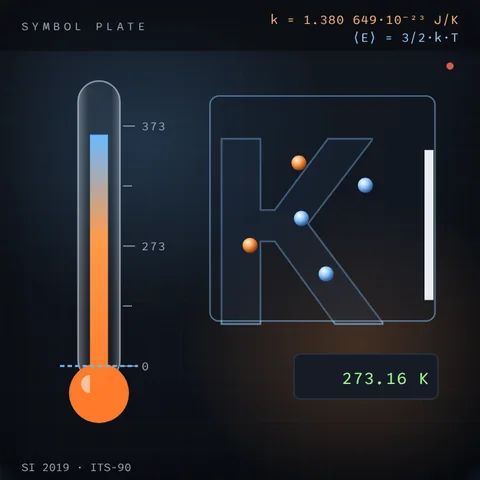
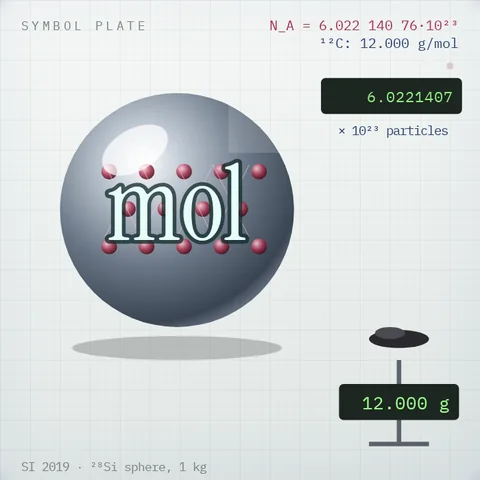
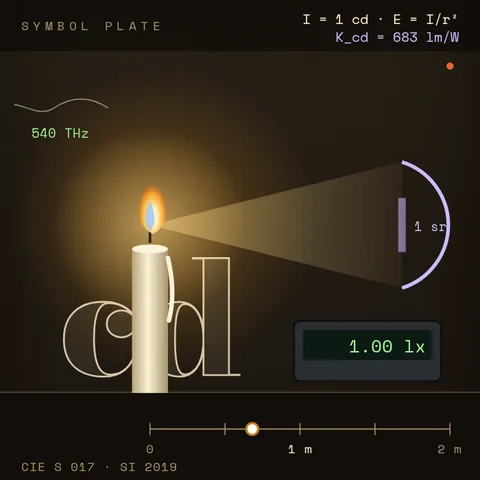
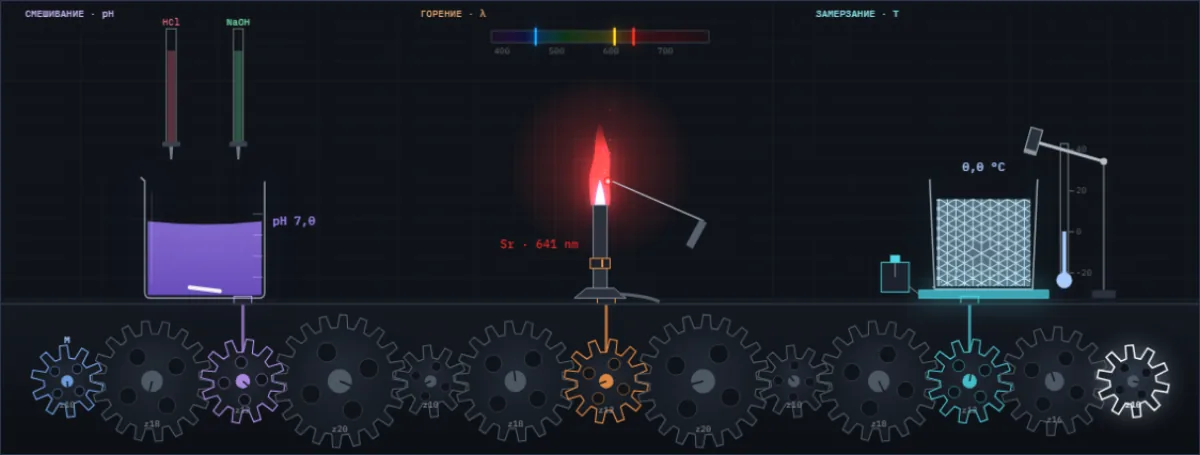
A drop of acid changes the colour of the juice, salt colours the flame, water freezes at a tap. Below them are all Simetrium sheets, by discipline and alphabetically.
Open the index →