INR is written in capitals: it is the abbreviation of International Normalized Ratio; Russian lab reports call the same ratio МНО. The number is dimensionless and is written without a unit, with one or two decimal places: INR 2.4, not “2.4 sec” and not “2.4 %”.
INR is not the prothrombin time: the seconds depend on the reagent and the instrument, and INR is deliberately cleared of them. Nor is it Quick's prothrombin percentage, whose scale runs the other way: the more the blood is thinned, the lower the percentage and the higher the INR.
Inside a drop of blood bearing the INR symbol, pale fibrin threads grow and fade again, while two red blood cells sway in the plasma until the clot catches them. The drop pulses with a glow, the coagulometer stopwatch runs on the right, and the slider of the INR scale at the bottom reaches 2.5, the middle of the green therapeutic range 2.0—3.0.
Quantity data sheet
dimensionless ratio · coagulation sheet 1/1 · rev. 2026-09International normalized ratio INR
Dimensionless quantity · ratio of prothrombin times raised to the power ISI
A number invented so that the same pills mean the same
In the 1970s a patient taking warfarin in Manchester and a patient in Boston had the same test, the prothrombin time, the seconds it takes plasma to clot, and doctors in both cities aimed to lengthen it two to two and a half times. But British laboratories used a sensitive reagent made from human brain, while North American ones used an insensitive one from rabbit brain, and the same “twice as long as normal” in Boston called for a noticeably larger dose, so American patients bled more often, even though everyone followed the same rule.
In 1983 WHO proposed a way out similar to the one metrologists use to bring instruments to a common accuracy class: each reagent is given a certified sensitivity index, ISI, found by comparison with an international reference, and the ratio of times is raised to that power. The result, INR, should come out the same whichever reagent the laboratory happens to use.
This sheet tests one blood sample with four reagents, shows why the correction is a power rather than a factor, and what happens if the ISI is assigned inaccurately.
01 · Definition
prothrombin time · MNPT · ISIINR is the ratio of the patient's prothrombin time to the mean normal prothrombin time of the same laboratory, MNPT, raised to the power ISI, the sensitivity index of the reagent. The prothrombin time is the number of seconds from adding thromboplastin and calcium to the plasma until a clot appears, and MNPT is the geometric mean of this time in twenty or more healthy people on the same reagent and instrument.
The ISI is found by calibration: plasmas from healthy people and from patients on warfarin are measured both with the reagent in question and with the WHO reference thromboplastin, and the logarithms of the times are plotted against each other. The points fall on a straight line whose slope is the ISI, and since the line is drawn in logarithms, the correction to the ratio is not a factor but an exponent.
The reference reagent is assigned an ISI of 1.0 by definition; the less sensitive a reagent is to a fall in clotting factors, the less it lengthens the time and the higher its ISI. Modern recombinant reagents keep their ISI close to one, old rabbit reagents reached 2.5, and then the difference in seconds between two laboratories could be as much as one and a half times.
Different seconds, one number
The same patient plasma is poured into four cuvettes with different thromboplastins, and a shared stopwatch at the top starts all four tests at once. In each cuvette the steel ball of a mechanical coagulometer rocks back and forth: while the plasma is liquid it moves freely, and when a clot forms and fibrin threads grow through it, the ball stops and the cuvette records its time. Below the cuvettes are the seconds, the simple ratio to MNPT and the INR after the ISI power.
ISI {isi} · MNPT {mnpt}
A reagent with its own certificate
Just as an ammeter's data sheet states its accuracy class, a box of thromboplastin states its ISI, and both numbers are obtained by comparison with a reference, not calculated from the design. The difference is that the accuracy class merely warns of a possible error, whereas the ISI enters the formula for the result directly, and if it is assigned wrongly, every INR the laboratory reports will be wrong. That is why ISTH guidelines require the ISI to be verified locally for each reagent and instrument pair, and an error of ten per cent in the index shifts the result at an INR of about three by almost eleven per cent.
02 · Conversion
seconds to INR · INR to seconds · ISI errorFrom seconds to INR and back
Enter the prothrombin time in seconds and choose a reagent, and the sheet will calculate the INR, show what INR the same seconds would give on other reagents, how many seconds are needed for the target values, and how far an inaccurate ISI shifts the result.
A rule to remember: seconds without the name of the reagent mean nothing, while an INR needs no seconds to mean everything.
INR was designed and calibrated for people taking vitamin K antagonists, above all warfarin. For direct oral anticoagulants and in liver disease it does not reflect how strongly the blood is anticoagulated, even though the laboratory will print it, so such values must not be compared with the 2.0—3.0 range.
| {k} | {v} | {note} |
{text}
04 · Measuring instruments
tube · ball · light · stripFour ways to spot a clot
A stopwatch and a technician's hand
In 1935 Armand Quick held a tube of plasma in a water bath at 37 °C, added thromboplastin with calcium, started a stopwatch and tilted the tube once a second until the plasma stopped running down. The method remained manual for half a century, and differences in the eyes and movements of technicians added their own share to the spread that later had to be reduced to a single number.
A ball that found the going sticky
A steel ball lies in a cuvette of plasma, and an alternating magnetic field rolls it across the bottom; while the plasma is liquid, the amplitude of the swings stays constant, but as soon as fibrin threads grip the ball, the amplitude drops sharply and the instrument records the time. The mechanical method is not troubled by cloudy, icteric or lipaemic plasma, in which an optical instrument has difficulty seeing the clot.
A clot seen as a shadow
Large laboratory analysers monitor the light passing through the cuvette: the forming fibrin scatters it, and the transmission curve drops in a step. The instrument finds the point of inflection and calls it the prothrombin time, and it processes hundreds of samples an hour, applying to each of them the same ISI of its reagent and instrument pair.
INR without a laboratory
Portable coagulometers measure the clotting of a drop of whole blood on a test strip, most often electrochemically, by the change in current as thrombin forms, and immediately display the INR, converted using the ISI of the strip lot. People with mechanical heart valves use them at home and adjust their own dose, and studies have shown that such self-monitoring leads to fewer thromboses than infrequent laboratory visits.
05 · Writing rules
number · seconds · rangeINR without a unit, seconds with a reagent
INR is written as a bare number, prothrombin time in seconds together with the laboratory's normal range, and the target range as two limits joined by a dash.
The first line on the right gives a dimensionless ratio seconds, the second turns the range into per cent, the third derives INR from seconds without knowing either the MNPT or the ISI, and the fourth gives the index, which is an exponent, the dimension of time. The fifth types the Russian МНО in Latin letters, so a search of the report will not find it, and the sixth applies the warfarin range to a drug for which INR is not calibrated.
06 · Neighbouring units
second · IU · Quick prothrombinINR has three neighbours: the second, in which the clotting time itself is measured; the international unit, in which heparin and clotting factors are dosed; and Quick's prothrombin in per cent, which expresses the same test as a fraction of normal plasma.
Prothrombin times: INR is built from the ratio of two of them.
The same idea of a WHO reference, but for the activity of heparin and clotting factors.
A fraction of normal plasma read from a calibration curve; it falls as INR rises.
07 · Historical section
archive · from mouldy clover to WHOHow a cattle disease became a pill, and a pill became a number
{title}
{text}
How many seconds give INR 2.5
The height of a bar is the prothrombin time at INR 2.5 and MNPT 12 s for reagents with ISI 1.0, 1.3, 1.8 and 2.3, on a scale from zero to 30 s; calculated with the formula PT = MNPT · INR^(1/ISI). The frame visits the reagents in turn.
Going by the ratio of times, this blood would look like 2.5 and like 1.5 at once, and only the ISI power brings the four bars to one number.
Why the correction is a power, not a factor
When the same plasmas are measured with two reagents and the logarithms of the seconds are plotted against each other, the points fall on a straight line, but its slope is not one: an insensitive reagent stretches the time more slowly, so each step of the reference matches only part of a step of the reagent. A straight line in logarithms means a power law between the times themselves, and so, to convert the ratio of one reagent into the ratio of another, it has to be raised to a power equal to the ratio of the slopes.
The WHO reference thromboplastin was assigned a slope of one, and then the power for any reagent is simply its slope relative to the reference, the ISI. The ratio raised to this power becomes the ratio the reference would have shown, and laboratories all over the world start speaking in one number.
The reference itself has to be replaced too: the original reagent made from human brain was used up long ago, and each new batch of the WHO reference is calibrated against the previous one, so INR, like the international unit, rests on a chain of comparisons leading back to a single box from the 1970s.
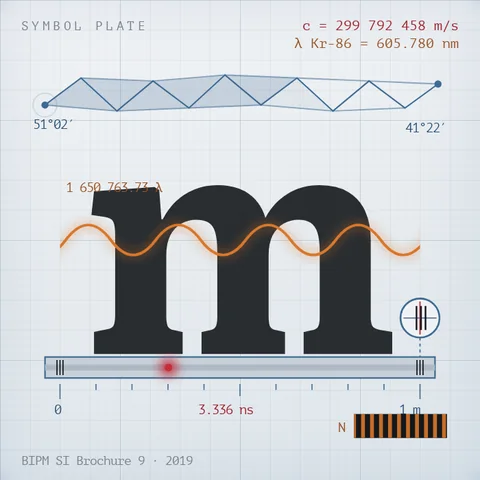
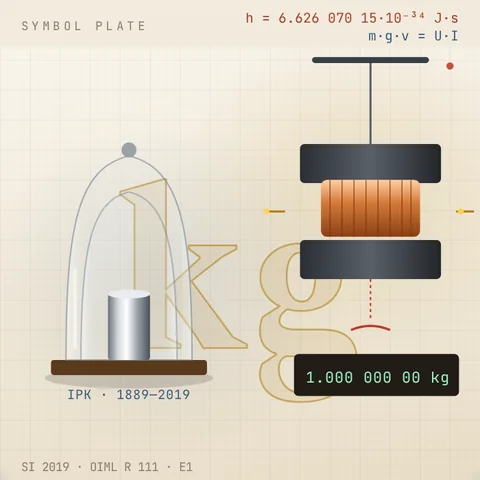
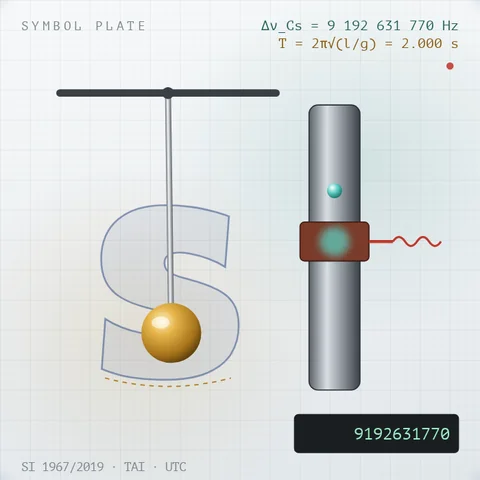
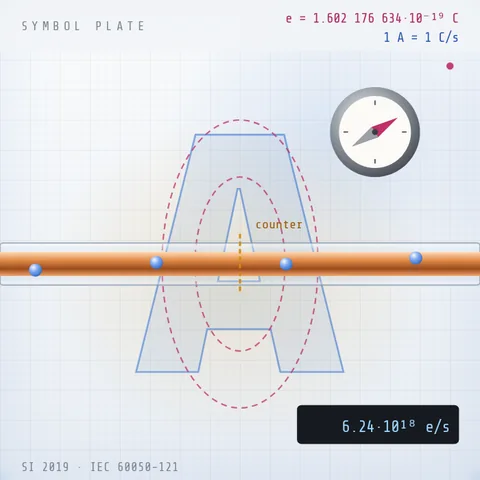
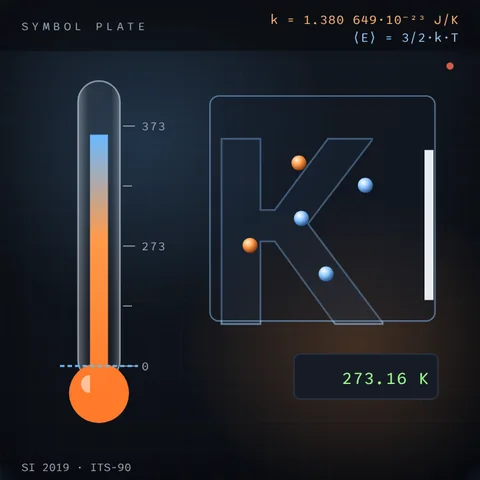
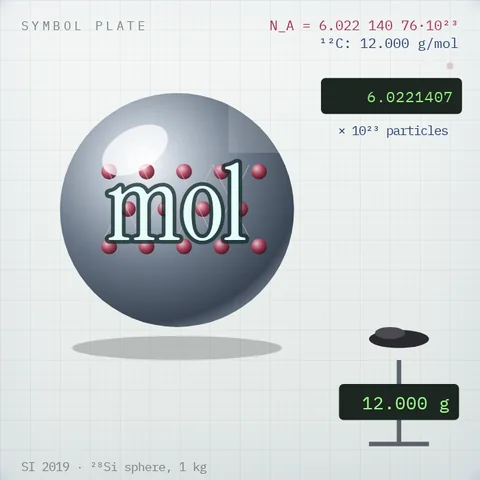
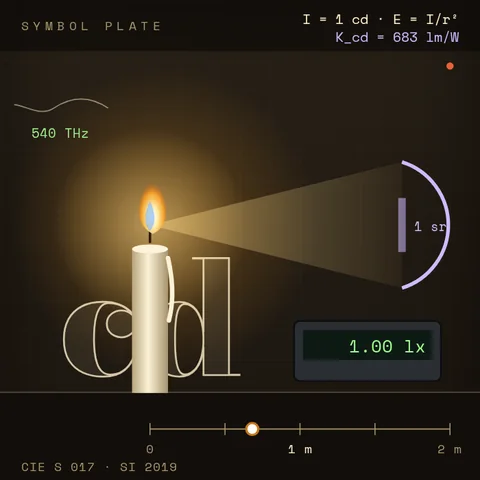
The seven SI base units
Catalogue of quantities
Medicine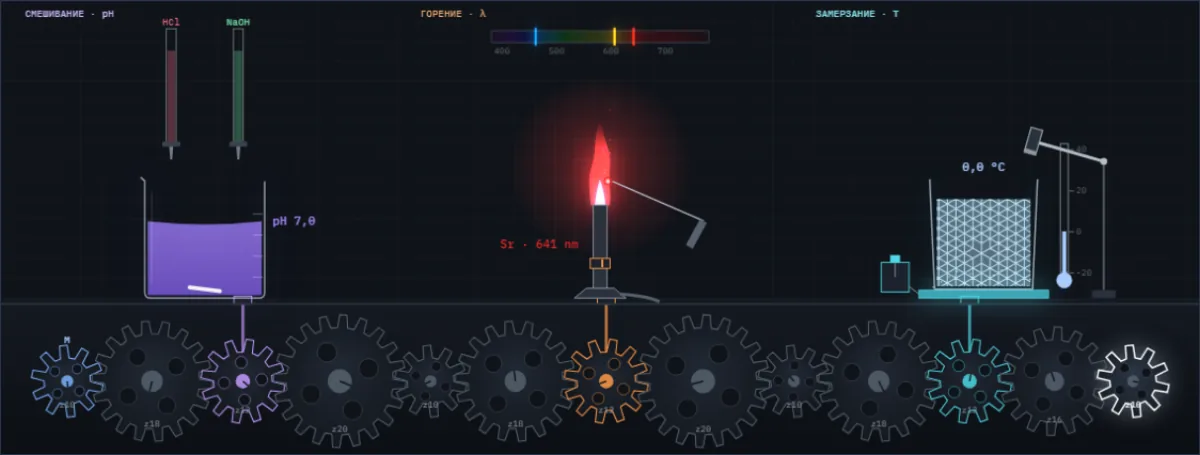
A drop of acid changes the colour of the juice, salt colours the flame, water freezes at a tap. Below them are all Simetrium sheets, by discipline and alphabetically.
Open the index →