Litre per hour
A car stands in a traffic jam with the engine running. The speedometer is at zero, the odometer does not move, yet the fuel needle creeps down. The trip computer shows how much goes in litres per hour: about 0.7 for a car, about 3 for a truck. More in winter and in the heat.
A litre per hour is the volume of fuel an engine burns in an hour. On the move litres per 100 km are handier, but a standing car covers no distance, and only time is left. Litres per hour are used for idling, generators, outboard motors, locomotives and aircraft. Volume is converted to mass through density, and mass to CO₂ emissions: a litre of petrol gives about 2.3 kg of carbon dioxide, a litre of diesel about 2.7.
| Notation | l/h or L/h · both are correct |
| Definition | 1 l/h = 1 dm³ per 3600 s = 2.78·10⁻⁷ m³/s |
| Smaller | 1 l/h = 16.7 mL/min = 0.278 mL/s |
| In mass | petrol 0.745 kg/h · diesel 0.835 kg/h per 1 l/h |
| Link to distance | l/100 km = 100 · Q / v, goes to infinity as v → 0 |
| Typical values | car idling 0.6–0.8 · truck idling about 3 · car on the motorway 6 · Boeing 747 about 12 000 |
01 · Definition
Volume per time, not per distance
Consumption Q is the volume of fuel V divided by the time t. An idling engine does not move the car; it turns itself, the alternator, the pumps and the air-conditioning compressor. That takes power, and the power comes from burnt fuel. So idling is not free even for a standing car.
Weather changes the load. In frost a cold engine runs at raised revs and a rich mixture until it warms up, and heated windows and seats load the alternator. In the heat the air-conditioning compressor runs. In rain the headlights, wipers and fan are on. Every extra kilowatt at idle costs roughly 0.3–0.4 l/h.
Why a standing car has no litres per 100 km
The slider sets the speed of a car with a 1.6 l engine. On the left is consumption over time, on the right over distance. Below 15 km/h litres per 100 km shoot up, at zero they do not exist at all, while litres per hour stay finite. The consumption model is this page's estimate for a level road.
Standing for an hour: how much burns
The main action is the «Join the jam» button. A car with a 1.6 l engine, a 2.0 l crossover, a city bus and a truck drive up and join the tail of the jam, engines running. The oncoming lane crawls in jerks; our own moves a couple of metres every ten minutes. Above each vehicle is a measuring cylinder, as if everything burnt were poured into it. An hour of standing passes in 20 seconds, and the slider under the scene rewinds it both ways. The weather is chosen under the scene: in frost a cold engine burns twice as much for the first minutes and the exhaust hangs in white clouds; in the heat the air conditioning runs; in rain the headlights, wipers and heating. On the right are the loads: idling, climate and electrics, warm-up. Consumption figures are this page's average estimates for vehicles in good order.
—
02 · Conversion
| {n} | {v} | {note} |
A US gallon is 3.785 l, an imperial gallon 4.546 l. A truck that «burns a gallon an hour at idle» uses 3.8 l/h if the gallon is American.
Quick CO₂ count: multiply litres per hour of petrol by 2.3, of diesel by 2.7. You get kilograms of carbon dioxide per hour.
03 · Orders of magnitude
04 · Measuring instruments
05 · Writing rules
06 · Neighbouring units
07 · Historical section
The litre per hour rests on two accepted units: the litre, exactly 1 dm³ since 1964, and the hour, 3600 seconds. The quantity itself is simple; measuring it honestly is hard. A trip computer does not measure fuel, it calculates it from injector opening time, so it is off by 5–10 %. Accurate measurement uses scales: the tank on a balance, a stopwatch, and mass converted to volume through density.
The density of petrol changes with temperature by about 0.1 % per degree. A litre filled in frost is heavier than a litre filled in the heat, so laboratories record consumption in kilograms per hour and get litres by conversion at 15 °C.
Catalogue of quantities
the whole index →The seven SI base units
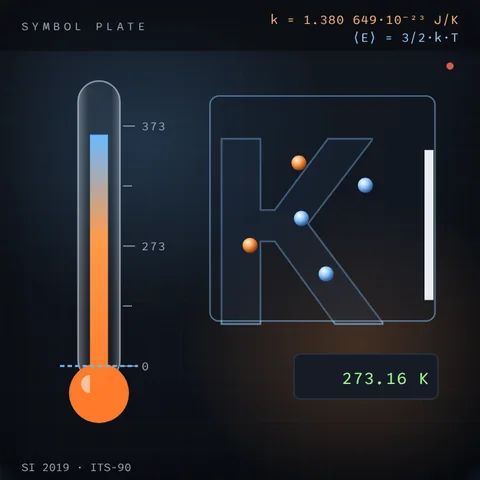
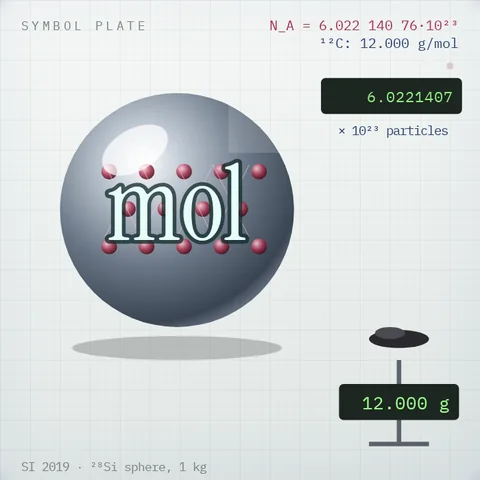
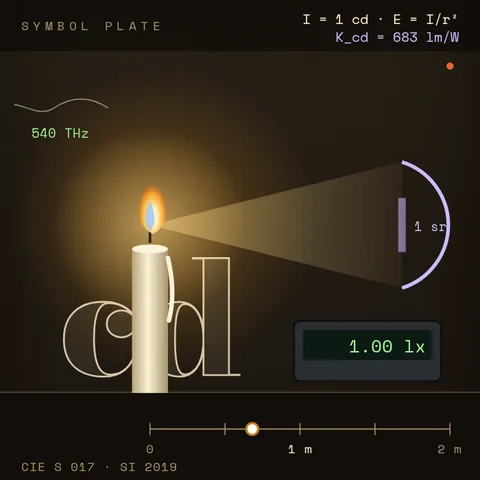
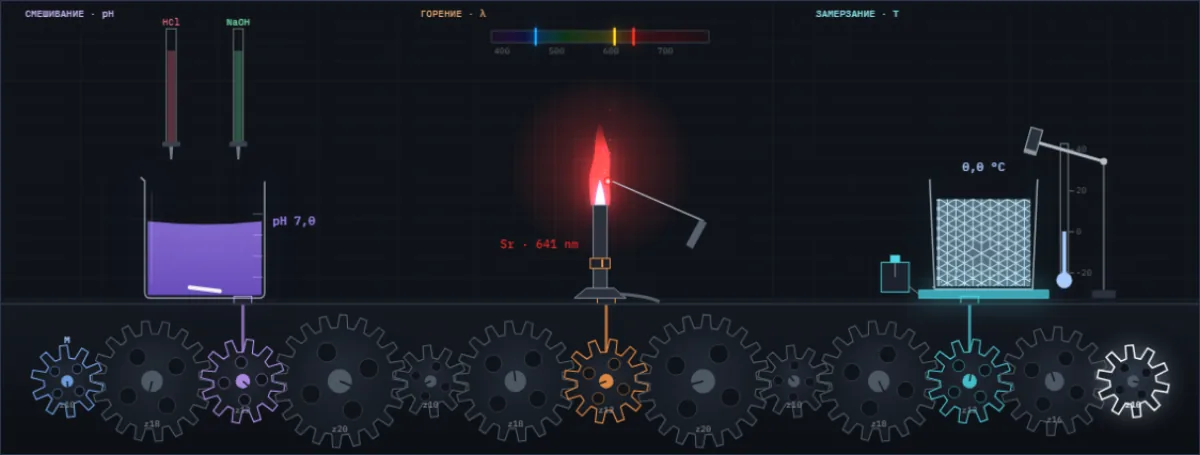
A drop of acid changes the colour of the juice, salt colours the flame, water freezes at a tap. Below them are all Simetrium sheets, by discipline and alphabetically.
Open the index →