Linear mass
The site foreman counts rebar in metres: the cage needs 1 130 m of Ø12 bar. The warehouse sells by the tonne. By the table a metre weighs 0.888 kg, and a tonne is 1 126 m. The bundle is weighed on the crane: 997 kg, 100 bars of 11.7 m each — that is 1 170 m. The steel was rolled to the minus tolerance, a metre weighs 0.852 kg, and the tonne turned out 47 metres longer than by the table.
Linear mass is the mass of one metre of a section’s length. It equals the section area multiplied by the density: m₁ = ρ · A. For steel it is simple: 1 cm² of section gives 0.785 kg per metre. Linear mass takes you from metres to tonnes when ordering, from tonnes to metres at acceptance, and in a design — from lengths to the steel mass in the schedule and to the self-weight load.
| Notation | m₁, q, g — «mass of 1 m» in section tables, kg/m |
| Definition | m₁ = ρ · A; for steel ρ = 7850 kg/m³, that is 0.785 kg/m per 1 cm² |
| Round bar of diameter d | m₁ = 0.006165 · d², d in mm: Ø12 — 0.888, Ø20 — 2.47 kg/m |
| Metres in a tonne | L = 1000 / m₁: Ø12 — 1 126 m, angle 63×5 — 208 m |
| Actual and table | GOST sets the tolerance on the mass per metre in per cent; mills roll near the lower limit |
| Where | steel schedule on the drawing, ordering and acceptance, self-weight load in kN/m |
01 · Definition
Section area times density
A metre of a section is a prism 1 m long with base area A. Its volume is A · 1 m, its mass ρ · A. That is why linear mass does not depend on the shape of the section: an angle, a square and a round bar of the same area weigh the same per metre. It depends only on the area and the material. An aluminium section of the same area weighs almost three times less per metre than a steel one, a copper one — 14 % more.
Section tables give the mass for nominal dimensions. Real rolled steel differs: the rolls wear, and the section comes out now thicker, now thinner. The standard allows the mass per metre to deviate by a few per cent either way. Steel is sold by mass, and it pays the mill to roll near the lower limit: the tonne comes out longer. For whoever buys metres it is a plus, for the strength calculation a minus: the section is slightly smaller than in the table.
A metre of section in seven materials
Rows are materials, all with the same section. The bar is the mass per metre. On the right — how many metres in a tonne. Choose the section area.
Five sections, three batches, one tonne
The main action is the «Start acceptance» button. An overhead crane lifts a bundle of rolled steel, and the crane scale under the hook shows its mass. The bars are counted and measured with a tape measure. The mass divided by the total length is the actual mass per metre. The calliper checks the section, and from its area the same mass per metre is obtained by calculation. The actual value is compared with the GOST table, and you work out how many metres a tonne will give. Wire rod has no bars: a coil cannot be counted, and its length is found only through the mass. Below the scene you choose the section — rebar Ø12, wire rod 6.5, angle 63×5, square bar 20 or hexagon bar S24 — and the batch: nominal, on the negative tolerance or on the positive one. The «Next bundle» button takes the next one.
—
02 · Conversion
Quick count for steel: kg/m = 0.785 · A, with A in cm². For a round bar — 0.00617 · d², d in mm: Ø10 — 0.617, Ø16 — 1.58, Ø32 — 6.31 kg/m.
American section tables use lb/ft: 1 lb/ft = 1.488 kg/m. Rebar #4 (½″) — 0.668 lb/ft, that is 0.994 kg/m. A W8×10 beam weighs 10 lb/ft — 14.9 kg/m.
| extrusion | kg/m | m per tonne | A, cm² | where |
| {k} | {v} | {h} | {a} | {n} |
03 · Orders of magnitude
04 · Measuring instruments
05 · Writing rules
Series · Drafting and CAD
desk tips for every sheet06 · Neighbouring units
07 · Historical section
Mass per metre is a derived quantity: mass divided by length. Both are measured roughly. A crane scale is off by kilograms per tonne, a tape over 12 m by millimetres, and the mass per metre of a bundle comes out to about 0.2 %. That is enough to see a negative tolerance of 3–5 %.
For ribbed rebar the mass per metre is the main characteristic: the section area is determined from it, and «diameter 12» is nominal. A bar that is 6 % lighter than the table has a 6 % smaller area, and the standard rejects such a batch: the strength calculation assumes the nominal area.
Catalogue of quantities
the whole index →The seven SI base units
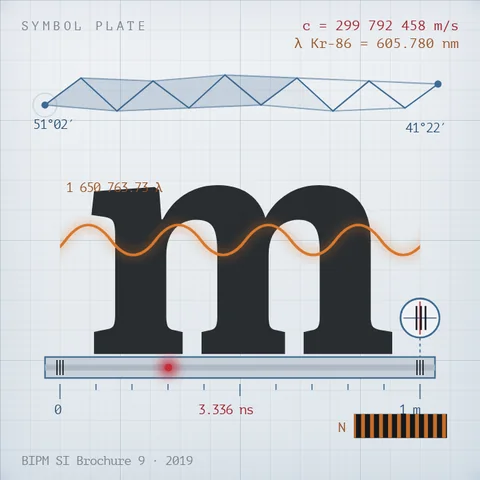
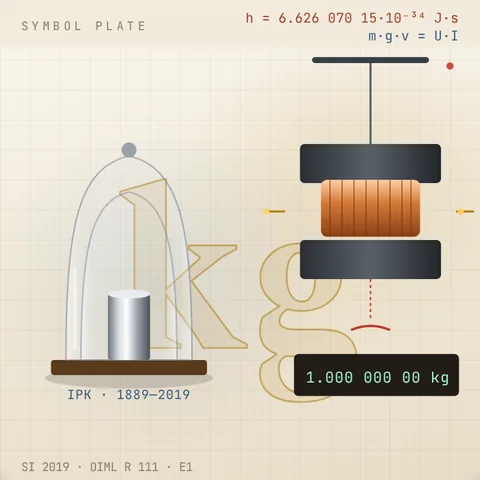
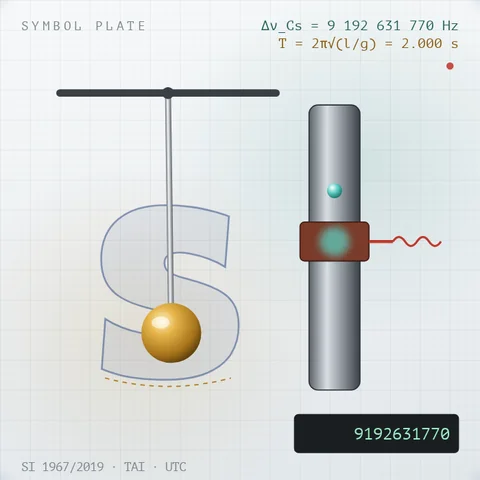
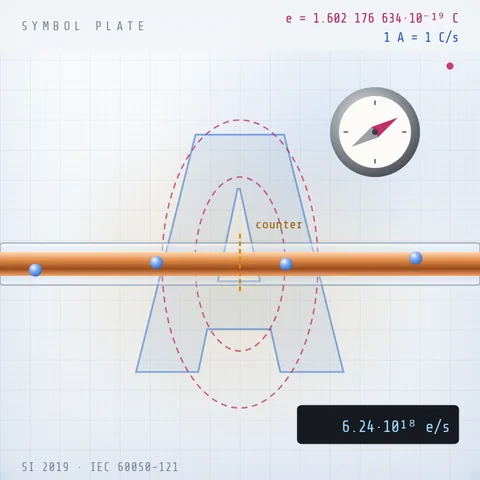
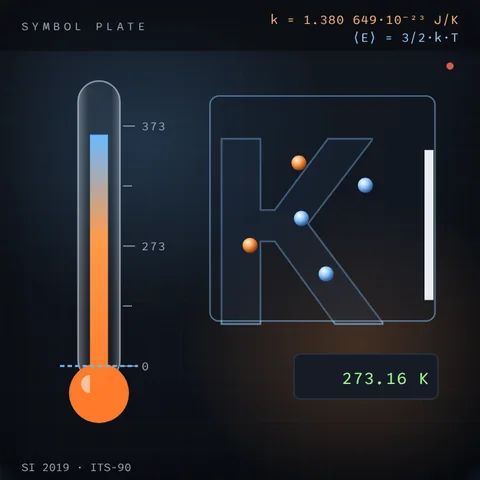
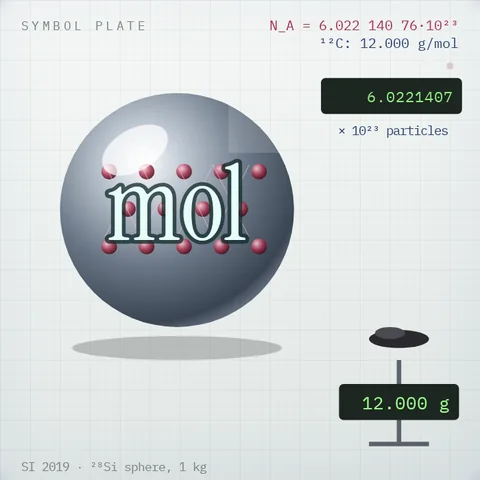
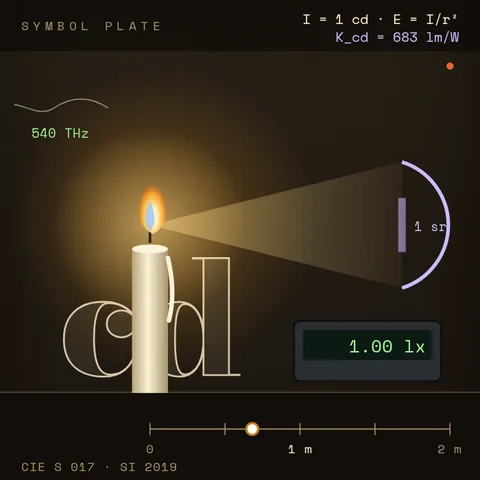
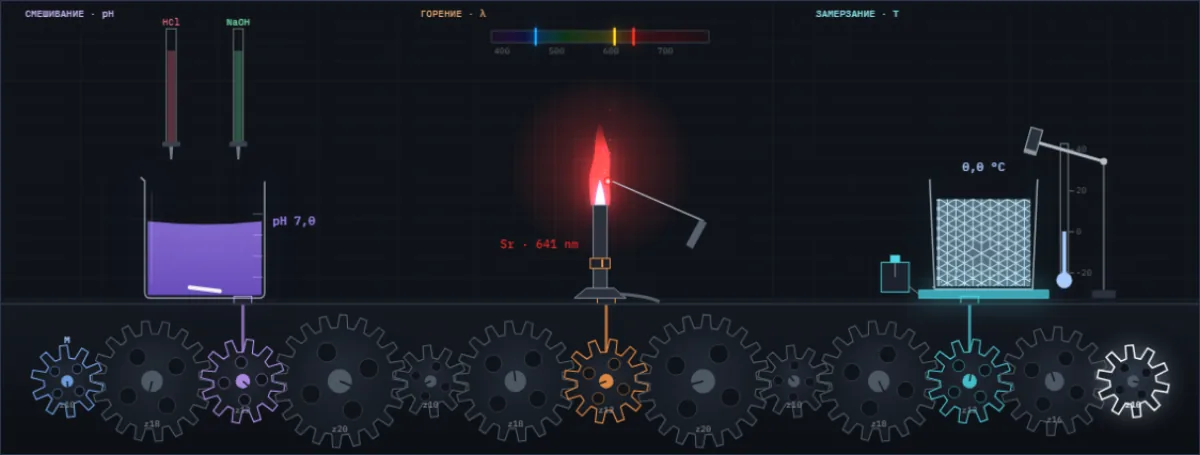
A drop of acid changes the colour of the juice, salt colours the flame, water freezes at a tap. Below them are all Simetrium sheets, by discipline and alphabetically.
Open the index →