The symbol is written with capital Latin letters MET, from metabolic equivalent of task, and with no plural "s" after a number: 8 MET, although METs also appears in English-language papers. The derived unit of accumulated exertion is MET-min or MET-h, minutes or hours multiplied by the number of MET.
MET is a multiple of rest, not energy: eight MET means the body spends eight times as much as when sitting, and how many kilocalories that is depends on body mass. Nor should it be confused with mechanical work: of all the energy that MET indicates, less than a quarter goes to the treadmill belt, and the rest turns into heat.
The letters MET run along the treadmill belt, each at its own rhythm, and behind the letter E the glow of burning fuel flares up. On the left a Douglas bag breathes, with bubbles of exhaled air drifting toward it along a tube; on the right a blue column of absorbed oxygen rises from zero to the 3.5 mark and flashes, while green activity marks blink below.
Quantity data sheet
multiple of resting metabolism sheet 1/1 · rev. 2026-09Metabolic equivalent MET · 3.5 mL O₂/(kg·min)
Non-SI unit · quantity: exercise intensity as a multiple of resting oxygen uptake
How many times a sitting person
A cardiologist discharging a patient after a myocardial infarction cannot just say "you may go for walks": he needs a measure that is the same for a walk, for washing floors and for climbing stairs. That measure was taken from the body itself: the unit is the oxygen a calmly seated adult uses, 3.5 millilitres per kilogram of body mass per minute, and every activity came to be described by how many times more it costs than rest.
Brisk walking turned out to be about four MET, running at ten kilometres per hour about ten, and sleep a little under one. Since a litre of oxygen burns about five kilocalories in the body, MET converts straight into calories and watts, and it then turns out that a running marathoner develops more than two horsepower, almost all of which goes into heat.
The page puts a person on a treadmill, calculates their oxygen from the equations of the American College of Sports Medicine and shows why the standard 3.5 does not suit everyone.
01 · Definition
oxygen · mass · minute · calorieThe metabolic equivalent is the ratio of oxygen uptake during a given activity to the uptake at rest, taken as 3.5 mL O₂ per kilogram of body mass per minute. One unit describes a person sitting calmly in an armchair, and an activity of n MET requires n times more oxygen per kilogram.
Oxygen is convenient because it is easier to measure than heat: the body burns fats and carbohydrates, and each litre of oxygen absorbed releases about five kilocalories, slightly more for carbohydrates and slightly less for fats. Hence one MET is roughly equal to one kilocalorie per kilogram per hour, or 1.2 watts per kilogram, so a person weighing seventy kilograms at rest heats a room like an eighty-five-watt light bulb.
For walking and running the American College of Sports Medicine derived equations in which oxygen is the sum of three parts: rest, horizontal movement and climbing uphill. Running costs twice as much as walking on the level but half as much on a climb, because in running the body is already thrown upward and does part of the work against gravity anyway.
How many light bulbs the body would light
On the left a person on a treadmill: speed and grade change the gait, the tilt of the belt and the pace at which they breathe in blue oxygen molecules and breathe out orange carbon dioxide. On the right is a MET scale with marks for everyday activities, along which an arrow creeps; above it is a grid of sixteen light bulbs of a hundred watts each, shining as much as all the energy the body spends at that minute, and a green bar below them shows the same power in horsepower, with a tick at one.
A stove with a small motor inside
Muscles turn about a quarter of the chemical energy into movement, and the rest becomes heat, which is why a runner in the heat overheats before getting tired. On a climb you can see how much work is actually done: lifting seventy kilograms by one metre per second costs about seven hundred watts, almost a horsepower, while the body spends three to four times more, and the scene shows both figures side by side: the full power in light bulbs and the useful work against gravity.
02 · Conversion
SI · old units · personal METFrom oxygen to calories, watts and horses
Enter the intensity in MET, in millilitres of oxygen, in kilocalories or in watts, and the page will convert it into all the other measures for a person weighing seventy kilograms. The third tab shows how many "personal" MET the same exertion amounts to for people of different sex, age and mass.
A rule to remember: kilocalories per minute equal MET multiplied by body mass in kilograms and divided by 57, so a person of seventy kilograms at 8 MET spends about ten kilocalories per minute.
A fitness tracker that shows "calories burned" most often multiplies tabulated MET by your mass and time, knowing neither your resting rate nor your technique. For an untrained person the error of such an estimate easily reaches a third, which is why MET is good for comparing activities with one another but poor for working out how many cakes you can eat after a run.
| {k} | {v} | {note} |
{text}
04 · Measuring instruments
bag · spirometer · gas analyzer · trackerHow to catch an exhaled breath
A rubberized bag on the back
In 1911 the Oxford physiologist Claude Douglas put a mouthpiece with a valve on a test subject, letting the inhalation in from the room and sending the exhalation into a bag of rubberized fabric. The volume of the bag was then run through a gas meter and a sample analyzed for oxygen and carbon dioxide; the method is so accurate that it still serves as the reference against which electronic gas analyzers are checked.
A bell that sinks
In the Benedict–Roth spirometer a person breathes pure oxygen from a bell above water, and the exhaled carbon dioxide is absorbed by soda lime. With each breath the bell sinks a little, a pen draws a stepped curve, and its slope directly shows how much oxygen the body takes in per minute; this is how basal metabolism was measured in clinics in the first half of the twentieth century.
Every breath separately
A modern metabolic cart stands next to the treadmill: a turbine in the mask measures the flow, and fast sensors measure the fraction of oxygen and carbon dioxide in every exhalation, so VO₂ and the ratio of CO₂ to O₂ appear on the screen breath by breath. From that ratio the device also learns what the muscles are currently running on, fat or carbohydrate, and refines how many kilocalories a litre of oxygen costs.
A tracker that does not breathe
An accelerometer on the wrist or hip does not see oxygen: it counts accelerations and converts them to MET with equations fitted on volunteers in a laboratory with a metabolic cart. For walking and running such a conversion works tolerably, but cycling, strength exercises and climbing uphill are underestimated by the tracker, because the arm is almost motionless during them.
05 · Writing rules
symbol · time · massMET is not "per hour"
Intensity is written as a number of MET without units of time, accumulated exertion in MET-min or MET-h, and oxygen uptake as a full unit with the kilogram and the minute.
The first line on the right divides intensity by time, although MET already describes expenditure per unit of time, and the second loses the kilogram and the minute and turns into the volume of a single gulp. A weekly total is written in MET-min, not in MET; eight MET is eight kilocalories per kilogram per hour, not eight kilocalories in general; an expenditure in kilocalories without body mass cannot be checked; and lowercase "met" is confused with the verb and with a metabolite.
06 · Neighbouring units
calorie · horsepower · wattMET stands between the calorie, with which food and heat are counted, the horsepower, with which Watt measured a horse's work at a gin, and the watt, to which both are reduced in the SI.
About five kilocalories are released by a litre of oxygen absorbed.
A running marathoner spends more than two, and turns about half of one into work.
One MET is about 1.2 W per kilogram of body mass.
07 · Historical section
archive · from the horse gin to the CompendiumHow work came to be measured by breathing
{title}
{text}
Three and a half turned out to be generous
The blue bell is the distribution of measured resting oxygen uptake in several hundred adults in the 2005 study by Byrne et al., with a mean of about 2.6 mL per kilogram per minute; the orange line is the standard 3.5. The marker runs along the bell from the most economical to the most wasteful.
If true rest is below the standard, tabulated MET understate the true multiple of the exertion, and a calorie calculation through 3.5 overstates it, especially in heavy and elderly people.
A unit taken from one man
The number 3.5 was not derived from physiology: in 1990 Jetté, Sidney and Blümchen, in a review on exercise testing, fixed it as the resting oxygen uptake of one forty-year-old man weighing seventy kilograms, whose data had long circulated in textbooks. So the unit came to resemble the old measures of length tied to a king's elbow: it has a definition, but no reference standard that could be placed in a laboratory.
The ratio makes it convenient and treacherous at once. Oxygen per kilogram already takes mass into account, so the same MET means different watts in a light and a heavy person, and since fat hardly breathes, a heavy person's resting expenditure per kilogram is lower, and their true "own" MET turns out smaller than the standard.
The compilers of the Compendium of Physical Activities therefore advise multiplying the tabulated value by the ratio of standard rest to individual rest calculated from basal metabolism formulas, while in the clinic the absolute VO₂ in millilitres per kilogram per minute is still recorded, from which MET can always be obtained back.
The seven SI base units
Catalogue of quantities
Medicine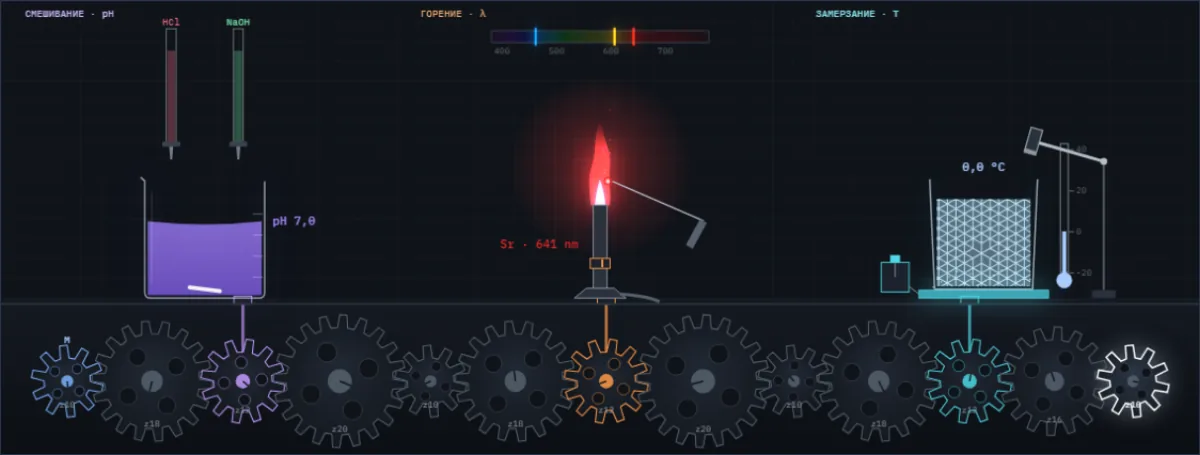
A drop of acid changes the colour of the juice, salt colours the flame, water freezes at a tap. Below them are all Simetrium sheets, by discipline and alphabetically.
Open the index →