params
Here is a riddle that trips up even programmers. The French model Mixtral is called “8×7B”, that is, eight experts of seven billion parameters each. Multiply and you get fifty-six billion. But the file holds only 46.7 of them, and the model answers as fast as a thirteen-billion model. Where did the nine billion go, and why does a huge model run like a medium one — you will understand when you reach the mixture-of-experts experiment.
A parameter is a single number inside a neural network that is tuned during training: the weight of a connection between two neurons. A model knows exactly what is written in its parameters, and the count of these numbers has become the main measure of its size. From it you can estimate almost everything needed in practice: how much memory the model will take, which graphics card it will run on, how fast it will type an answer and what its training cost. This sheet has a calculator for fourteen models and twelve devices, a breakdown of model names and three experiments: assemble a transformer, squeeze the weights down to two bits and see how a mixture of experts works.
Calculator
Will the model fit and how fast will it talk
Choose a model, a weight format, a context length and how many people write to it at once. Memory is the sum of the weights and the key-value cache, which grows with every token read. Answer speed almost always depends not on computation but on how fast memory can deliver the weights: for every new token they have to be read in full.
What it costs to grow a model
Enter the number of parameters and how many tokens of text the model will read in training. Each token costs about six floating-point operations per parameter: two to make a prediction, four to correct the error. The rest is arithmetic: divide by the speed of an H100 graphics card, taking into account that on average it is loaded only forty percent.
Etymology
Beside the measure, the weight and the billion
Behind the words “seven billion parameters” hide three stories. A Greek word that mathematicians used for an auxiliary quantity; the old word “weight”, which neural networks borrowed from scales and weights; and the billion, which means different numbers in different countries. The last story is the trickiest: if you translate an article about neural networks, check which “billion” the author meant.
In China, Japan and Korea large numbers are counted not in thousands but in ten-thousands: 亿 is a hundred million, and seven billion sounds like “seventy hundred millions”. In India, Bangladesh and Pakistan the lakh (a hundred thousand) and the crore (ten million) are customary, so 7B is easy to hear there as “seven hundred crore”. And in Brazil bilhão is a thousand million, whereas in Portugal the corresponding word is a million million, and there they write mil milhões.
01 · Definition and a single neuron
Billions of knobs on one instrument
Picture a huge console studded with knobs like a sound engineer’s, only instead of a hundred knobs it has eight billion. Each knob is a parameter, one number. The input text is turned into numbers, passes through the console, and at every knob is multiplied by its value. Training is a long process in which the machine turns all the knobs at once, bit by bit, so that the answers get closer to the right ones. When training is finished, the knobs freeze, and everything the model “knows” is written in their positions.
More knobs mean more subtle patterns can be remembered, but also a higher price: every number has to be stored somewhere and read at every step. That is why the most practical calculations follow from the parameter count: memory is the parameters times the bytes of one number; answer speed is the memory bandwidth divided by that same quantity; training cost is six operations per parameter for every token read. All the formulas below can be copied.
Take an umbrella today?
The neuron receives three signals: cloudiness, humidity and the rain forecast. It multiplies each by its own weight, adds them up and adds a bias, then squeezes the sum into a number from zero to one — the confidence to “take”. Turn the knobs: line thickness is the size of the weight, orange is a weight “for”, teal is “against”. Try tuning the neuron so that it answers “take” only when the forecast is bad.
Why 8 × 7 = 46.7 and it runs like a 13
Mixtral replicated not the whole model but only its fattest part — the feed-forward blocks, where most of the knowledge is stored. There are eight such expert blocks in each layer, while the attention layers, the vocabulary and the normalizations are shared by all experts. Added up honestly, this gives 46.7 billion, not fifty-six: nine billion shared parameters would be counted eight times.
And the speed is explained by the router. For each token in each layer it picks two experts out of eight, and the other six rest at that moment. So only 12.9 billion parameters work on a single token. Memory is needed as for a big model — all the experts must lie ready — while reading and computing are needed as for a small one. DeepSeek-V3, Qwen3 and Kimi K2 are built the same way; see them in the “Experts” experiment.
Assemble, compress, distribute
In the “Device” experiment you assemble a transformer from layers: move the number of layers and the model width and see where the parameters live — in the vocabulary, in attention or in the feed-forward blocks. In the “Compression” experiment a real weight matrix is rounded to eight, four and two bits: you can see how the error grows and why outliers spoil everything unless the matrix is cut into blocks. And in the “Experts” experiment tokens run through the model, and the router lights up only a few experts out of hundreds for each.
02 · Orders of magnitude
From a worm to the human brain
Drag the slider: it follows a logarithm, and every step is ten times larger than the one before. Beside the models stand living nervous systems, in which synapses, the connections between neurons, play the role of parameters. The comparison is rough — a synapse is far more complex than a single number — but it conveys the order of magnitude honestly: the largest models are still a hundred times smaller than the brain.
03 · Model name and the weight of a parameter
Read a file name like a passport
Open model names look like spells: Qwen3-235B-A22B-Instruct-2507-Q4_K_M.gguf. But every piece of them means something — size, number of active parameters, purpose, release date and weight format. Paste a file name or pick an example, and the breakdown will show what you are downloading and how much memory it will take.
The llama.cpp formats (Q8_0, Q6_K, Q4_K_M…) store weights in blocks and add a scale to each block, so their bits per weight are fractional numbers. The values are averages for Llama 3 models; for other models the file may differ by a few percent.
04 · Models of the world
Open models and their sizes
For closed models the parameter count is usually kept secret, so all the calculations on this sheet are made on open-weight models from the USA, France, China and the United Arab Emirates. Their parameters can be downloaded and recounted yourself. Tap a row to read the details and drop the model into the calculator.
Three ways without guessing
The number in the name is rounding, sometimes a very loose one: “7B” can mean anything from 6.7 to 7.6 billion. The exact number comes from the model itself. If it cannot be loaded entirely, the header of a safetensors file will do: it records the shapes of all the matrices, and their products add up to N.
{code}A quick estimate from file size: N ≈ file bytes × 8 ÷ bits per weight. A 16.1 GB file in BF16 is eight billion parameters.
05 · Writing rules
06 · Neighbouring units
07 · Historical section
The first parameters of a neural network could be touched by hand. In 1958 the American psychologist Frank Rosenblatt built the Mark I Perceptron at the Cornell Aeronautical Laboratory: a camera of four hundred photocells looked at a picture, and the connection weights were stored in potentiometers — the same knobs that adjust volume. During training small electric motors turned them, and engineers literally saw the machine “learn”.
Fifty-four years later the AlexNet network, which won the ImageNet image-recognition contest, had sixty million parameters, and they did not fit into a single graphics card with three gigabytes of memory. Alex Krizhevsky cut the network in half and trained it on two gaming cards at once. Since then the question “will it fit” has been the main question of the whole industry, and the answer still begins with the parameter count.
Series · AI
units of language modelsHow a neural network is measured
Parameters are what a model is made of, and tokens are what it reads and writes. Together they determine everything else: how many operations training and answering need, how much memory and energy will go, and how fast the model types a word. On the left is the console where these measures meet in one query; on the right are the sheets of the series.
Catalogue of quantities
the whole index →The seven SI base units
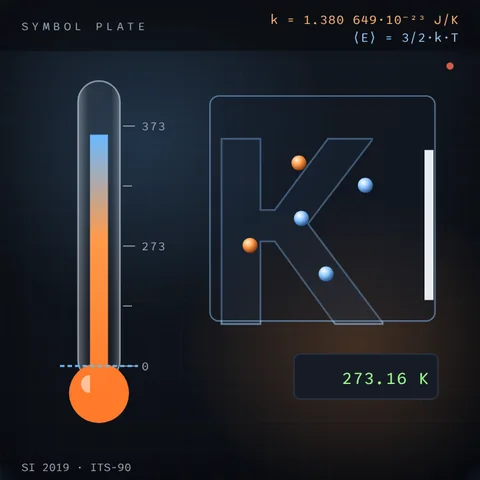
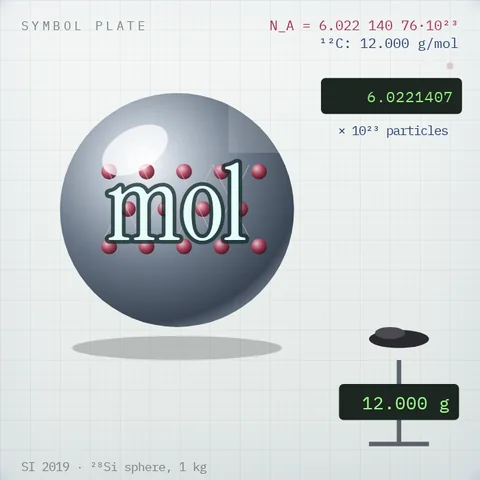
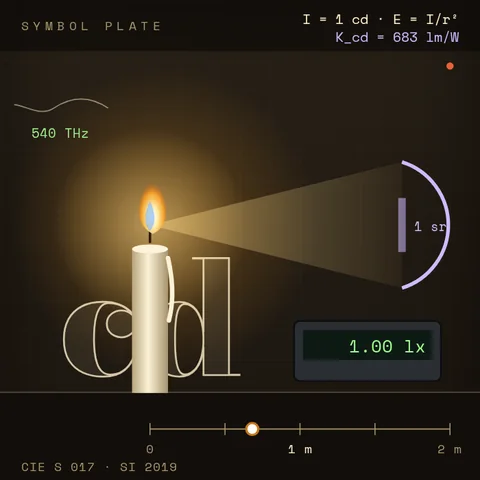
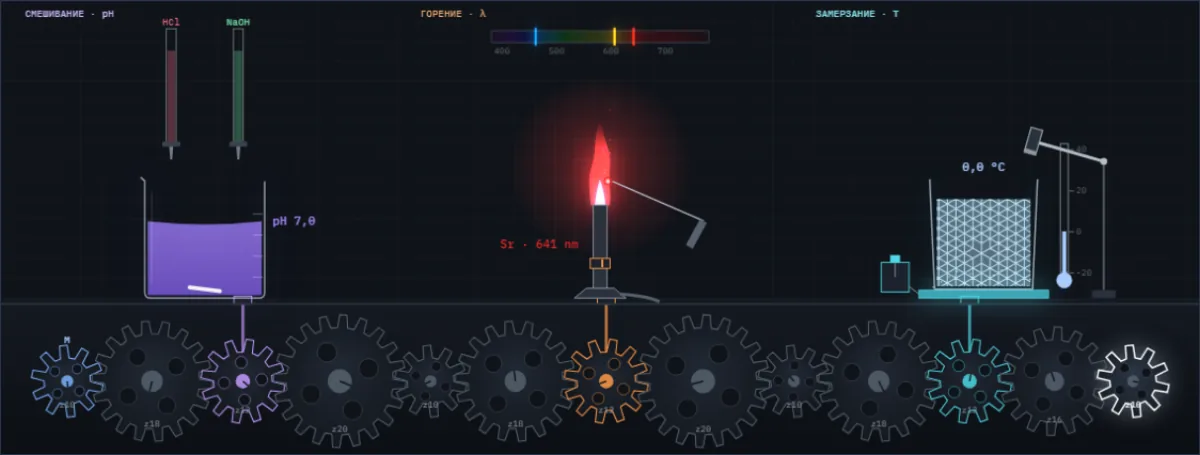
A drop of acid changes the colour of the juice, salt colours the flame, water freezes at a tap. Below them are all Simetrium sheets, by discipline and alphabetically.
Open the index →