Gram per mole
To take 6.022·10²³ molecules of water, a chemist does not count them. He weighs out 18.015 g. That number is the molar mass: how many grams one mole of a substance weighs. For salt it is 58.44 g/mol, for sugar 342.3, for haemoglobin about 64 500.
Molar mass is added up from atomic masses according to the formula of the molecule. Atomic masses are measured with a mass spectrometer: a magnet separates ions by mass, and heavier ones fly along a flatter arc. The SI unit is kg/mol, but laboratories write g/mol. That way the number equals the mass of the molecule in daltons.
| Notation | g/mol · in SI kg/mol |
| Definition | M = m / n — the mass of a substance divided by its amount |
| Reference values | M(¹²C) = 12.000 000 012 6 g/mol · M_u = 1.000 000 001 05 g/mol |
| Introduced | gram atomic weights — since the nineteenth century · kg/mol — since the mole joined the SI, 1971 |
| Standards | ISO 80000-9 · IUPAC Green Book · CIAAW 2021 |
| Typical values | 18.015 g/mol — water · 180.16 — glucose · 64 500 — haemoglobin |
01 · Definition
The mass of one mole
Take a substance and divide its mass by the amount of substance in moles. You get the molar mass M. For a pure substance it is constant. 9 g of water is 0.5 mol, 36 g is 2 mol, and the ratio is always 18.015 g/mol.
It is calculated from the formula of the molecule. The atomic mass of each element is taken from the IUPAC table, multiplied by the number of atoms, and the results are added up. Atomic masses are averages over the natural mixture of isotopes. That is why chlorine has 35.45 and not a whole number.
Build a molecule and weigh a mole
The balls are the atoms of the molecule; their size grows with atomic mass. The strip below shows the same mass in parts: what share of the molar mass falls on each element. Black is carbon, blue is hydrogen, green is nitrogen, crimson is oxygen, grey is chlorine.
What flies into the spectrometer
Each cell holds the skeletal formula of a substance from the experiment. Corners and line ends are carbon atoms, the hydrogens on them are not drawn, a double line is a double bond. Nitrogen is marked green, oxygen crimson. The green number under the formula is the molar mass in g/mol. In the centre is caffeine: a blue spark runs around its rings.
A magnet separates ions by mass
In the centre is a mass spectrometer in cross-section. Vapour of the substance enters the source, a hot filament knocks electrons out of the molecules, and the voltage U accelerates the ions. In the magnetic field B an ion flies along an arc of radius r = √(2mU/e) / B: the heavier it is, the flatter the arc. The blue dashed lines are beams of ions of different mass; their brightness is the share of such molecules in nature. The spread of the beams in the drawing is enlarged 8 times, otherwise neighbouring masses would merge into one arc. Only the beam whose radius is exactly 200 mm enters the collector slit, and the collector lights up crimson. The field changes slowly, and the screen on the right records the spectrum as a crimson line; the blue mark is the mass at the slit right now. Below the screen is a balance: exactly one mole of the substance is placed on it. The console on the left shows the molar mass and the instrument mode. A click on the spectrometer sets the field to the highest peak, a click on the balance puts a mole on it. If nothing is touched for 20 s, the experiments run by themselves.
—
02 · Conversion
| {n} | {v} | {note} |
Daltons and g/mol give the same number, but they are different quantities. The dalton is the mass of one molecule, g/mol is the mass of a mole. Since 2019 the numbers no longer coincide exactly: according to CODATA 2022 they differ by 1.05·10⁻⁹, far beyond the reach of any balance.
Engineering tables use kg/kmol and lb/lb-mol. Their number is the same as for g/mol: a kilomole is a thousand times larger than a mole, and so is a kilogram. A pound-mole is 453.59 mol.
03 · Orders of magnitude
04 · Measuring instruments
05 · Writing rules
06 · Neighbouring units
07 · Historical section
The atomic mass of an element depends on where the sample was taken. Hydrogen from sea water and from natural gas contains different shares of deuterium. That is why CIAAW gives an interval for hydrogen, 1.007 84–1.008 11, and calculations use the conventional 1.008. Because of this the molar mass of water is accurate only to the fifth digit.
The scale itself rests on carbon-12. Until 2019, M(¹²C) was exactly 12 g/mol by definition. Since the mole was defined through the Avogadro number, it has been measured: according to CODATA 2022 it is 12.000 000 012 6 g/mol with an uncertainty of 3.7·10⁻⁹ g/mol. A chemist will not notice the difference.
Catalogue of quantities
the whole index →The seven SI base units
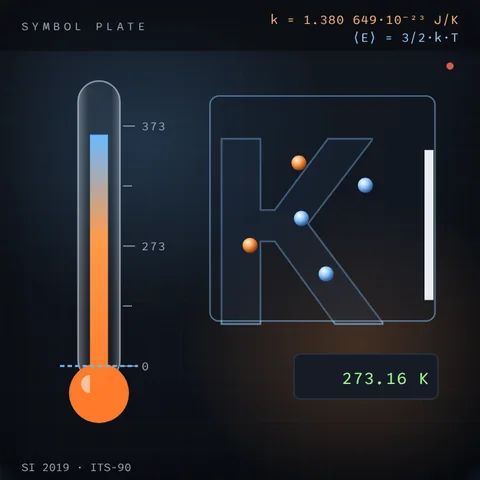
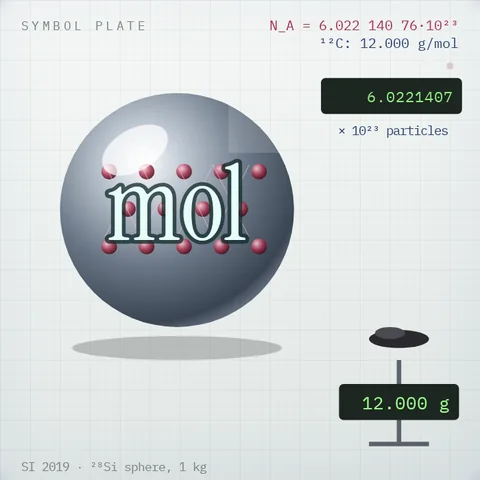
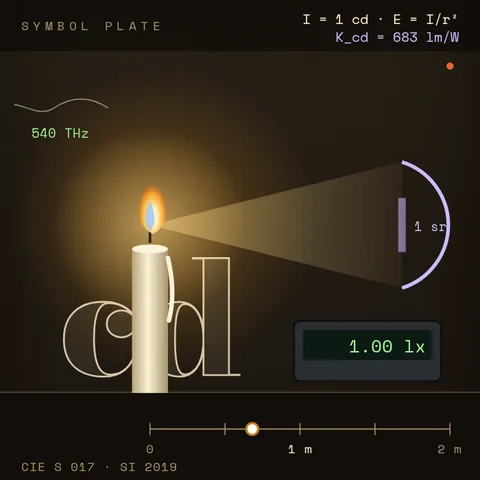
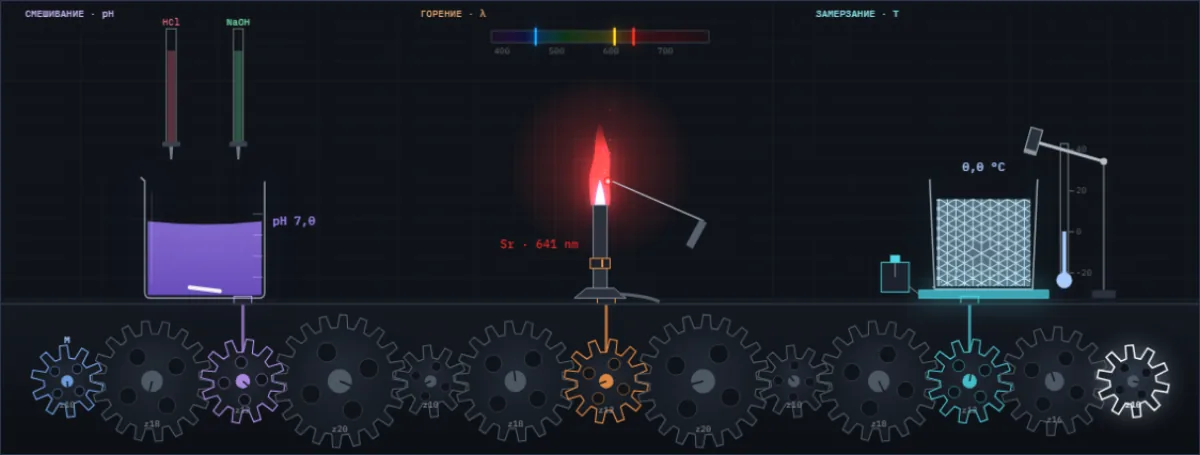
A drop of acid changes the colour of the juice, salt colours the flame, water freezes at a tap. Below them are all Simetrium sheets, by discipline and alphabetically.
Open the index →