Newton of thrust
A newton is the force that speeds up a kilogram by one metre per second every second. An apple of about 100 grams presses on your palm with a force of one newton. A rocket engine throws out hundreds of kilograms of gas per second at 3–4 km/s and gets millions of newtons of thrust — meganewtons.
Thrust has two terms: the momentum of the jet ṁ·vₑ and the pressure difference at the nozzle exit. That is why the same engine pulls less at ground level than in vacuum, and the shape of the nozzle decides where it works best. A rocket lifts off only if its thrust is greater than its weight; their ratio is the thrust-to-weight ratio.
| Notation | N · kN · MN |
| Definition | 1 N = 1 kg·m/s² — by Newton’s second law F = ma |
| Thrust | F = ṁ·vₑ + (pₑ − pₐ)·Aₑ |
| Old units | 1 kgf = 9.80665 N · 1 tf = 9.807 kN · 1 lbf = 4.448 N |
| Liftoff | thrust-to-weight ratio F / mg greater than 1 · rockets at launch 1.2–1.6 |
| Typical values | apple — 1 N · jet engine — hundreds of kN · liquid rocket engine — about 2 MN · heavy rocket — 30–70 MN |
01 · Definition
Force, jet momentum and exit pressure
Newton’s second law: force equals mass times acceleration. A newton is the force that gives a kilogram an acceleration of 1 m/s². An engine pushes off its own jet: every second it throws out a mass ṁ at a velocity vₑ and gets a force ṁ·vₑ — by the third law.
The second term is pressure. If the gas at the nozzle exit presses harder than the air, it still pushes; if weaker, the air squeezes the jet and takes away thrust. A long nozzle accelerates the gas more and works well in vacuum, but loses at ground level. A short one is the opposite. Specific impulse Isp is thrust per weight of propellant used per second, in seconds: the higher it is, the more economical the engine.
How many newtons it takes to lift off
Choose what to lift and set the thrust — the scale is logarithmic, from 0.1 N to 100 MN. Weight is the force of gravity mg. Liftoff happens when thrust is greater than weight.
Garage: build a rocket from parts
The rocket stands in the assembly hall. Every part changes the mass, the air drag and the thrust: the fairing sets the shape of the nose, the fuselage the diameter of the tanks and how many engines fit, the fins the stability at max-Q, the engine and the nozzle the thrust and specific impulse. The part changed last is highlighted. On the right are the mass by parts, the thrust-to-weight ratio and the Δv budget. When the rocket is ready — «Roll out to the pad».
Build a rocket — and see whether it lifts off
The rocket is built in the garage above: fairing, fuselage, fins, engines, nozzle, propellant and payload. Whatever is built rolls out to the pad. The main action is «Launch»: countdown, ignition, liftoff, the sound barrier, maximum dynamic pressure, engine cutoff and coasting up to the highest point. In the garage you can add a second stage and turn on «Turn to orbit»: after liftoff the rocket pitches over towards the horizon, the first stage separates, the second gains about 7.8 km/s sideways — and if the perigee is above 160 km, the rocket is in orbit. Without the turn the flight is vertical, like a sounding rocket. The first seconds run slowly, after that the flight is sped up; the slider under the scene rewinds it. On the right is a cutaway nozzle: exit pressure against ambient pressure, which set the shape of the jet and the thrust.
—
02 · Conversion
| {n} | {v} | {note} |
Quick estimate: a tonne-force is almost 10 kN, a hundred tonnes of thrust is about 1 MN. More precisely, multiply by 9.807.
American engines are often described in pounds-force: a million lbf is 4.45 MN.
03 · Orders of magnitude
04 · Measuring instruments
05 · Writing rules
06 · Neighbouring units
07 · Historical section
The newton is a derived SI unit: kilogram, metre and second. Since 2019 the kilogram has been defined through the Planck constant, and the newton rests on it too. Force standards are machines that load a sensor with known weights in a known gravitational field; the largest hold several meganewtons.
The thrust of a rocket engine is not a fixed rating. It depends on the ambient pressure, so specifications give two figures: at sea level and in vacuum. Old handbooks gave thrust in tonnes-force; under GOST 8.417 this is a non-SI unit, converted to newtons by multiplying by 9 807.
Catalogue of quantities
the whole index →The seven SI base units
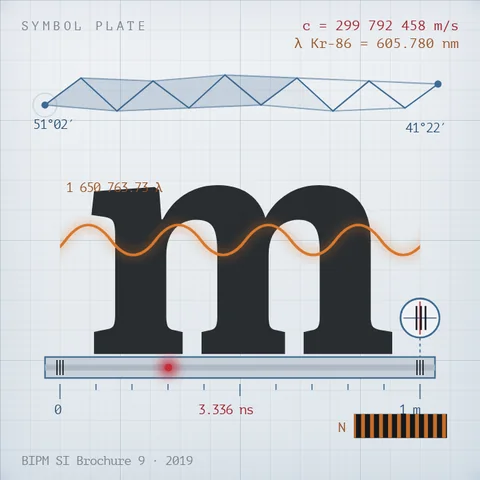
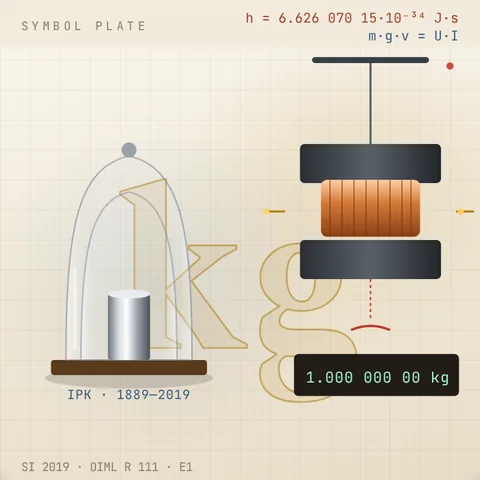
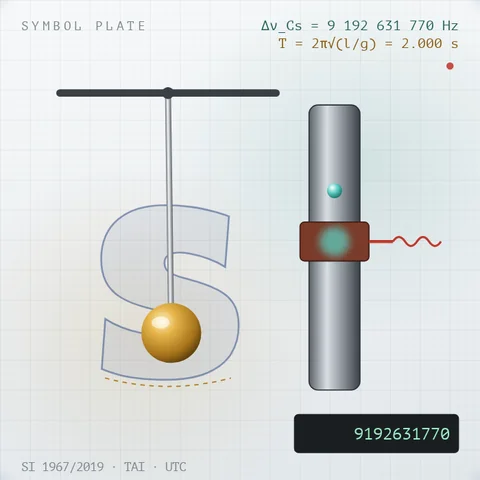
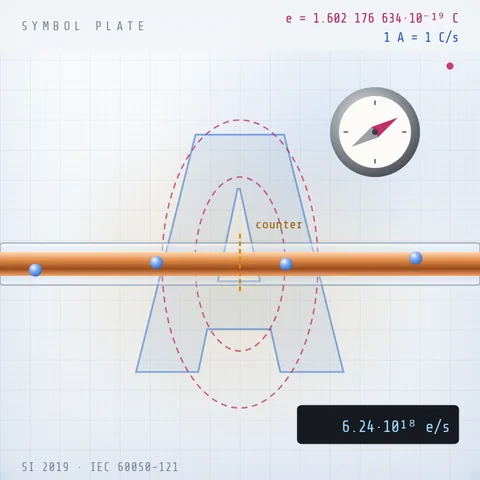
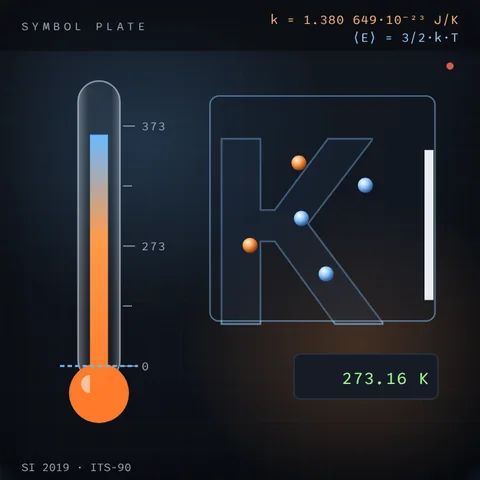
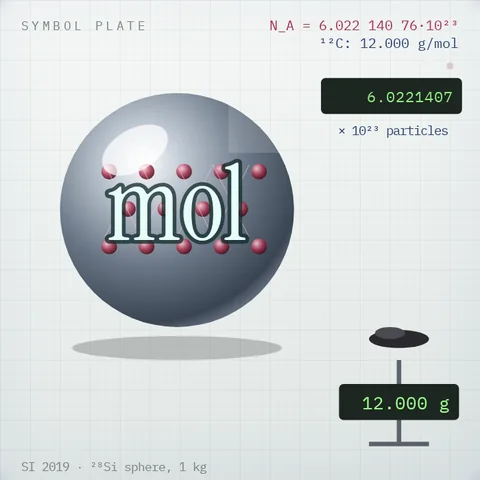
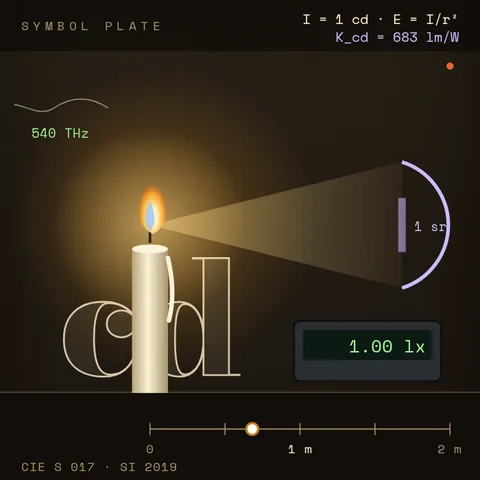
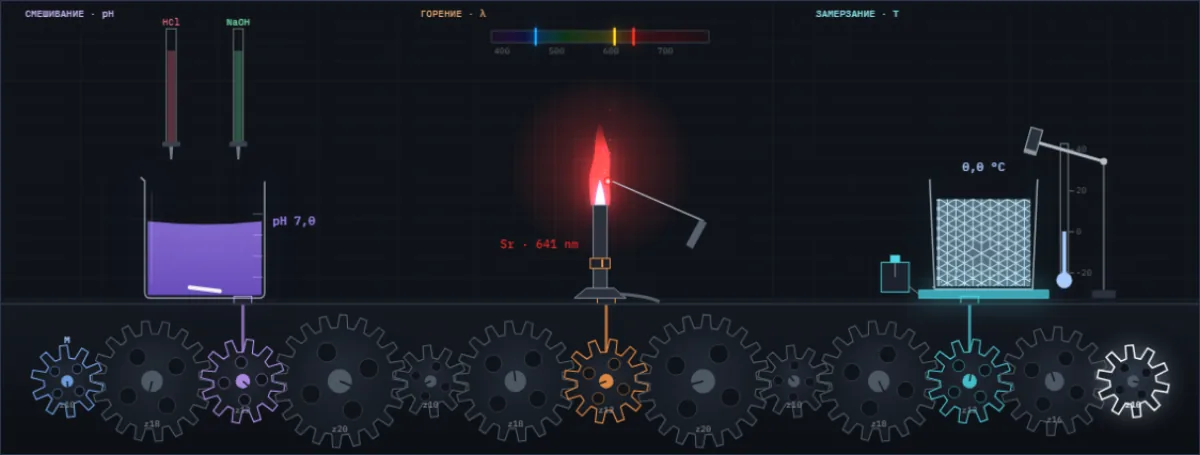
A drop of acid changes the colour of the juice, salt colours the flame, water freezes at a tap. Below them are all Simetrium sheets, by discipline and alphabetically.
Open the index →