¤/Mtok
In March 2023 a million input tokens of GPT-4 cost thirty dollars, and output cost sixty. In autumn 2026 the cheapest models of the big companies, which beat it on benchmarks, charge ten cents for input and fifty for output. That is hundreds of times less, although graphics cards got cheaper only by a few times. Where does the discount come from? And why does an answer still cost five times more than a question at almost every service? The key is in the “Cost price” experiment.
Language models are sold not by the request or by the minute but by the token, and the price is quoted per million. This sheet offers a bill calculator with caching, a batch discount and hidden reasoning, a comparison of the cloud with your own graphics card, an experiment in which a long chat grows costlier quadratically, a lab on caching and reasoning, the traps of tariffs and the bill fields of different services. Prices come from the November 2026 price lists. They change, so any number can be replaced with your own.
Calculator
What your service will cost per month
Pick a model (its prices are filled in and can be edited) and describe one typical request: how many tokens it has, what share repeats and lands in the cache, how much the model answers and how much it silently thinks. The language changes the token count of the same text. Batch mode — the answer within a day for half price.
What a million tokens cost on your own hardware
A GPU is rented by the hour, not by the token, so the price of a token depends on how many of them the card manages to produce. For a single user it writes slowly, for a batch many times more for the same fee. Speed is computed the same way as on the tok/s sheet. Utilisation is the share of the hour that the card actually works.
Etymology
Ransom, notice and Joachim’s valley
The words we use for the bill of a neural network are older than any machine. A price was once payment for guilt, a tariff was the Arabic “notice” of duties, and the dollar is named after a silver mine in Bohemia. The sign ¤ was invented when a symbol for money in general was needed, without a country.
01 · Definition and the long chat
You pay for what is read and what is written
The service charges for every token the model has read and every token it has written. Reading is cheap: all tokens of the request pass through the network in one batch, and the graphics card is fully loaded with work. Writing is expensive: every token of the answer is a separate pass over all the weights, and the card spends most of the time waiting for memory. Hence the price difference — output costs 4–8 times more than input.
The model remembers nothing between messages, so the chat sends it the whole history again every time — and the whole history is paid for again as input. The first turns are almost free, but by the fortieth every question drags tens of thousands of tokens of the past behind it. Move the slider on the right: without a cache the bill grows as the square of the number of turns.
Lab · three experiments with the bill
Cost price, cache and the iceberg of reasoning
“Cost price” shows how an hour of GPU rental is split among the users of a batch and why an answer costs more than a question. “Cache” — a long instruction that the service remembers for a few minutes: is it worth paying for the write. “Reasoning” — what it costs when the model thinks in silence.
03 · Tariff traps
Where the bill departs from the price list
The price per million looks simple, but the final bill is made of multipliers that are not in the heading of the price list. Tap a card: the multiplier is recalculated for the request from the calculator above — the same model, language and tokens.
04 · The bill in code
Where in a service’s response the tokens for the bill are found
Every API response brings along a usage field — how many tokens of what there were. Services name them differently, and it is easy to count the cache twice or to forget the reasoning. Tap a row to read the details.
{code}05 · Writing rules
06 · Neighbouring units
07 · Historical section
The till over six years
In May 2024 DeepSeek of Beijing released the V2 model priced at one yuan per million input tokens — about fourteen cents, roughly a hundred times cheaper than GPT-4 Turbo. The secret was in the design: a mixture of experts, where only a small part of the weights works on each token, and compressed attention with a small cache. A few days later ByteDance, Alibaba, Baidu and Tencent cut the prices of their models several-fold, and some made the junior models free. The Chinese press called it a price war.
The lesson is useful today too: the price per million is not only margin but engineering. How many parameters work per token, how many bits per weight, how much memory the cache eats, how many users share one graphics card — all of it shows in the price. That is why models of the same level cost tens of times differently.
Series · AI
units of language modelsHow a neural network is measured
The price is the result of all the other sheets: it is counted in tokens, grows with context length, falls with server speed and with the number of bits per weight, and reasoning models pay for every hidden token. On the left are the details of one request, where every row leads to its own sheet; on the right are the sheets of the series.
Catalogue of quantities
the whole index →The seven SI base units
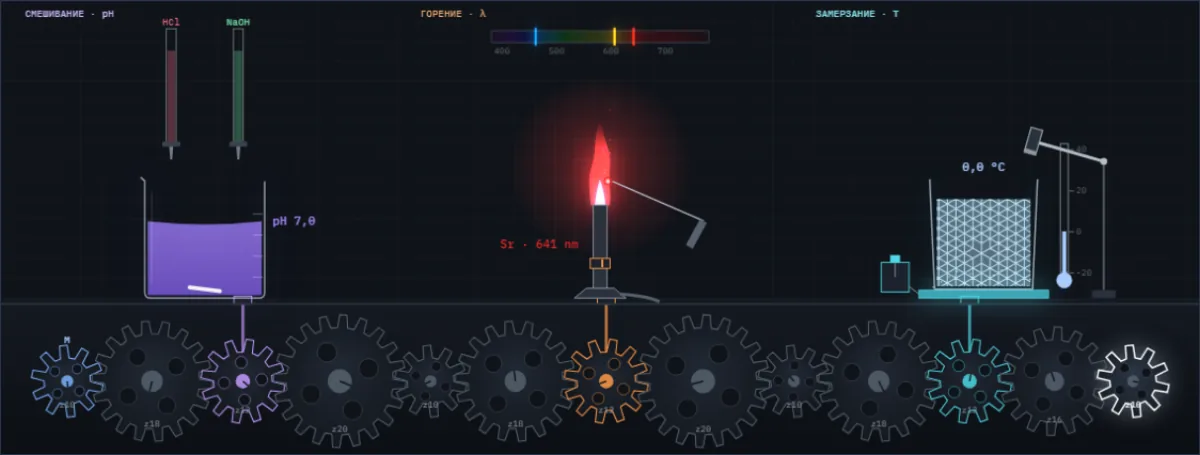
A drop of acid changes the colour of the juice, salt colours the flame, water freezes at a tap. Below them are all Simetrium sheets, by discipline and alphabetically.
Open the index →