SIMETRIUM .COM T · top_p · min_p
EN|36 languages
SYMBOL PLATET = 0.2 … 2.0p ∝ e^(z/T)012012top_p 1.0softmax(z/T) · Boltzmann 1877AAAWgmp1bWIAAAAeanVtZGMycGEAEQAQgAAAqgA4m3EDYzJwYQAAABZcanVtYgAAAEdqdW1kYzJtYQARABCAAACqADibcQN1cm46YzJwYTo0YTE1Y2I3Yi0yMWY0LTRlOGMtODI2NC1iYjVlMDk4MjI3NTAAAAADl2p1bWIAAAApanVtZGMyYXMAEQAQgAAAqgA4m3EDYzJwYS5hc3NlcnRpb25zAAAAALxqdW1iAAAARGp1bWRjYm9yABEAEIAAAKoAOJtxE2MycGEuaW5ncmVkaWVudC52MwAAAAAYYzJzaKpsl7VgyYIEU1E9Ki89hPUAAABwY2JvcqNpZGM6Zm9ybWF0bWltYWdlL3N2Zyt4bWxqaW5zdGFuY2VJRHgseG1wOmlpZDphMWZiNzczYy01ZmMwLTRlNmEtOTIyMS0yMDlhNTgyNmQ1OWNscmVsYXRpb25zaGlwaHBhcmVudE9mAAAB4mp1bWIAAABBanVtZGNib3IAEQAQgAAAqgA4m3ETYzJwYS5hY3Rpb25zLnYyAAAAABhjMnNoyFrkKS8hESq1ZRvCAcO8LgAAAZljYm9yomdhY3Rpb25zgqJmYWN0aW9ua2MycGEub3BlbmVkanBhcmFtZXRlcnOha2luZ3JlZGllbnRzgaJjdXJseC1zZWxmI2p1bWJmPWMycGEuYXNzZXJ0aW9ucy9jMnBhLmluZ3JlZGllbnQudjNkaGFzaFggXTxBkNIdKaE6vnczD9ggdRadgMmRH7khnvGb7ey2WnmkZmFjdGlvbngdY29tLmFudGhyb3BpYy5jbGF1ZGUucHJvdmlkZWRqcGFyYW1ldGVyc6F4H2NvbS5hbnRocm9waWMub3JpZ2luLWNvbmZpZGVuY2VndW5rbm93bmtkZXNjcmlwdGlvbnhmQ2xhdWRlIHByb3ZpZGVkIHRoaXMgZmlsZSBhdCB0aGUgcmVxdWVzdCBvZiBhIHVzZXIgYW5kIG1heSBoYXZlIGNyZWF0ZWQgb3IgbW9kaWZpZWQgdGhlIGZpbGUgY29udGVudHMubXNvZnR3YXJlQWdlbnShZG5hbWVmQ2xhdWRlcmFsbEFjdGlvbnNJbmNsdWRlZPUAAADIanVtYgAAAEBqdW1kY2JvcgARABCAAACqADibcRNjMnBhLmhhc2guZGF0YQAAAAAYYzJzaKZhl//1m/L5sWhI1ixzu3AAAACAY2JvcqVjYWxnZnNoYTI1NmNwYWRMAAAAAAAAAAAAAAAAZGhhc2hYIClm3ID5TVA1JwD1esMBgPavKKyAOijeID7MXvtRe7QZZG5hbWVuanVtYmYgbWFuaWZlc3RqZXhjbHVzaW9uc4GiZXN0YXJ0GR0iZmxlbmd0aBkeBAAAAj5qdW1iAAAAJ2p1bWRjMmNsABEAEIAAAKoAOJtxA2MycGEuY2xhaW0udjIAAAACD2Nib3KlY2FsZ2ZzaGEyNTZpc2lnbmF0dXJleE1zZWxmI2p1bWJmPS9jMnBhL3VybjpjMnBhOjRhMTVjYjdiLTIxZjQtNGU4Yy04MjY0LWJiNWUwOTgyMjc1MC9jMnBhLnNpZ25hdHVyZWppbnN0YW5jZUlEeCx4bXA6aWlkOmYzMDg5ZGQ4LWFjM2QtNDg1YS05MmI5LWRlZjYwNjRjYjU1NHJjcmVhdGVkX2Fzc2VydGlvbnODomN1cmx4LXNlbGYjanVtYmY9YzJwYS5hc3NlcnRpb25zL2MycGEuaW5ncmVkaWVudC52M2RoYXNoWCBdPEGQ0h0poTq+dzMP2CB1Fp2AyZEfuSGe8Zvt7LZaeaJjdXJseCpzZWxmI2p1bWJmPWMycGEuYXNzZXJ0aW9ucy9jMnBhLmFjdGlvbnMudjJkaGFzaFggUjhFXjNayD//hvmOfIBY8+PG/OXqtOlvoroBasxzOL+iY3VybHgpc2VsZiNqdW1iZj1jMnBhLmFzc2VydGlvbnMvYzJwYS5oYXNoLmRhdGFkaGFzaFgg6eJQhKTrZodY2lk8mGeL+BLPTW4T5gn3NQVmsnSFJ2x0Y2xhaW1fZ2VuZXJhdG9yX2luZm+jZG5hbWVvQW50aHJvcGljIEZpbGVzZ3ZlcnNpb25lMS4wLjBrc3BlY1ZlcnNpb25lMi40LjAAABA4anVtYgAAAChqdW1kYzJjcwARABCAAACqADibcQNjMnBhLnNpZ25hdHVyZQAAABAIY2JvctKEWQISogEmGCFZAgowggIGMIIBjaADAgECAhRA5aAK7sI50L64g/oGQgU9Z1UTADAKBggqhkjOPQQDAzBJMRcwFQYDVQQKEw5BbnRocm9waWMsIFBCQzEuMCwGA1UEAxMlQW50aHJvcGljIENvbnRlbnQgQ3JlZGVudGlhbHMgUm9vdCBDQTAeFw0yNjA4MDcxODQzNTZaFw0yODA4MDYxOTQzNTZaMEQxFzAVBgNVBAoTDkFudGhyb3BpYywgUEJDMSkwJwYDVQQDEyBBbnRocm9waWMgQ2xhdWRlIENvbnRlbnQgU2lnbmluZzBZMBMGByqGSM49AgEGCCqGSM49AwEHA0IABJh6CmvLUBgFFNU0vUKlOVtE6djd17L5SuwX0LemFisBM3dkd/3cyjxFA3Qo5S46fX0/ihY0VZ7mfb9KF703t5OjWDBWMA4GA1UdDwEB/wQEAwIHgDAVBgNVHSUEDjAMBgorBgEEAYPoXgIBMAwGA1UdEwEB/wQCMAAwHwYDVR0jBBgwFoAUzlHiBIFOZFsj+OPEz5o+nMHXXMIwCgYIKoZIzj0EAwMDZwAwZAIwMXMdFJ4BetLLVY7ORuE9noqbbAZOZn/aArXyTwFAZfKrPzxF2vPoJNf1+UCdg1XGAjBwX1zd9WGqYkqmL5SFqw1QySjr1zJfpJM9+1rdDwSPLMOPOjKuiXjoU/pUUeG9RwmhY3BhZFkNngAAAAAAAAAAAAAAAAAAAAAAAAAAAAAAAAAAAAAAAAAAAAAAAAAAAAAAAAAAAAAAAAAAAAAAAAAAAAAAAAAAAAAAAAAAAAAAAAAAAAAAAAAAAAAAAAAAAAAAAAAAAAAAAAAAAAAAAAAAAAAAAAAAAAAAAAAAAAAAAAAAAAAAAAAAAAAAAAAAAAAAAAAAAAAAAAAAAAAAAAAAAAAAAAAAAAAAAAAAAAAAAAAAAAAAAAAAAAAAAAAAAAAAAAAAAAAAAAAAAAAAAAAAAAAAAAAAAAAAAAAAAAAAAAAAAAAAAAAAAAAAAAAAAAAAAAAAAAAAAAAAAAAAAAAAAAAAAAAAAAAAAAAAAAAAAAAAAAAAAAAAAAAAAAAAAAAAAAAAAAAAAAAAAAAAAAAAAAAAAAAAAAAAAAAAAAAAAAAAAAAAAAAAAAAAAAAAAAAAAAAAAAAAAAAAAAAAAAAAAAAAAAAAAAAAAAAAAAAAAAAAAAAAAAAAAAAAAAAAAAAAAAAAAAAAAAAAAAAAAAAAAAAAAAAAAAAAAAAAAAAAAAAAAAAAAAAAAAAAAAAAAAAAAAAAAAAAAAAAAAAAAAAAAAAAAAAAAAAAAAAAAAAAAAAAAAAAAAAAAAAAAAAAAAAAAAAAAAAAAAAAAAAAAAAAAAAAAAAAAAAAAAAAAAAAAAAAAAAAAAAAAAAAAAAAAAAAAAAAAAAAAAAAAAAAAAAAAAAAAAAAAAAAAAAAAAAAAAAAAAAAAAAAAAAAAAAAAAAAAAAAAAAAAAAAAAAAAAAAAAAAAAAAAAAAAAAAAAAAAAAAAAAAAAAAAAAAAAAAAAAAAAAAAAAAAAAAAAAAAAAAAAAAAAAAAAAAAAAAAAAAAAAAAAAAAAAAAAAAAAAAAAAAAAAAAAAAAAAAAAAAAAAAAAAAAAAAAAAAAAAAAAAAAAAAAAAAAAAAAAAAAAAAAAAAAAAAAAAAAAAAAAAAAAAAAAAAAAAAAAAAAAAAAAAAAAAAAAAAAAAAAAAAAAAAAAAAAAAAAAAAAAAAAAAAAAAAAAAAAAAAAAAAAAAAAAAAAAAAAAAAAAAAAAAAAAAAAAAAAAAAAAAAAAAAAAAAAAAAAAAAAAAAAAAAAAAAAAAAAAAAAAAAAAAAAAAAAAAAAAAAAAAAAAAAAAAAAAAAAAAAAAAAAAAAAAAAAAAAAAAAAAAAAAAAAAAAAAAAAAAAAAAAAAAAAAAAAAAAAAAAAAAAAAAAAAAAAAAAAAAAAAAAAAAAAAAAAAAAAAAAAAAAAAAAAAAAAAAAAAAAAAAAAAAAAAAAAAAAAAAAAAAAAAAAAAAAAAAAAAAAAAAAAAAAAAAAAAAAAAAAAAAAAAAAAAAAAAAAAAAAAAAAAAAAAAAAAAAAAAAAAAAAAAAAAAAAAAAAAAAAAAAAAAAAAAAAAAAAAAAAAAAAAAAAAAAAAAAAAAAAAAAAAAAAAAAAAAAAAAAAAAAAAAAAAAAAAAAAAAAAAAAAAAAAAAAAAAAAAAAAAAAAAAAAAAAAAAAAAAAAAAAAAAAAAAAAAAAAAAAAAAAAAAAAAAAAAAAAAAAAAAAAAAAAAAAAAAAAAAAAAAAAAAAAAAAAAAAAAAAAAAAAAAAAAAAAAAAAAAAAAAAAAAAAAAAAAAAAAAAAAAAAAAAAAAAAAAAAAAAAAAAAAAAAAAAAAAAAAAAAAAAAAAAAAAAAAAAAAAAAAAAAAAAAAAAAAAAAAAAAAAAAAAAAAAAAAAAAAAAAAAAAAAAAAAAAAAAAAAAAAAAAAAAAAAAAAAAAAAAAAAAAAAAAAAAAAAAAAAAAAAAAAAAAAAAAAAAAAAAAAAAAAAAAAAAAAAAAAAAAAAAAAAAAAAAAAAAAAAAAAAAAAAAAAAAAAAAAAAAAAAAAAAAAAAAAAAAAAAAAAAAAAAAAAAAAAAAAAAAAAAAAAAAAAAAAAAAAAAAAAAAAAAAAAAAAAAAAAAAAAAAAAAAAAAAAAAAAAAAAAAAAAAAAAAAAAAAAAAAAAAAAAAAAAAAAAAAAAAAAAAAAAAAAAAAAAAAAAAAAAAAAAAAAAAAAAAAAAAAAAAAAAAAAAAAAAAAAAAAAAAAAAAAAAAAAAAAAAAAAAAAAAAAAAAAAAAAAAAAAAAAAAAAAAAAAAAAAAAAAAAAAAAAAAAAAAAAAAAAAAAAAAAAAAAAAAAAAAAAAAAAAAAAAAAAAAAAAAAAAAAAAAAAAAAAAAAAAAAAAAAAAAAAAAAAAAAAAAAAAAAAAAAAAAAAAAAAAAAAAAAAAAAAAAAAAAAAAAAAAAAAAAAAAAAAAAAAAAAAAAAAAAAAAAAAAAAAAAAAAAAAAAAAAAAAAAAAAAAAAAAAAAAAAAAAAAAAAAAAAAAAAAAAAAAAAAAAAAAAAAAAAAAAAAAAAAAAAAAAAAAAAAAAAAAAAAAAAAAAAAAAAAAAAAAAAAAAAAAAAAAAAAAAAAAAAAAAAAAAAAAAAAAAAAAAAAAAAAAAAAAAAAAAAAAAAAAAAAAAAAAAAAAAAAAAAAAAAAAAAAAAAAAAAAAAAAAAAAAAAAAAAAAAAAAAAAAAAAAAAAAAAAAAAAAAAAAAAAAAAAAAAAAAAAAAAAAAAAAAAAAAAAAAAAAAAAAAAAAAAAAAAAAAAAAAAAAAAAAAAAAAAAAAAAAAAAAAAAAAAAAAAAAAAAAAAAAAAAAAAAAAAAAAAAAAAAAAAAAAAAAAAAAAAAAAAAAAAAAAAAAAAAAAAAAAAAAAAAAAAAAAAAAAAAAAAAAAAAAAAAAAAAAAAAAAAAAAAAAAAAAAAAAAAAAAAAAAAAAAAAAAAAAAAAAAAAAAAAAAAAAAAAAAAAAAAAAAAAAAAAAAAAAAAAAAAAAAAAAAAAAAAAAAAAAAAAAAAAAAAAAAAAAAAAAAAAAAAAAAAAAAAAAAAAAAAAAAAAAAAAAAAAAAAAAAAAAAAAAAAAAAAAAAAAAAAAAAAAAAAAAAAAAAAAAAAAAAAAAAAAAAAAAAAAAAAAAAAAAAAAAAAAAAAAAAAAAAAAAAAAAAAAAAAAAAAAAAAAAAAAAAAAAAAAAAAAAAAAAAAAAAAAAAAAAAAAAAAAAAAAAAAAAAAAAAAAAAAAAAAAAAAAAAAAAAAAAAAAAAAAAAAAAAAAAAAAAAAAAAAAAAAAAAAAAAAAAAAAAAAAAAAAAAAAAAAAAAAAAAAAAAAAAAAAAAAAAAAAAAAAAAAAAAAAAAAAAAAAAAAAAAAAAAAAAAAAAAAAAAAAAAAAAAAAAAAAAAAAAAAAAAAAAAAAAAAAAAAAAAAAAAAAAAAAAAAAAAAAAAAAAAAAAAAAAAAAAAAAAAAAAAAAAAAAAAAAAAAAAAAAAAAAAAAAAAAAAAAAAAAAAAAAAAAAAAAAAAAAAAAAAAAAAAAAAAAAAAAAAAAAAAAAAAAAAAAAAAAAAAAAAAAAAAAAAAAAAAAAAAAAAAAAAAAAAAAAAAAAAAAAAAAAAAAAAAAAAAAAAAAAAAAAAAAAAAAAAAAAAAAAAAAAAAAAAAAAAAAAAAAAAAAAAAAAAAAAAAAAAAAAAAAAAAAAAAAAAAAAAAAAAAAAAAAAAAAAAAAAAAAAAAAAAAAAAAAAAAAAAAAAAAAAAAAAAAAAAAAAAAAAAAAAAAAAAAAAAAAAAAAAAAAAAAAAAAAAAAAAAAAAAAAAAAAAAAAAAAAAAAAAAAAAAAAAAAAAAAAAAAAAAAAAAAAAAAAAAAAAAAAAAAAAAAAAAAAAAAAAAAAAAAAAAAAAAAAAAAAAAAAAAAAAAAAAAAAAAAAAAAAAAAAAAAAAAAAAAAAAAAAAAAAAAAAAAAAAAAAAAAAAAAAAAAAAAAAAAAAAAAAAAAAAAAAAAAAAAAAAAAAAAAAAAAAAAAAAAAAAAAAAAAAAAAAAAAAAAAAAAAAAAAAAAAAAAAAAAAAAAAAAAAAAAAAAAAAAAAAAAAAAAAAAAAAAAAAAAAAAAAAAAAAAAAAAAAAAAAAAAAAAAAAAAAAAAAAAAAAAAAAAAAAAAAAAAAAAAAAAAAAAAAAAAAAAAAAAAAAAAAAAAAAAAAAAAAAAAAAAAAAAAAAAAAAAAAAAAAAAAAAAAAAAAAAAAAAAAAAAAAAAAAAAAAAAAAAAAAAAAAAAAAAAAAAAAAAAAAAAAAAAAAAAAAAAAAAAAAAAAAAAAAAAAAAAAAAAAAAAAAAAAAAAAAAAAAAAAAAAAAAAAAAAAAAAAAAAAAAAAAAAAAAAAAAAAAAAAAAAAAAAAAAAAAAAAAAAAAAAAAAAAAAAAAAAAAAAAAAAAAAAAAAAAAAAAAAAAAAAAAAAAAAAAAAAAAAAAAAAAAAAAAAAAAAAAAAAAAAAAAAAAAAAAAAAAAAAAAAAAAAAAAAAAAAAAAAAAAAAAAAAAAAAAAAAAAAAAAAAAAAAAAAAAAAAAAAAAAAAAAAAAAAAAAAAAAAAAAAAAAAAAAAAAAAAAAAAAAAAAAAAAAAAAAAAAAAAAAAAAAAAAAAAAAAAAAAAAAAAAAAAAAAAAAAAAAAAAAAAAAAAAAAAAAAAAAAAAAAAAAAAAAAAAAAAAAAAAAAAAAAAAAAAAAAAAAAAAAAAAAAAAAAAAAAAAAAAAAAAAAAAAAAAAAAAAAAAAAAAAAAAAAAAAAAAAAAAAAAAAAAAAAAAPZYQHuR6V8ITjoK/2XwO3F+ygwwxY8pIlsWuqEB/luFM1/cCQOyNfOaS/9abiezzF2TOVdWxGeDCjGZ0zLplEOFUwo=
Letter case
It is written T or τ; in code, temperature; in llama.cpp, --temp. The number has no unit: 0 always gives the most probable token, 1 gives the distribution the model learned, above 1 is bolder, all the way to nonsense.
Do not confuse
Temperature does not make a model smarter or dumber: it only decides how boldly to draw from what the model has already computed. It is not “creativity” and not degrees. And zero does not promise identical answers — why is explained in section 03.
The cast letter T is a thermometer: the column in its stem rises from cold to heat, and the slider in the crossbar moves along a scale from 0 to 2. On the left are six probability bars: in the cold the leader takes almost everything, in the heat the bars even out. On the right is the sampling roulette — a golden sector for the leader and a blue one for the second word; the pointer spins and picks. Along the bottom run the finished tokens of the answer.
Unit passport · AI series · boldness of choice

T

Sampling temperature
pᵢ = e^(zᵢ/T) / Σⱼ e^(zⱼ/T) · T → 0: greedy · T = 1: as trained

In September 2025 the lab Thinking Machines asked the open model Qwen3-235B a thousand times in a row to tell about the physicist Richard Feynman. The temperature was set to zero — at which the model must take the most probable word every time, so all one thousand answers should have matched letter for letter. Only the first 102 tokens matched. At the 103rd, in 992 answers Feynman was born in “Queens, New York”, and in eight, in “New York City”. In all, there were 80 different texts. Where does randomness come from when it has been switched off? The answer is in section 03.

A language model does not write a word all at once: it gives a score — a logit — to each of the tens of thousands of tokens in its vocabulary. To pick one, the logits are divided by the temperature and turned into probabilities, and then a lot is drawn. A small T widens the gap between the leader and the rest; a large one smooths it. This page has a roulette for your own logits, a translator of settings between six services, a text generator with top_k, top_p and min_p cut-offs, the Boltzmann physics the formula itself came from, and an analysis of why zero is not zero.

What it is
the divisor of the logits before softmax: how boldly the model picks the next token
Notation
T, τ; temperature; in Chinese 温度
Dimension
dimensionless; in physics the same formula with kT in joules
Range
OpenAI, Gemini and DeepSeek — 0 to 2; Anthropic — 0 to 1; local runs — no upper limit
Typical values
0 — data extraction · 0.15 — Mistral Small 3 · 0.6 — Llama 3.1, Qwen3, DeepSeek-R1 · 1.0 — gpt-oss, Gemma 3, Gemini 3
References
Boltzmann, 1877 · Ackley, Hinton, Sejnowski, 1985 · Holtzman et al., 2019 (top_p)
Calculate your logits Find the settings Why zero is not zero
Calculator
Tool · logit roulette

What temperature will do to your options

Enter candidates and their logits separated by semicolons. The logprobs from an API response will do as well: softmax does not change if you add the same number to all logits, and a logprob is a logit minus a common constant. Then set the temperature and cut-offs — you will see how likely each option is to come up, and how often a long answer will turn off the most probable path.

optionT = 1at Tresult
Tool · settings translator

One task — six services

The same number means different things in different services. Anthropic’s scale ends at one, DeepSeek quietly multiplies your temperature by 0.3, and the transformers library does not notice it at all without the do_sample flag. Pick a task and a service — you get the parameters and a ready code snippet.

Task
Service

Task temperatures are an editorial recommendation on the model’s own scale, where 1 is the distribution it learned. Service figures come from their documentation: ranges, defaults and the DeepSeek-V3 rescaling.
Etymology

Mixture, specimen and soft maximum

The word “temperature” came into neural networks not from meteorology but from statistical physics: the token-choice formula is literally the Boltzmann distribution, with the logit of opposite sign in place of energy. And temperature itself once meant not degrees but the right proportion of a mixture.

temperatureLat. temperatura
temperare · to mix→measure of a mixture→T in softmax
Latin temperare means “to mix in due measure, to moderate”; from it also comes “temperament”, a mixture of the four humours of the body. Temperatura first meant the right proportion, then a degree of warmth. In 1985 Hinton and colleagues took the physical word for their Boltzmann machine, and it passed into language models.
samplingEng. sampling
exemplum · specimen→essample · sample→sampling
Latin exemplum, “taken out”, came through Old French essample into English sample — a specimen taken from a lot. Sampling is drawing a specimen at random but by the rules of probability. The opposite is greedy decoding, “greedy” choice: always take the leader.
softmaxBridle, 1989
max · winner→soft · gently→shares for all
The British engineer John Bridle gave this name to a function that does not declare a single winner, as max does, but hands out shares to everyone by the exponential of the score. As T → 0, softmax turns into a hard max; as T → ∞, into equal shares.
What it is called in other languages
温度 wēndù — Chinese; 温度 ondo — Japanese; 온도 — Korean
temperatura — Spanish, Portuguese, Italian; température, Temperatur
درجة الحرارة — Arabic; तापमान — Hindi; temperatur — Mongolian
Almost everywhere the everyday word “temperature” is used, not a physics term — in documentation and in interfaces alike.
Abbreviations nearby
top_kkeep the k most probable tokenstop_pnucleus sampling: keep the leaders until their sum reaches pmin_pdrop everything more than 1/min_p times weaker than the leadergreedygreedy choice, same as T = 0logprobnatural logarithm of a token’s probability
01 · Definition and a cup of something hot
Interactive · next word
«It’s cold. I’ll pour myself a cup of hot …»
Temperature

The model scores, the draw decides

At each step the model outputs one number — a logit — for every token in the vocabulary. Logits are not probabilities by themselves: they are scores and can be negative. The softmax function raises e to the power of each score and divides by the sum — giving shares that add up to one. Temperature sits in the denominator of the exponent: the logits are divided by T before exponentiation.

Dividing by a number below one stretches the gap: for a leader ahead by 0.3 at T = 0.1 the lead becomes threefold, and the exponential gives it almost everything. Dividing by a number above one squeezes the gap, and even “asphalt” gets a chance in the cup. Move the slider on the left and pour some cups: at zero all twenty will be tea.

z — logits · T — temperature · p — probabilities · H — entropy, bits · E — level energy · k — Boltzmann constant
Reference · benchmark values
T = 0greedy choice: always the token with the highest logit T = 1the distribution unchanged — the one the model learned × ehow many times likelier a token whose logit is higher by T is — at any T T → ∞all tokens equally likely: from a vocabulary of 200 000 — pure noise
Lab · three experiments with a draw

Generator, cut-off and Boltzmann gas

“Generator” is a tiny language model that has learned the word pairs of this page right in your browser and writes text with the settings you choose. “Cut-off” shows the distribution after one word and which options top_k, top_p and min_p cut away. “Boltzmann” is a vessel of particles on six energy levels: at the same temperature they settle exactly by the same formula as tokens.

Temperature
top_k
top_p
min_p
After word

Chart · leader and spread
How temperature splits one cup
The same twelve options as in section 01. The golden curve is the share of the leader “tea”, the blue one is how many options are really in play: two to the power of the entropy. The vertical line is the temperature from the lab. Up to 0.3 the choice is almost greedy; after 1 the spread grows more slowly than it seems.
Chart · what the authors recommend
Recommended temperature by model card
Developers of open models state in the description which settings the model works best with. The spread is noticeable: Mistral Small 3 is advised to be kept almost cold, while gpt-oss and Gemma 3 are advised to sit at one. The caption on the right gives the accompanying cut-offs.
02 · Orders of magnitude · sampling temperature T

dimensionless, logarithmic scale

03 · Why zero is not zero

A thousand answers at T = 0

At zero temperature there is no sampling: the model takes the leader. But the leader is determined by logits, and logits are sums of millions of products computed by a graphics card. Adding floating-point numbers depends on the order: (0.1 + 10²⁰) − 10²⁰ gives 0, while 0.1 + (10²⁰ − 10²⁰) gives 0.1. The server bundles your request into a batch with other people’s, and the batch size decides the order in which the kernels add the numbers. When two tokens have almost equal logits, a tiny difference in the last digit changes the winner — and after that the answers diverge for good.

Token number in the answer
From the Thinking Machines report: Qwen3-235B-A22B-Instruct, 1000 answers of 1000 tokens each, T = 0. What is reliable: the divergence beginning at the 103rd token, the 992 / 8 split and the result — 80 different answers, the most frequent repeated 78 times. The intermediate branchings are drawn schematically.

Order of addition · float64
(0.1 + 1e20) - 1e2000.1 + (1e20 - 1e20)0.10.1 + 0.20.30000000000000004
What to do if you need reproducibility
Locally — run one request at a time or with a fixed batch: then the order of addition does not change.
Since 2025, vLLM and SGLang have modes with batch-invariant kernels: slower, but 1000 out of 1000 are identical.
In an API — pass a seed where there is one, and store the answer: OpenAI promises reproducibility with a seed “as far as possible”, but does not guarantee it.
04 · Temperature in code

One word, eight behaviors

The parameter is called almost the same everywhere, but defaults, limits and the order of cut-offs differ between programs. The main traps are transformers without do_sample, a different scale in DeepSeek, and the reverse order of cut-offs in llama.cpp. Tap a row to read the details.

toolparameterdefault

For work · three snippets

Recompute logprobs from an API response for another temperature; turn on sampling with min_p in transformers; put temperature last in the llama.cpp chain.

05 · Writing rules
Correct
Incorrect
06 · Neighbouring units
07 · Historical section

From gas in a vessel to a chatbot

annealing · 1983
slow cooling
Note

Temperature entered computing before neural networks. In 1983 the IBM physicists Scott Kirkpatrick, Daniel Gelatt and Mario Vecchi invented simulated annealing: searching for the best solution to a problem the way a smith anneals metal. At first it is “hot” — the algorithm accepts even worse steps in order to jump out of a pit. Then the temperature is slowly lowered, and the system freezes into a good solution. This is how microchips were laid out on a die and travelling-salesman routes were planned.

In language models temperature is usually not lowered during an answer, but the idea is the same: heat means variety and risk, cold means reliability and repetition. Try the “Cool slowly” button in the “Boltzmann” experiment: the particles gather on the lowest level, like metal that has set without cracks.

e^(−E/kT)
level occupancy
Series · AI
units of language models

How a neural network is measured

Temperature is the last step before the word: the model with its parameters has already computed the logits over the whole context, and temperature decides how a token is drawn from them. It also changes the entropy of the answer, and so its perplexity. On the left is the information about one request, where each row leads to its own page; on the right are the pages of the series.

usage · one request
Catalogue of quantities
the whole index →
the foundation · 7 units

The seven SI base units

on the sheet’s topic · model training and AI
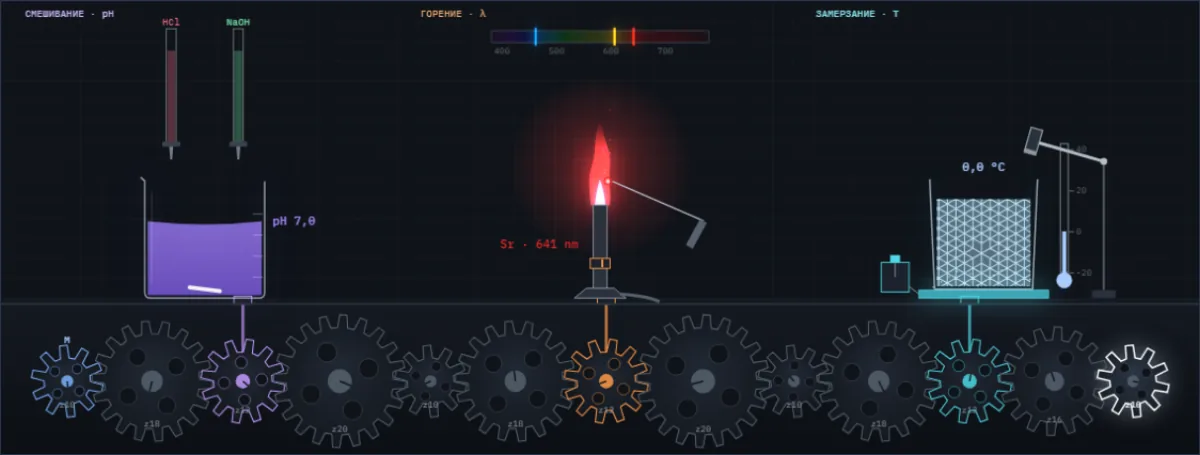
The index lab: a glass of cabbage juice, a burner, a glass of water on a cold plate and a gear train
Index · all quantities on one page
The lab at the entrance to the index

A drop of acid changes the colour of the juice, salt colours the flame, water freezes at a tap. Below them are all Simetrium sheets, by discipline and alphabetically.

Open the index →
08 · Your language
every link is a real page in that locale

Read it in your own language

translated and checkeddraft translationqueued