SpO₂ is written with a capital S and O, a lower-case p and a subscript 2: S stands for saturation and p for pulse, that is, saturation measured by a pulse oximeter. The letters in front matter: SaO₂ is the same quantity measured in arterial blood by an analyser, ScvO₂ is measured in central venous blood, and their numbers differ.
Saturation is the fraction of haemoglobin that carries oxygen, not the amount of oxygen in the blood: in anaemia SpO₂ can be 99 % while the tissues are short of oxygen. Nor is it the partial pressure PaO₂ in mmHg, which is linked to saturation by an S-shaped curve and is about 90 mmHg at 97 %.
On the left a fingertip with its nail is clamped between the LEDs and a photodiode: red 660 nm and infrared 940 nm light flash in turn and pass through the finger, while the artery inside pulses in time with the heart. On the right a pulse wave sweeps across the small screen and a beat marker blinks, and the slider on the scale below comes to rest at 97 % — the usual saturation of a healthy person at sea level.
Quantity data sheet
oxyhaemoglobin fraction · pulse sheet 1/1 · rev. 2026-09Pulse oximetry SpO₂ · % · min⁻¹
Dimensionless quantity · fraction of oxyhaemoglobin in pulsatile arterial blood, %; pulse rate in beats per minute
Two lights that see right through the blood
In 1972 Takuo Aoyagi, an engineer at the Tokyo firm Nihon Kohden, was trying to measure cardiac output from the way a dye is diluted in the blood, and he was annoyed by an artefact: the signal of light passing through the ear wavered in time with the pulse. He realised that this wavering was a gift — only arterial blood pulsates, so if you look only at the fluctuating part of light of two colours, skin, bone and veins drop out of the calculation by themselves.
That is how the pulse oximeter came about — a clip that shows within seconds what percentage of the haemoglobin in the arteries is carrying oxygen. By the end of the 1980s it had become mandatory in anaesthesia, and in the 2020 pandemic it became a home device for millions of people — and it then emerged that in people with dark skin it more often shows a normal value when oxygen is already low.
This sheet passes light through a finger, shows how two pulse waves turn into a percentage, and examines where the error comes from and what regulators are doing about it.
01 · Definition
two lights · ratio R · calibrationSpO₂ is the fraction of oxyhaemoglobin among the haemoglobin able to carry oxygen, measured from light that has passed through tissue. Oxyhaemoglobin is bright red and absorbs little red light at 660 nm but more infrared at 940 nm, while reduced haemoglobin does the opposite; the ratio of the two absorptions tells how much of the haemoglobin is carrying oxygen.
To exclude skin, bone and venous blood, the device takes only the pulsatile part of the signal, AC, and divides it by the constant part, DC, for each colour, then divides the red ratio by the infrared one. The result is a dimensionless number R, the “ratio of ratios”, and the larger it is, the lower the saturation.
Light scatters in a finger in too complex a way for the percentage to be derived from R by theory, so the relationship is found by experiment: volunteers breathe a gas mixture low in oxygen, arterial blood is sampled, and the “R — SaO₂” points form a calibration curve stored in the device. In simplified form it is close to the straight line SpO₂ ≈ 110 − 25·R.
What the device sees and what it does not
On the left is a real fingertip pulse oximeter on a finger whose skin is coloured according to the Monk scale: the screen on the top cover shows saturation and pulse, and a cutaway in the housing shows how the red and infrared LEDs take turns shining through the fingertip, above the pulsing artery, to the photodiode. On the right is a bedside monitor with the two pulse waves as the photodiode sees them: their amplitude is AC and their offset is DC. The sliders set the true arterial saturation, skin pigmentation, perfusion and pulse; the device shows its own number, and the sheet compares it with the truth.
Calibration on light-skinned volunteers
Melanin absorbs red light considerably more strongly than infrared, so in dark skin less red light reaches the pulsing artery and comes back, and the signal becomes weaker and biased. If the calibration curve was built mainly on light-skinned volunteers, the device does not account for this bias and overestimates saturation, most of all at low values, where the error is most dangerous. In 2020 a study in NEJM showed that occult hypoxaemia — a true SaO₂ below 88 % with SpO₂ of 92—96 % — occurred three times as often in Black patients as in white patients.
02 · Conversion
curve · accuracy · altitudeFrom per cent to oxygen pressure
Enter a saturation, a partial pressure of oxygen or a ratio R, and the sheet converts them into one another along the haemoglobin dissociation curve, shows the range in which the true SaO₂ lies given the permissible device error, and what saturation to expect at altitude.
A rule to remember: 90 % saturation is about 60 mmHg of oxygen, and below this point the curve falls away steeply.
Carbon monoxide binds haemoglobin as carboxyhaemoglobin, which at 660 nm looks almost like oxyhaemoglobin, so in poisoning a pulse oximeter shows a normal 98 % even though the blood is short of oxygen. Methaemoglobin, by contrast, pulls the reading towards 85 % whatever the true saturation; in both cases only the CO-oximeter of a blood gas analyser gives the truth.
| {k} | {v} | {note} |
{text}
04 · Measuring instruments
ear · clip · watch · CO-oximeterFour ways to see the colour of blood
A device for pilots without an oxygen mask
During the war Glenn Millikan built an ear oximeter to warn pilots of oxygen shortage at altitude. The earlobe was warmed so that the blood in it became almost arterial, and the device compared red and green light; it worked, but it was temperamental and had to be calibrated on each person, because nobody yet knew how to isolate the pulsatile part of the signal.
Aoyagi's clip
In the clip two LEDs switch on alternately, sometimes with a pause in which the photodiode measures the ambient light of the room, so the device receives three signals hundreds of times a second. From the red and infrared waves it extracts the pulsatile parts, computes R, averages it over several seconds and converts it into per cent using the calibration table, while the period of the wave gives the pulse rate.
Light that does not pass through
A watch cannot shine light right through the wrist, so the LED and the photodiode sit side by side and the device catches light scattered back from under the skin. Pulse rate is measured this way reliably, usually with green light, but saturation is less accurate: the signal is weaker, the wrist moves, and most such devices are not medical devices.
The reference against which the clip is judged
In a blood gas analyser arterial blood is haemolysed, placed in a cuvette and illuminated at dozens of wavelengths, so the instrument distinguishes oxyhaemoglobin, reduced haemoglobin, carboxyhaemoglobin and methaemoglobin separately. Its SaO₂ is the truth against which pulse oximeters are calibrated and tested, and in doubtful cases a doctor takes arterial blood rather than trusting the clip.
05 · Writing rules
Sp and Sa · percent · oxygenThe letter before O₂ names the device
Saturation is written with the designation of its source, a whole number of per cent and the conditions — whether the person is breathing room air or receiving oxygen.
The first line on the right loses the letter case, the subscript and the per cent sign, the second confuses saturation with oxygen pressure, and the third puts an equals sign between the clip and the blood gas analyser, although the permissible device error is several per cent. The fourth calls the fraction of occupied haemoglobin an amount of oxygen, the fifth credits the device with a precision to tenths that it does not have, and the sixth gives the pulse in hertz, although 72 beats per minute is 1.2 Hz.
06 · Neighbouring units
pressure · wavelength · frequencySpO₂ is surrounded by the millimetre of mercury, in which the oxygen pressure in blood is measured, the nanometre — the wavelength at which the haemoglobins differ in colour — and beats per minute, which the same device counts from the pulse wave.
Linked to saturation by the S-shaped haemoglobin dissociation curve.
660 and 940 nm are chosen where the haemoglobins differ most.
Pulse rate from the period of the pulse wave, the same rate as the heart's.
07 · Historical section
archive · from earlobe to FDAHow an artefact became the main signal
{title}
{text}
How often the device missed a lack of oxygen
Bar height is the share of measurement pairs in which SpO₂ was 92—96 % while the true SaO₂ was below 88 %, in white and Black patients in the study by Sjoding et al., NEJM 2020; the scale runs from zero to 12 %. The frame goes round the bars.
A threefold difference with the same number on the screen — and it was after this study that regulators revised the testing requirements.
A device calibrated on people
A pulse oximeter has no standard that can be placed in the clip: the calibration curve for each model is recorded on living people who are gradually deprived of oxygen in a laboratory while arterial blood is drawn from them at the same time. The ISO 80601-2-61 standard requires at least ten healthy volunteers and several hundred pairs of points in the range from 70 to 100 %, and accuracy is expressed as the root-mean-square difference Arms: regulators allow no more than three to four per cent.
The weak point turned out to be who those ten people were. The old rules required only a few volunteers with dark skin, so devices that passed testing were barely checked on them; the average error for the whole group looked small, and a systematic bias affecting some of the people disappeared in it.
After the studies of 2020—2022 the FDA convened an advisory panel and proposed testing devices on people across the whole range of pigmentation, assessing it objectively by skin colour rather than by questionnaire, and reporting accuracy separately for each group. For the first time a question of fairness became a question of metrology: who the calibration was made for.
The seven SI base units
Catalogue of quantities
Medicine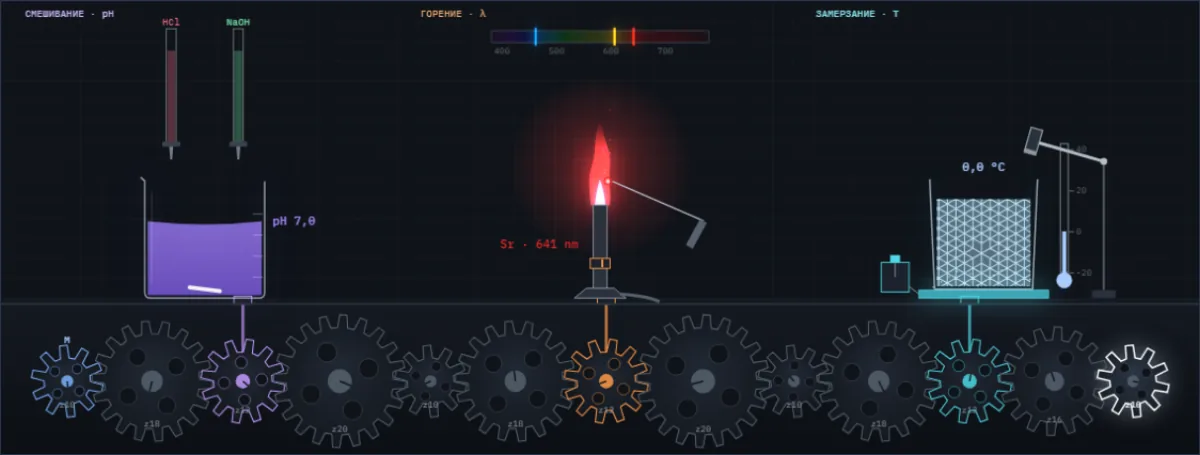
A drop of acid changes the colour of the juice, salt colours the flame, water freezes at a tap. Below them are all Simetrium sheets, by discipline and alphabetically.
Open the index →