TEU
Stand two twenty-foot containers end to end and put a forty-footer next to them. You would expect the lengths to match, but the pair turns out seventy-six millimetres shorter. There is no mistake: the twenty-foot container was deliberately made an inch and a half shorter than twenty feet, so that two such boxes, together with the gap for the connecting locks, fit exactly into the slot of one forty-footer. Thanks to this gap they can be stacked mixed together, and a ship, a train and a warehouse can all be counted in one unit: the TEU.
A twenty-foot equivalent unit is the space for one standard container twenty feet long and eight feet wide. It is how ship capacity, port throughput and the capacity of yards and trains are counted, and almost all the world's trade in manufactured goods is recorded in this unit: about ninety percent of everything that is not poured into tankers or heaped into bulk carriers travels in steel boxes. A forty-foot container counts as two TEU, a forty-five-footer usually as two and a quarter, and the twenty-footer itself as exactly one, whether it is a dry van, a reefer or a tank.
Conversion
Boxes to TEU, volume and tonnes
Enter the number of containers and choose their type. On the right you will see how many TEU and FEU that is, how many cubic metres there are inside, how much cargo the plate allows you to load, and how much ground the boxes take up if they are stood in a single tier.
Every container checks its own number
On the door of every container there is a large number of four letters and seven digits, and the last digit, drawn in a frame, is calculated from the others. If a storekeeper gets even one letter wrong, the terminal software spots the trouble at once. Type in a number from a door or make up your own.
Etymology
Box, foot and equivalent
The name of the unit is put together from three words, each from its own world: one from Latin, another from an old English measure, the third from the language of accountants. It is curious that in the metric world, which has long measured in millimetres, containers are still named by the foot.
01 · Definition and the whole fleet
Eight feet that changed the world
Everything in the container world rests on four corner fittings, steel castings with oval openings welded to every corner of the box. The standard fixes their positions to the millimetre, and that is why one and the same spreader lifts a reefer and a tank, and a twistlock fastens a box in the same way to a ship's deck, a railcar and a truck chassis. All sea containers have one width, eight feet; the length varies but in multiples, and the height grows: from eight feet on the very first ones to nine and a half on today's high cubes.
TEU counts slots, not cargo. Any twenty-foot box is one TEU, a forty-footer two, and it makes no difference whether it holds three tonnes of pillows or twenty-six tonnes of tiles. That is why a ship's capacity in TEU is always larger than the number of loaded boxes it can carry: if each were loaded with fourteen tonnes, the biggest ship in the world would sink to her load line having filled only some of the slots.
Where the ordinary forty-footer went
In the eighties the ordinary forty-foot container was the king of the ocean lines, and today hardly any new ones are built. The key is that most of the goods sailing from Asia are light: trainers, jackets, furniture, toys, household appliances. Such cargo fills the box to the ceiling long before it reaches the permitted tonnes, and every extra centimetre of height turns into money. A high cube is a foot taller, holds thirteen percent more, weighs only about a hundred and fifty kilograms more and costs almost the same to build. The carrier charges the same rate or nearly so, the crane lifts it with the same spreader, and the ship puts it in the same slot.
Heavy cargo, meanwhile, goes into twenty-foot boxes, because the twenty and the forty have one plate: about thirty tonnes gross. In this arrangement the ordinary forty-foot container simply has no work left. You can still meet it where roads or tunnels will not let through the extra thirty centimetres, but fleet owners order almost nothing but high cubes. Check it yourself in the Cargo experiment: move the density, and you will see for which cargoes the tall box wins and for which its height is wasted.
Twelve boxes on one platform
Choose a type and a container appears on the platform in isometry, with real markings, a plate and dimensions. Note that all of them, except the American 53′, stand on the very same corner fittings.
Load it, deliver it, stack it
In the Cargo experiment, change the density of the goods and watch what limits each box, volume or mass, and which one pays better. In the Road experiment, send a container by truck along the roads of eight countries and find out how much cargo it may be loaded with and whether the rig will pass under a bridge. And in the Terminal experiment, choose a machine, raise the stack and touch any box to see how many neighbours will have to be moved before the crane can reach it.
02 · Evolution of ships
From fifty-eight boxes to twenty-four thousand
In seventy years the capacity of the largest container ship has grown more than two hundred times, and its length only two and a half times. Ships ran up against quays about four hundred metres long and began to grow wider, row after row, and taller, tier after tier. Move the slider through the years, and on the canvas the ship of each era will stand at the same scale as the earlier ones. On the right you can see how many rows of containers fit across the hull and how far today's giants have gone beyond the dashed line of the old Panama Canal.
For the early ships the capacity has been converted to TEU approximately: boxes 35 feet long were carried then, and ships were compared by the number of slots for them.
03 · Country limits
Where the box gets stopped
The container is the same all over the world, but the roads are not. The plate on the door allows about thirty tonnes gross, but it is not the plate that decides: it is the law of the country the truck will drive through, and the bridges over that road. So the very same forty-foot container is hauled almost full in China and under-loaded by a third in the USA, and forwarders keep a whole map of limits in their heads. Choose a country and see what awaits the box on the road, on the railway and in the port.
Two tiers on a train make the carriage of each box almost half as dear, but they need clearance under bridges and wires of about six and a half metres. That is why on the electrified lines of Europe and Russia containers travel in a single tier, while in North America, where diesel locomotives pull the trains, they travel in two.
Since 1 July 2016 the SOLAS rule has applied worldwide: without a confirmed gross mass, the VGM, a box is not loaded onto a ship. It was introduced after accidents in which tonnes missing from the paperwork broke stacks and even hulls. The width of ships is limited by locks: the old Panama ones let through thirteen rows, the new ones since 2016 twenty, and the Suez Canal has no locks at all.
04 · What moves the boxes
Machines that grab by the corners
Not one of these machines lifts a container with slings, the way ordinary cargo is lifted. All of them lower a spreader onto the roof of the box, a frame with four twistlocks, and grab it by the corner fittings. That is why a container is lifted equally fast from the quay, from a stack, from a railcar and from a truck, and the whole chain from a factory in Shenzhen to a warehouse in Hamburg needs not a single docker.
05 · Writing rules
06 · Neighbouring units
07 · Historical section
Before the container, a ship stood in port longer than it sailed. Dockers carried cargo from the hold to the quay one sack and one crate at a time, and loading a cargo steamer took a week. Malcom McLean, the owner of a trucking firm from North Carolina, once waited several hours in a queue at the quay and thought it would be simpler to lift the whole truck body onto the ship. In 1956 he did just that, and the cost of loading a tonne fell almost forty-fold.
But the real revolution came when the boxes of different companies became identical. The engineer Keith Tantlinger, who worked for McLean, invented the corner fitting and the twistlock, and McLean gave the patents to the industry so that a common ISO standard could be built on them. Since then any container fits any crane, railcar and ship on the planet, and shipping a refrigerator across an ocean costs less than bringing it home from the shop.
Catalogue of quantities
the whole index →The seven SI base units
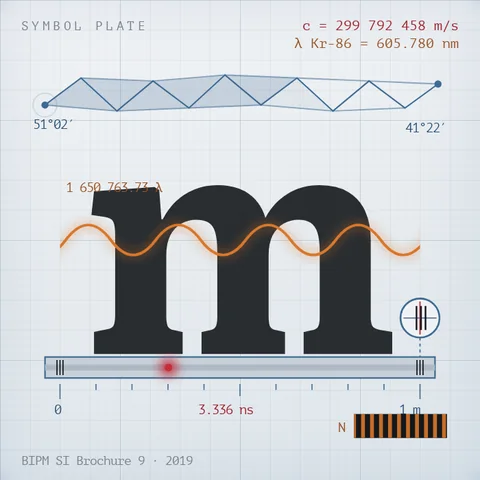
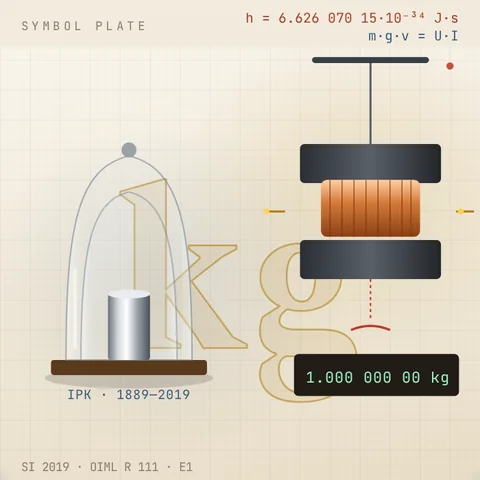
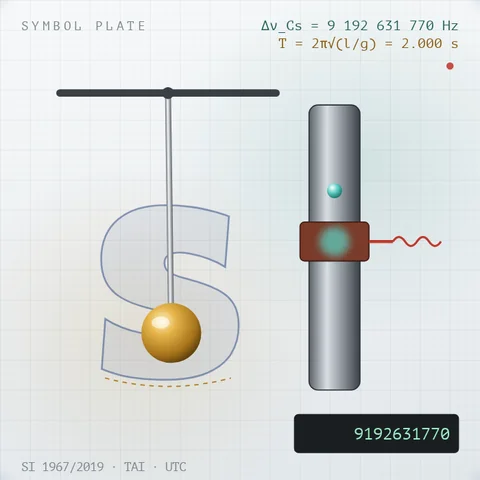
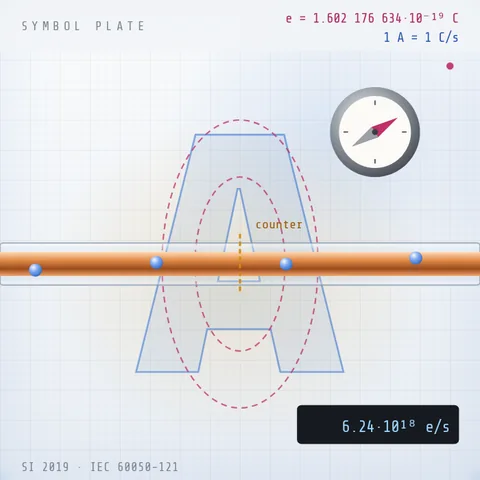
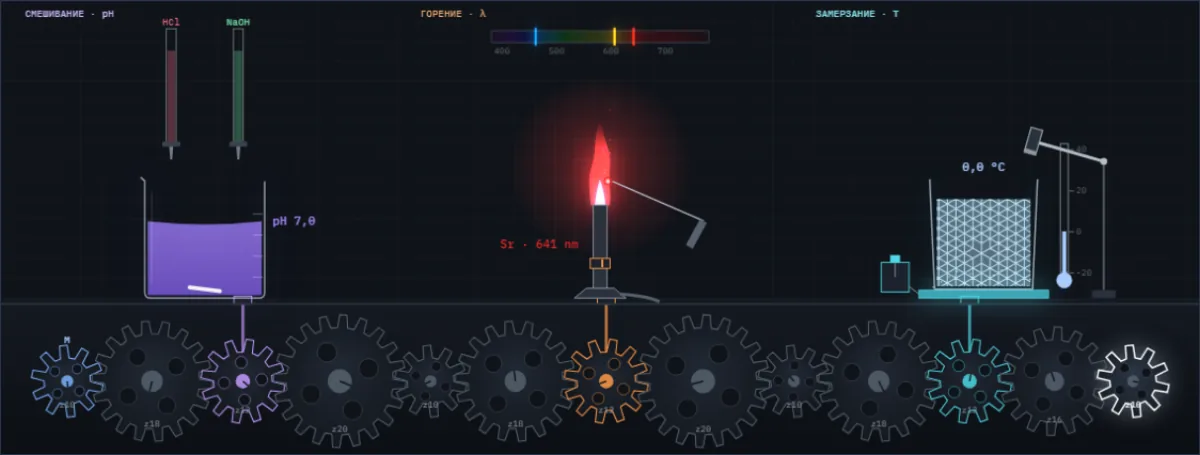
A drop of acid changes the colour of the juice, salt colours the flame, water freezes at a tap. Below them are all Simetrium sheets, by discipline and alphabetically.
Open the index →