The radial growth rate of a colony is written with a capital K and a subscript lowercase r: Kr. The unit is millimetres per day, mm/d. For fast fungi, µm/h or mm/h is used. The day is written with a lowercase d; it is a non-SI unit of time accepted for use with the SI.
Kr — the speed of the colony edge, not a gain in mass. A dense and a sparse colony can spread equally fast while their mass differs. Nor should it be confused with the specific growth rate μ in h⁻¹: that tells how many times the biomass increases per hour. Kr and μ are related, but they are different quantities.
A white colony grows on amber agar in a Petri dish. Its edge spreads in a circle, and the hyphal tips on the rim quiver. Once a day a blue marker line with the day number appears on the bottom of the dish. A tick runs along the ruler from the centre and reaches the 32 mm mark. On the right the column in the thermometer wavers, and a green dash marks the optimum temperature. A glare moves across the glass of the lid.
Quantity data sheet
mycology rev. 2026-10Mycelium growth Kr, mm/d
Derived unit · quantity: radial growth rate of the colony, mm/d = 1.16·10⁻⁸ m/s
Why a mycelium grows in a circle at a constant speed
A technician puts a piece of mycelium in the centre of a Petri dish. Every morning he turns the dish over and traces the colony edge on the bottom with a marker. After a week the bottom shows a target of rings. The gaps between the rings are almost equal: the colony adds the same number of millimetres to its radius every day.
This is odd if you remember bacteria: their number doubles and growth gets faster and faster. A mycelium is built differently. Only the hyphal tips at the colony edge grow, while the inner part merely supplies them with food. The width of this growing rim is constant, so the edge moves at a constant speed.
The edge speed Kr depends on the species of fungus, the medium and, most of all, the temperature. Every species has a lower limit, an optimum and an upper limit. At 24 °C the button mushroom adds about 3 mm a day, the oyster mushroom at 27 °C about 8 mm. The mould Neurospora covers more than 4 mm an hour at 35 °C and fills the dish in less than a day.
01 · Definition
colony edge · lag · temperatureKr — the distance the colony edge moves in a day. It is found from two marks: the difference of the radii is divided by the time between them. The first hours after inoculation are not counted. This is the lag phase: the mycelium gets used to the new medium and the edge hardly moves.
After the lag the radius grows along a straight line until the colony reaches the dish wall or the food runs out. The slope of this line is Kr. In 1971 the British mycologist Anthony Trinci showed that Kr equals the width of the growing rim multiplied by the specific growth rate μ.
The dependence of Kr on temperature is a hump-shaped curve. Below the minimum the fungus does not grow. From the minimum to the optimum the speed rises smoothly, and beyond the optimum it quickly falls to zero. These three points are called the cardinal temperatures. They are determined for each species.
Trace the colony with a marker and find its speed
At the top is a Petri dish with the chosen fungus and the incubator. Time runs in days, and the display is sped up. The “Mark” button puts a marker ring on the bottom along the current colony edge, as a technician does. The last two rings give Kr. The temperature slider moves the incubator, and the medium slider sets its richness. Emerald shows growth, indigo the marker marks, brick red a temperature beyond the limit of growth. Below there are three views. “Dish” is the colony and rings from above. “Radius” is the radius against time: the lag phase and a straight line with the slope Kr. “Temperature” is Kr against temperature for all four fungi, and the dot shows the incubator.
Warmth speeds growth until it starts to destroy the cell
As the temperature rises, the enzymes in the hyphal tip work faster and the colony edge speeds up. But the fungal proteins withstand heat only up to a certain limit. Beyond the optimum some of the enzymes lose their shape, and growth slows down sharply rather than smoothly. Set the oyster mushroom to its optimum and then press “+5 °C” twice: at the third mark the colony will almost stop. For the same reason the button mushroom is not grown in the heat, while Neurospora only benefits from warmth.
02 · Conversion
speed units · how long to wait · fungi side by sideFrom millimetres per day to hours and years
Enter the speed of the colony edge in any unit. The first tab converts it into other speed units. The second works out when the colony will fill the dish and reach a given radius. The third puts the four fungi from the scene side by side at one temperature.
Rule of thumb: 1 mm/d is about 42 µm per hour and 36.5 cm per year.
A standard Petri dish is 90 mm across, and the radius to the wall is about 45 mm. A fast fungus fills it before the technician has time to make two marks. That is why long “race” tubes are used for Neurospora and Trichoderma; more on them in the instruments block.
| {k} | {v} | {note} |
{text}
04 · Measuring instruments
marker · race tube · incubator · time-lapse imagingGrowth is measured with a ruler, but at the right moment
Marker and ruler
The simplest method. The dish is turned over and the colony edge is traced on the bottom with a marker, with the date and hour written beside it. A day later it is traced again. The distance between the rings is measured with a ruler along two perpendicular diameters and averaged: colonies are rarely perfectly round.
Race tube
For fast fungi a dish is too small. A long glass tube is taken instead, a layer of agar is poured along its bottom, and the fungus is sown at one end. The front runs along the tube like a runner on a track, and it is marked on the glass every few hours. Neurospora covers a tube 30—40 cm long in a few days.
Thermostat
The cardinal temperatures are found by growing one fungus in several incubators at once: for example at 10, 15, 20, 25, 30 and 35 °C. The temperature in each is held to about half a degree, otherwise the growth curve blurs. The light is also switched off: in many fungi it changes the growth rate.
Time-lapse imaging of a hyphal tip
The speed of the colony edge is made up of the speeds of individual hyphal tips. It is measured under a microscope: a camera takes a frame every half minute and a program tracks the tip. A micrometre a minute seems a negligible amount, but it is 1.7 mm a day, as much as a slow colony. The numbers in the figure are an example; different fungi have their own.
05 · Writing rules
speed · temperature · mediumWrite the speed together with the temperature and the medium
Kr is written in millimetres per day or in micrometres per hour. The temperature and the name of the medium must always be given beside it: without them the number cannot be compared with another. If the colony is measured by its diameter, this is stated explicitly.
Without the temperature and the medium the number says nothing: at another temperature the same fungus grows half as fast. The micron µ has been abolished; write µm. Kr is the speed of the radius, while the gain in diameter is twice as large; they must not be confused. The radius divided by the whole time since inoculation includes the lag and underestimates the speed. The area does not grow linearly, so mm²/d is not an edge speed. And the abbreviation “day” is not accepted: the day is written with the letter d.
06 · Neighbouring units
mycologyA colony in a dish begins with a spore about ten micrometres across. In a forest the same constant edge speed turns a mycelium into a fairy ring on a meadow, and over thousands of years into an organism covering hundreds of hectares.
What the colony grows from.
The same edge speed on a meadow.
965 ha of honey fungus over thousands of years.
07 · Historical section
archive · from the Petri dish to Trinci’s rimHow people came to understand why a colony grows in a straight line
{title}
{text}
The colony edge is not its mass
The edge speed is convenient: it is measured with a ruler without destroying the colony. But it answers only one question: how fast the fungus takes over new ground. On a poor medium the fungus often grows almost as fast, only the hyphae run sparsely to find food farther away. On the left of the figure are two colonies of the same radius: a dense one on a nutrient medium and a transparent one on starved agar.
So when the biomass is needed, the colony is lifted off the agar, dried and weighed. This is a separate measurement, in milligrams of dry mass. Kr from two experiments can be compared only on the same medium and at the same temperature.
On the right it is shown where the constant speed comes from. Only the hyphal tip grows. Behind it the hypha branches, and the new tips catch up with the front. As long as the width of the growing rim does not change, the edge moves at one speed.
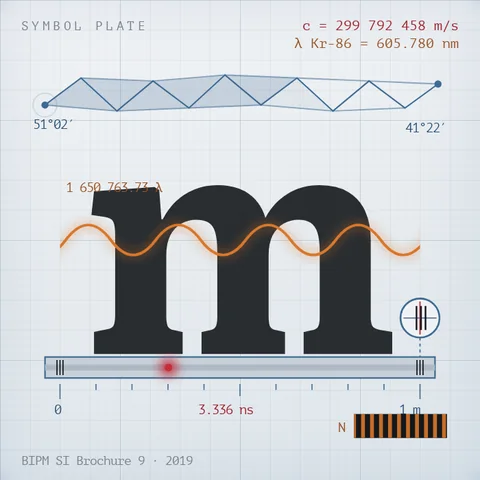
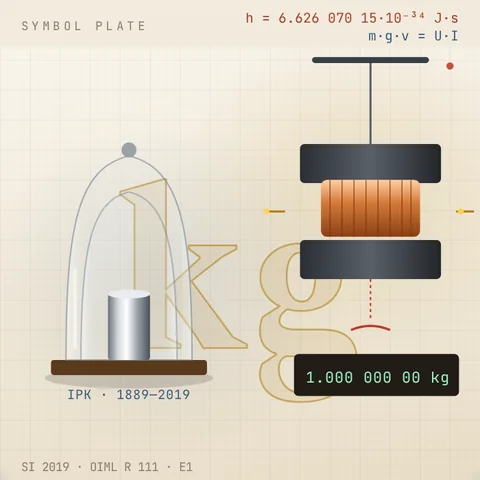
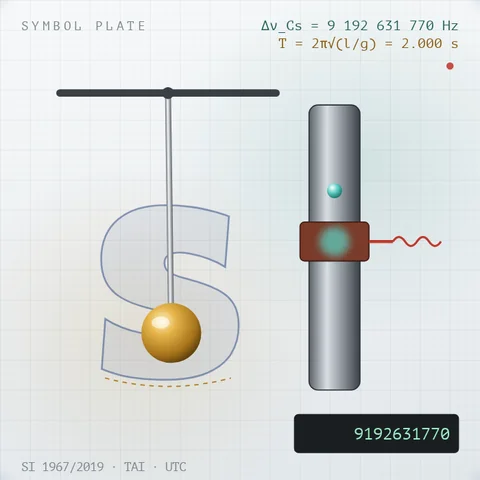
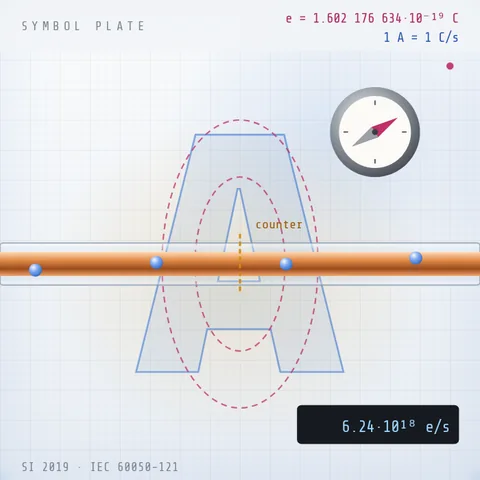
The seven SI base units
Catalogue of quantities
Mycology · 12 unit sheets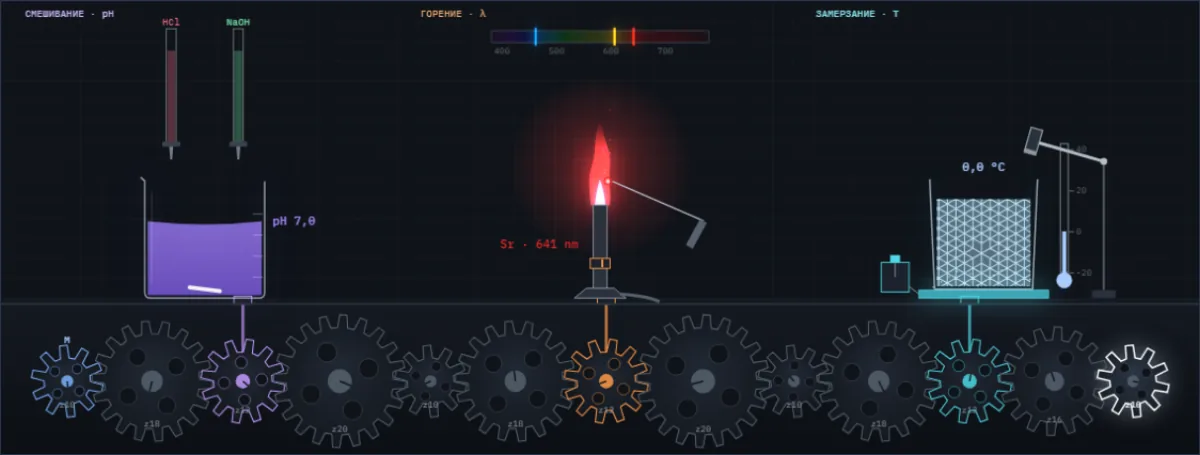
A drop of acid changes the colour of the juice, salt colours the flame, water freezes at a tap. Below them are all Simetrium sheets, by discipline and alphabetically.
Open the index →