Water activity is written with a lowercase a and a lowercase subscript w, for water: a_w. It is a dimensionless number from 0 to 1. It is often written as a percentage, the equilibrium relative humidity, ERH: a_w = 0.7 corresponds to 70 %.
Water activity and the moisture content of a product are different numbers. Moisture content tells how much water a product holds by mass. Water activity tells how free that water is. Honey contains about 17 % water and grain about 14 %, but a_w is almost the same for both: sugar holds water as firmly as starch does.
A slice of bread lies in a glass jar, with water at the bottom. Blue droplets rise from the water to the crumb. Through the letters a_w three mould colonies spread across the bread, and spores rise from them. Under the lid a mist comes and goes. On the right the hygrometer needle moves along the scale to the red mark 0.70, where the green mould zone begins.
Quantity data sheet
mycology rev. 2026-10Water activity a_w
Dimensionless quantity · vapour pressure above the sample divided by vapour pressure above pure water
Why a rusk keeps for years while bread goes mouldy in a week
Put a slice of fresh bread in a closed jar. In five to seven days green spots appear on it. A rusk made from the same bread will sit in the same jar for a year and not change. Mould spores are on both. The only difference is the water they can take.
The availability of water is measured by water activity, a_w. It is the vapour pressure of water above a product divided by the vapour pressure above pure water at the same temperature. For pure water a_w = 1. For fresh bread it is about 0.96, for a rusk about 0.3.
Most moulds need an a_w of at least 0.8. The hardiest start to grow at about 0.7. Below 0.6 almost nothing grows. That is why grain is stored dry, archives are kept at an air humidity of about 50 %, and jam is cooked with plenty of sugar.
01 · Definition
vapour pressure · isotherm · growth thresholdWater in a product can be free or bound. Starch, protein, sugar and salt hold the bound water. The firmer the hold, the fewer water molecules escape into the air above the product. So the vapour pressure above the product is lower than above pure water. Their ratio is the water activity.
If a product sits in a closed volume, the air above it comes into equilibrium with it. The relative humidity of the air then equals a_w multiplied by 100. This is what is used: a_w it is measured with a hygrometer in a small chamber above the sample.
The relationship between the moisture content of a product and its a_w is called the sorption isotherm. Every material has its own. Grain at 14 % moisture and paper at 8 % moisture can have the same a_w. And what matters to mould is precisely the a_w: it decides whether the fungus can take up the water.
When the first spots appear
At the top is a glass jar with a sample: bread, grain, a book or jam. Use the slider to set the air humidity in the jar, or for jam the sugar share. The sample gradually comes into equilibrium with the air, and its a_w is shown by the hygrometer. Time runs in days. Three moulds wait for their threshold: xerophilic Aspergillus grows from 0.70, Penicillium from 0.80, Mucor from 0.90. When a_w is above a threshold, the spores germinate and colonies spread. Blue shows water, green shows mould, red shows thresholds. Below are three views. “a_w by day” shows how the sample's activity changes and when colonies appeared. “Isotherm” shows how much water the material holds at each a_w. “Time to mould” shows how many days to wait for the first colony at different a_w.
The jar holds the humidity of the bread itself
In a closed jar the bread has nowhere to send its water. A little water goes into the air, and the air quickly becomes as humid as the bread, about 95 %. After that the bread hardly dries, and the mould has enough water. If the jar is opened or silica gel is put beside it, the air gets drier and the bread gives up its water. When its a_w falls below 0.7, mould stops growing. That is how a rusk is made.
02 · Conversion
air humidity · foods · microbe thresholdsFrom water activity to the moisture content of a material
Enter a_w, the relative humidity of the air or the vapour pressure. The first tab shows the vapour pressure and the moisture content of bread, grain and paper at this a_w and which microbes can grow. The second collects the a_w of common foods and things. The third gives the growth thresholds of microbes.
The a_w itself changes little with temperature. But when cooled, the air next to a cold wall can reach its dew point. Then water condenses on the glass of the jar or on the wall of an archive, and there a_w equals one. That is why damp things must not be put against a cold wall.
| {k} | {v} | {note} |
{text}
04 · Measuring instruments
sensor chamber · chilled mirror · moisture meter · loggerWater activity is measured in the air above the sample
Water activity analyser
The sample goes into a plastic cup and is slid into a small closed chamber. In a few minutes the air in the chamber comes into equilibrium with the sample. A capacitive sensor measures the air humidity and a thermometer measures the temperature. The instrument shows the a_w and the temperature at which it was taken. The method is described in the standard ISO 18787.
Chilled mirror
A small mirror sits above the sample and is cooled by a Peltier element. A beam of light is reflected from the mirror into a photodetector. When dew forms on the mirror, the reflected beam weakens and the instrument records the mirror temperature, the dew point. From the dew point and the sample temperature the instrument calculates the vapour pressure and a_w. This is the most accurate method, to ±0.003.
Grain moisture meter
At a grain elevator the thing measured is not a_w but the moisture content of the grain. The grain is poured into a cell between two plates and the instrument measures its electrical capacitance, which water changes strongly. Using the isotherm, the moisture content is converted into a_w. For wheat, 14 % moisture corresponds to an a_w of about 0.7 at 20 °C, so grain is dried to 13—14 %.
Logger in an archive
Paper by itself hardly goes mouldy as long as the air around it is dry. In archives and libraries small loggers are placed on the shelves, recording humidity and temperature every hour. If the air humidity stays above 65—70 % for long, the paper comes to the same a_w and spots appear on the spines. Stacks are kept at a humidity of about 45—55 %.
05 · Writing rules
fraction of one · temperature · difference from moisture contenta_w is written as a fraction of one, with a temperature
Water activity is written as a number from 0 to 1 with two or three decimal places and no unit. The temperature at which it was measured is given next to it. The moisture content of a product is written separately and in percent, noting whether it is on a wet or dry basis.
Activity is a fraction of one, while 72 % is already the relative humidity of air in equilibrium. “0.72 %” mixes up the two notations. 14 % is the moisture content of grain, not its activity. The threshold 0.70 refers to the a_w, not to the moisture content of the material. The instrument does not give five decimal places. And air humidity without a temperature is incomplete: when cooled, the same air can produce dew.
06 · Neighbouring units
mycology · pressure · solutionWater activity is the ratio of two vapour pressures, so its closest neighbour is the pascal. Sugar and salt lower it through the concentration of a solution, and that is measured in moles per litre. How fast mould grows when it has enough water is shown by the mycelium growth sheet.
Vapour pressure: 3169 Pa above water at 25 °C.
MThe stronger the syrup, the lower the a_w.
K_rColony speed when there is enough water.
07 · Historical section
archive · from the hair hygrometer to ISO 18787How it was understood that microbes care not about water but about its activity
{title}
{text}
a_w makes sense only at equilibrium
A human hair lengthens when the air gets damper and shortens when it dries. De Saussure's hygrometer of 1783 is built on this: a hair is stretched by a small spring and turns a needle through a lever. It shows the humidity of the air, not of a product. But if a product lies beside it for a long time in a closed volume, the two numbers coincide.
The key word is “long”. Fresh bread just put into a dry room gives off water, and the air at its surface is damper than in the room. While the exchange goes on, the a_w is different on the crust and in the middle of the crumb. That is why the standard requires waiting for equilibrium and keeping the temperature constant.
On the right is what happens without equilibrium. The sensor needle first jumps to the humidity of the room and only then slowly approaches the a_w of the sample. The value at which it stops is recorded.
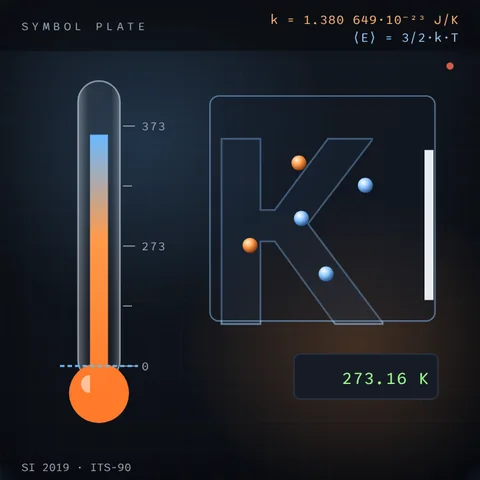
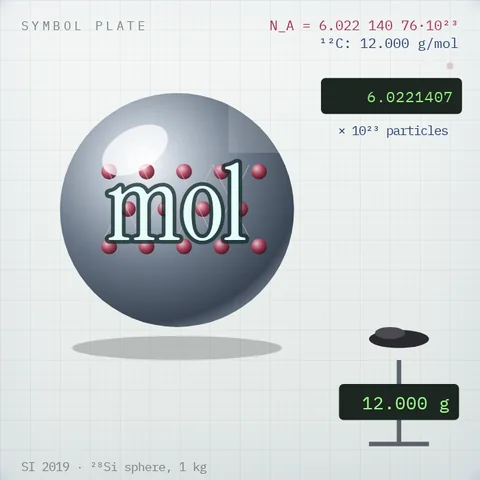
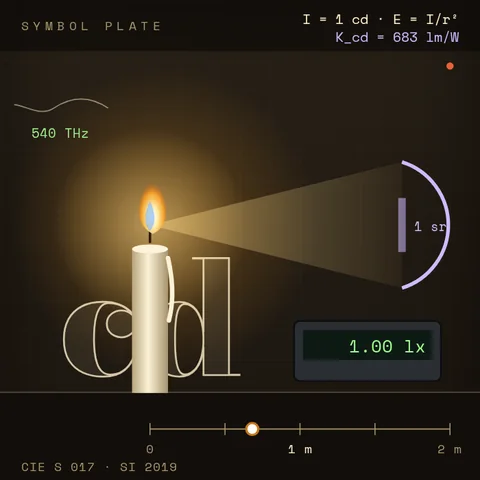
The seven SI base units
Catalogue of quantities
Mycology and water · 12 passports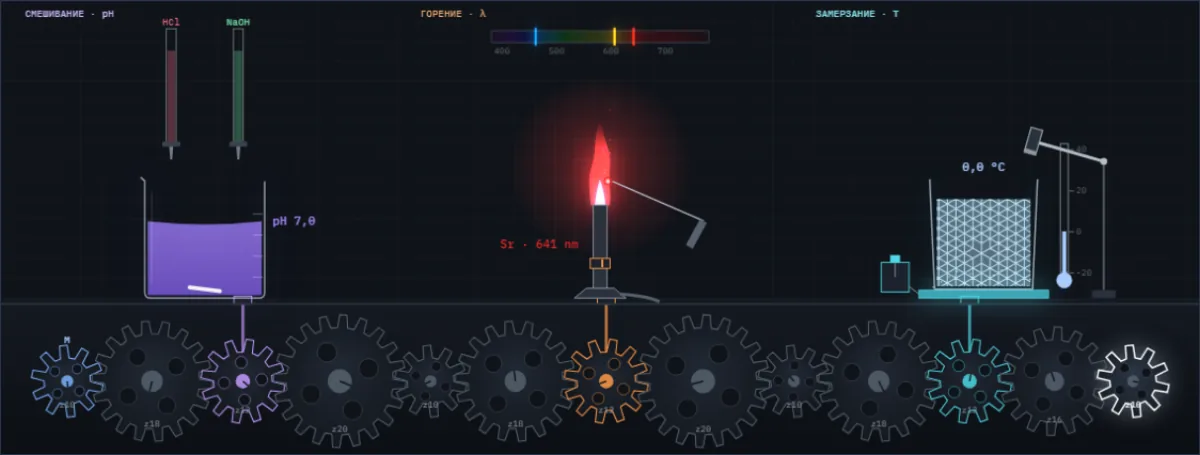
A drop of acid changes the colour of the juice, salt colours the flame, water freezes at a tap. Below them are all Simetrium sheets, by discipline and alphabetically.
Open the index →