The growth rate of a ring is written with a lowercase v, the radius with a lowercase r, the diameter with a capital D. The unit is the metre per year, m/a, where a stands for year. In everyday use people write centimetres per year: 25 cm/a. The age of a ring is written with a lowercase t and always marked “estimate”.
Speed along the radius and along the diameter: the diameter grows twice as fast. The edge of a ring in a meadow and the edge of a colony in a dish: in the dish the hyphae grow without a break, in the meadow only in warm, wet weather. And do not confuse a ring of mushrooms with a lightning scorch or burnt-out grass: they have no dark leading edge.
The meadow is seen from above. The ring widens: the dark band of the leading edge and the brown dead zone move away from the centre, and the mushrooms on the ring move out with them. The dark band pulses, spores rise from one mushroom. A yellow tape is stretched from the peg in the centre to the edge, and the marker on it reaches the 3.0 m mark. At the bottom right is the year counter: 3, 7, 11. The recording indicator blinks.
Quantity data sheet
mycology rev. 2026-10Fairy rings v, m/a
Derived SI unit · quantity: the speed at which the edge of a mycelium spreads across a meadow
The ring in the meadow gets wider every year
In summer a ring of mushrooms appears in the meadow. Inside, the grass has withered, and along the outer edge runs a band of thick, dark grass. A year later the ring is in the same place, only wider. After ten years its diameter is already several metres.
The ring is the edge of a single mycelium. It started to grow from one spore in the centre and spreads in all directions at one speed. In the middle the food has run out and the hyphae there have died. Only a narrow band at the edge stays alive, and the mushrooms rise above it.
The speed of the edge is measured in metres per year. For different fungi and on different soils it ranges from 10 to 50 centimetres per year. Knowing the speed and the radius, one can estimate the age of a ring. The largest rings in the meadows of Europe have, by estimate, been growing for several centuries.
01 · Definition
radius · season · age from sizeA fairy ring grows the same way as a fungal colony in a dish, only more slowly and across a whole meadow. The growth rate shows how far the edge of the ring moves away from the centre in a year. It is measured along the radius, from the centre to the leading edge. In the same time the diameter grows twice as much.
Growth does not go on all year round. In winter and in a dry summer the mycelium almost stands still; in spring and autumn it grows faster. So the speed in metres per year is an average over all seasons. In a dry year the ring can grow three times less than usual.
The age of a ring is obtained by recalculation: the radius is divided by the mean speed. This is an estimate, not a measurement. The speed changes from year to year, and nobody saw the start of the ring. So the age is written as a range, for example from 10 to 15 years.
How old is this ring
At the top is the meadow seen from above, as from a drone. The dark band is the leading edge of the ring: there the mycelium releases nitrogen, and the grass is thicker. Behind it come the line of mushrooms and the brown dead zone, where the soil stops absorbing water. Choose a fungus and set the speed, the summer moisture and the fertiliser. Time runs by seasons, and mushrooms appear in autumn. “Measure” stretches a tape from the centre to the edge. “Drought” makes the next summer dry. “Second ring” plants a neighbouring ring: where two edges meet, they die out. Ochre shows the mushrooms and the dead zone, green the grass of the leading edge, blue the measurements and the age. Below are three views. “Radius by year” shows the measurements and the line of mean speed. “Profile” shows what happens in the soil along the radius. “Age by diameter” shows how the age of a ring is estimated from its size for different fungi.
The fungus fertilises the grass ahead of it
The hyphae at the leading edge break down dead roots and leaves in the soil. This releases nitrogen, and the grass above the edge grows thicker and darker, as after fertilising. Behind the edge the hyphae wrap the soil so tightly that water runs off it, and the grass dries out. Further in, the mycelium dies and the grass recovers. If a lawn is fertilised, all the grass becomes equally dark and the ring almost vanishes, although the mycelium keeps growing.
02 · Conversion
units · age by diameter · recordsFrom metres per year to the age of a ring
Enter a growth rate or the diameter of a ring. The first tab converts the speed into other units. The second estimates the age of a ring from its diameter for different fungi, with a margin for the spread of speeds. The third collects the largest and oldest rings that have been written about.
Conversion to millimetres per day gives the average over the whole year. In fact the ring grows for about seven months, so in the season the edge moves roughly twice as fast as the average, and in winter it stands still.
| {k} | {v} | {note} |
{text}
04 · Measuring instruments
tape · drone · drop · old photographsA ring is measured with a tape and from the air
Peg and tape
The centre of the ring is found from three points on its edge, and a peg is driven in. From the peg the distance to the outer rim of the dark band is measured with a tape in several directions. The measurement is repeated every year at the same points. The difference between two measurements is the annual increment.
Drone photo
From the ground a large ring cannot be seen whole, but from above it reads at once, especially in a dry summer. A drone photographs the meadow from a known height, and each pixel of the image corresponds to a known number of centimetres. The diameter is measured on the image in several directions. This shows right away whether the ring is even or has already broken into arcs.
Drop test
Why the grass in the dead zone dries out is checked with a drop of water. On ordinary soil the drop soaks in within seconds. In the dead zone the hyphae coat the soil particles so tightly that the drop lies there for minutes. The time the drop takes to soak in is written in seconds. It is used to find the inner boundary of the ring even when the grass has not yet withered.
Old aerial photos
The speed of large rings cannot be measured in one year: the increment is smaller than the width of the dark band. But an old aerial photograph can be compared with a new one. If over 70 years the radius grew by 17 m, the mean speed is about 0.24 m/a. The numbers in the figure are an example of the calculation, not a measurement of a real ring.
05 · Writing rules
radius or diameter · period · estimateState whether it is along the radius or the diameter
The speed of a ring is written in metres or centimetres per year, with a note that it is along the radius. The size of a ring is given as a radius or a diameter, and this is always marked with a letter. The age is written as a range or marked “estimate”, and the speed at which it was calculated is stated.
Without a period it is unclear over what time the ring grew by 0.5 m, and whether this is along the radius or the diameter. “Ring 6 m” can be read both as a radius and as a diameter. An age without a speed cannot be checked. The year is denoted by the letter a, not y. A ring has no exact age, only an estimate. And 0.25 m is 250 mm, not 25.
06 · Neighbouring units
mycologyThe edge of a ring is the edge of a colony, only in a meadow and with breaks for winter. How fast hyphae grow without breaks, in a dish, is shown by the mycelium growth sheet. How much the mycelium under a ring weighs is worked out by the mycelium mass sheet. And the year is the unit in which both the speed of a ring and its age are measured.
The edge of a colony in a dish, mm/d.
kg/haWhat lies under the ring.
aThe measure of both speed and age.
07 · Historical section
archive · from the fairy dance to a ring 600 metres acrossHow a fairy-tale ring became a measure of time
{title}
{text}
The age of a ring is a recalculation, not a measurement
The radius of a ring is measured with a tape to the nearest centimetre. But the age is obtained from it by dividing by the mean speed, and that is known exactly only for the years when the ring was measured. A drought, a cold summer or a trampled path slows the edge. So the same ring of 3 m may be eight years old or fifteen.
There is another difficulty. An old ring seldom stays round. It meets a road, a tree or a neighbouring ring and breaks into arcs. Two mycelia do not enter ground where another has already been, so where their edges meet, both edges die out. On the right two rings grow towards each other and wipe each other out at the meeting point.
The age of large rings is therefore written as an estimate, and the method is stated: radius from a photograph, speed from measurements over several years. The more years of measurements, the narrower the range.
The seven SI base units
Catalogue of quantities
Mycology and time · 12 unit sheets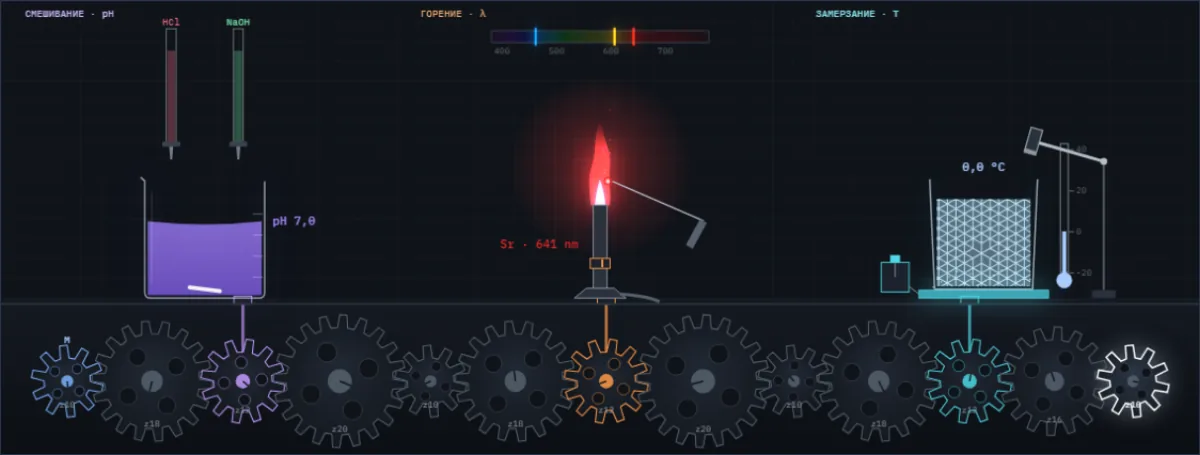
A drop of acid changes the colour of the juice, salt colours the flame, water freezes at a tap. Below them are all Simetrium sheets, by discipline and alphabetically.
Open the index →