Mass per area is written in grams per square metre, g/m², or in kilograms per hectare, kg/ha. A capital M with a subscript stands for mass: M_myc for the mycelium, M_fr for the fruit bodies. Hyphal length in soil is written with a lowercase L, in metres per gram of soil.
Dry mass and fresh mass are not the same: in a fresh mushroom nine tenths is water. Nor should the mass of the mycelium be confused with the mass of the mushroom crop: the crop is counted per season, the mycelium on the day of sampling. And a hectare is not "one mycelium per hectare": a single individual may occupy anything from a few metres to hundreds of hectares.
A coral fungus sways above the litter, spores rising from the tips of its branches. Underground, white hyphae spread out from its base, pass through the letters kg/ha and reach a spruce root. On the right the tube of a corer sinks into the soil, and the mark on the scale drops to 15 cm and flashes. At the top is a balance: the pan with hyphae outweighs the pan with the fruit body.
Quantity data sheet
mycology rev. 2026-10Mycelium and fruit body kg/ha · g/m²
SI derived unit · quantity: dry mass of a fungus per unit area
A coral fungus weighs two hundred and fifty grams. How much does the fungus weigh?
In autumn, a coral fungus is found in a spruce forest, branched like a sea coral. It is cut and put in the basket. But that is not the whole fungus. It is only the fruit body, which the fungus grows for a few weeks to scatter its spores.
The fungus itself has stayed in the soil. This is the mycelium, a network of threads called hyphae, about three micrometres thick. It entwines the roots of the spruce and lives for years. Every gram of forest soil can hold tens or hundreds of metres of hyphae. Under one square metre of forest they add up to about twelve thousand kilometres, almost a third of the equator.
The best way to compare mycelium and fruit body is by dry mass per unit area. Under a spruce forest the mycelium weighs about twenty grams per square metre. That is several times more than all the fruit bodies that will rise above the same metre in a season.
01 · Definition
hyphal length · mass of a metre · soil layerA fruit body can be weighed whole. The mycelium cannot: it cannot be lifted out of the soil. So its mass is calculated. A soil core is taken, the hyphae are washed out, and their length in one gram of soil is counted under a microscope.
A metre of hypha 3 µm thick weighs about 1.6 µg when dry. This is the volume of a cylinder multiplied by the density and by the dry-matter fraction. The length per gram is multiplied by the mass of a metre and by the mass of the soil under a square metre in the sampled layer. The result is the mass of mycelium per square metre.
Fruit bodies are easier to count: all the mushrooms on a sample plot are collected over the season, dried and weighed. Both masses are divided by the area, and then they can be compared. In fungi that live with tree roots, the fruit bodies are almost always lighter than the mycelium.
Which pan will outweigh
At the top is a cross-section of forest soil under coral fungi. The white threads are hyphae, and their density follows the L slider. Choose a forest, an area, the number of fruit bodies and the hyphal thickness. "Take a core" lowers the corer and counts the hyphae in the sample as a laboratory would, with scatter. "Fruiting" grows coral fungi. Fruit bodies are shown in coral, mycelium in slate blue, roots in green. Below are three views. "Scales" — the two masses side by side. "By depth" — how many hyphae there are in each centimetre of soil. "Year" — how both masses change month by month.
The tree feeds the mycelium
Coral fungi growing in coniferous and broadleaf forests live in partnership with trees. The hyphae entwine fine roots, receive sugars from the tree and give it water and nitrogen. So the mass of the mycelium is a part of the forest's own yield that the tree has invested in the underground network. The fungus grows its fruit bodies from the same reserves, but only when there is moisture and the nights are cool. In a dry year there are no fruit bodies at all, yet the mycelium remains.
02 · Conversion
mass per area · hyphal length · recordsFrom grams per metre to tonnes per hectare
Enter a mass per area or a hyphal length. The first tab converts units. The second calculates the mycelium mass for the chosen layer from the hyphal length in soil. The third collects the biggest fungi, by fruit body and by mycelium.
Different laboratories get different hyphal lengths per gram of soil, and the results differ two- or threefold. Dead and living hyphae are also not always distinguishable under the microscope. So the mass of mycelium is given with a margin: "on the order of a hundred kilograms per hectare".
| {k} | {v} | {note} |
{text}
04 · Measuring instruments
corer · grid · bag · dryingMycelium is not weighed, it is calculated
Soil corer
A steel tube is driven into the soil and a column of undisturbed earth, the core, is pulled out. It is cut into layers five centimetres thick and each is weighed. This gives the mass of soil under a square metre in the layer needed. Without this number, hyphal length per gram cannot be converted into mass per area.
Line-intersect method
Hyphae from a soil sample are stained and laid out on a filter. Measuring every thread is impossible. Instead, a grid is placed in the eyepiece and the number of times hyphae cross its lines is counted. From the number of intersections, the area and the total length of the lines, the hyphal length is obtained. The method was devised in 1966 for plant roots.
Mesh bag
Small bags of mesh with 50 µm openings, filled with clean sand, are buried in the soil. Roots cannot pass through such mesh, but hyphae can. After a few months the bags are dug up and the mycelium that has grown into them is weighed. This shows how much mycelium the forest grows in a season, usually hundreds of kilograms of dry mass per hectare.
Drying and scales
Fruit bodies from the sample plot are dried at 60—70 °C until their mass stops falling. A fresh coral fungus of 250 g weighs about 25 g after drying. Fungi can be compared only by dry mass: on a rainy day the same mushroom is heavier than on a dry one.
05 · Writing rules
dry or wet · layer · periodState which mass and which layer
The mass of a fungus per area is always accompanied by three notes: whether it is dry or wet, for which soil layer, and over what period. Without them, a number from one paper cannot be compared with a number from another.
Without the layer and the state, a number is incomplete: in the 0—30 cm layer there is more mycelium, and wet mass is five times the dry. The symbol for the hectare is ha, not "ga". A mushroom yield without a note is usually wet, and it is ten times heavier than the dry. L is length per gram of soil, not just length. Increment per season and standing stock on the sampling day are different quantities. And a gram per square metre is ten, not a hundred, kilograms per hectare.
06 · Neighbouring units
mycologyThe mass of a mycelium is the result of its growth: how fast the edge of a colony grows is told by the sheet on mycelial growth. A fruit body lives for the sake of spores, and their size and discharge are on neighbouring sheets. The area in hectares is a common yardstick for all.
Colony edge, mm/d.
v₀Why a fungus grows a fruit body.
ha10 000 m², a measure of forest area.
07 · Historical section
archive · from roots in a grid to a giant individualHow the whole fungus was seen
{title}
{text}
Mycelium mass is always a calculation
A fruit body can be put on the scales. The mycelium cannot: it cannot be separated from the soil whole. So its mass is always obtained by calculation from three measurements: the hyphal length in a gram of soil, the mass of a metre of hypha and the mass of soil in the layer.
Each of the three numbers is measured with its own error. The hyphal diameter varies from two to five micrometres, and the mass of a metre grows with the square of the diameter, a difference of six times. Part of the hyphae in a sample are already dead. So the mycelium mass is written rounded, with the method stated.
There is another way, a chemical one. The walls of fungal cells contain a substance, ergosterol, that plants lack. Its amount in a soil sample is converted into mycelium mass. On the right is an intersection counter under the eyepiece: each dot is a hypha that has crossed a grid line.
The seven SI base units
Catalogue of quantities
Mycology and area · 12 passports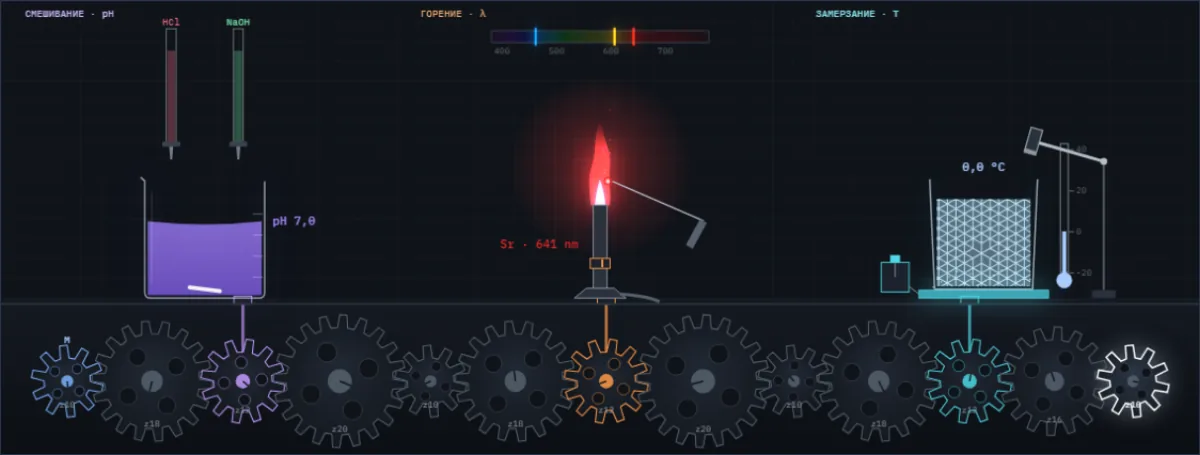
A drop of acid changes the colour of the juice, salt colours the flame, water freezes at a tap. Below them are all Simetrium sheets, by discipline and alphabetically.
Open the index →