The launch speed is written with a lowercase v with a zero subscript: v₀. The unit is the metre per second, m/s. The acceleration at discharge is often given as a fraction of the acceleration of free fall: a lowercase italic g. The stopping time of a spore in air is written with the Greek τ, the stopping distance as x with the label stop.
Launch speed is not settling speed. A spore leaves at about 1 m/s and falls a thousand times slower, at about 1 mm/s. Acceleration in g is not grams. And launch speed says nothing about range: a small spore is stopped by the air almost at once, while the heavy sporangium of Pilobolus flies for metres.
On the left is a mushroom with a pointed conical cap. Spores fall from between the gills. In the circle on the right a gill is magnified: on its surface, at the base of the spore, a drop grows, then the spore breaks free, flies sideways and turns sharply downward. The mark on the scale below the circle reaches 0.1 mm — that is how far the spore flies sideways. At the bottom, Pilobolus shoots a black sporangium towards the light. A high-speed-camera indicator blinks.
Quantity data sheet
mycology rev. 2026-10Spore discharge v₀, m/s
Derived SI unit · quantity: initial speed of a spore at discharge
A mushroom fires a spore and hits the gap exactly
Under the cap the gills stand almost shoulder to shoulder, with less than a millimetre between them. The spore sits on the side of a gill. If it were simply released, it would stick to the same gill. So the mushroom fires it off. The spore flies sideways about a tenth of a millimetre, stops in the air and falls down into the gap between the gills.
The shot is made by a drop of water. It gathers at the base of the spore and at some moment merges with the film on its surface. The water suddenly flows over, the centre of mass shifts, and the spore breaks away at about a metre per second. The acceleration is on the order of ten thousand g. The whole discharge lasts a few microseconds.
Other fungi shoot harder. Pilobolus, which grows on dung, throws its sporangium two and a half metres, straight onto the grass, towards the light. Ascomycete asci eject spores at tens of metres per second. But for a small spore what matters is not the speed but how quickly the air stops it.
01 · Definition
discharge · deceleration · fallThe launch speed v₀ is the speed of the spore in the first moment after it breaks free. It is measured from high-speed frames: by how many micrometres the spore has moved between two frames. After that the air slows it down, and the speed drops quickly.
For a small particle air is viscous, like honey for a pea. The drag force is proportional to speed, and the speed decays exponentially with the time constant τ. The smaller the particle, the smaller τ: for a spore of 5 µm it is about 0.08 ms. In that time the spore covers the distance x = v₀·τ, about 0.1 mm, and stops.
After stopping, the spore falls. Gravity balances drag at the speed v = g·τ, less than a millimetre per second. At this speed the spore sinks between the gills and leaves from under the cap. The large sporangium of Pilobolus slows down much more gradually, so it flies for metres. For it, drag grows faster than speed, and a correction for the Reynolds number is added to the calculation.
Why a spore does not stick to the neighbouring gill
At the top is a cross-section of the discharge site: the gills of a cap, an ascomycete ascus in a fruit body on a wheat ear, or Pilobolus on dung. Press “Fire”: the projectile leaves at speed v₀ and its trajectory is calculated with air drag. The display is slowed down: the first microseconds are stretched, otherwise they cannot be seen. The sliders change the speed, the size of the projectile and the gap between the gills or the launch angle. “No air” draws where the projectile would have gone in a vacuum. Green shows the gills and the target, plum shows the spore and its path, red shows a miss and the path without air. Below are three views. “Trajectory” is the path at true scale. “Speed” is how it falls with time, on a logarithmic scale. “Size and path” is how far particles of different sizes fly at one speed.
The spore falls straight down, and the mushroom takes this into account
After stopping, the spore falls straight down. If a gill is tilted, the spore will hit it and stick. That is why the mushroom keeps its gills plumb: if the stalk is tilted, within a few hours it bends and levels the cap again. Small mushrooms with a pointed conical cap have narrow, tall gills, and the gaps between them are fractions of a millimetre. The gap must be larger than the spore's path, but not by much: that way more spores fit on the gills.
02 · Conversion
speed units · shots side by side · path by sizeFrom metres per second to spore lengths
Enter a speed and choose a unit. The first tab converts it into other units, including spore lengths per second, which is how speeds of projectiles of different sizes are compared. The second puts the shots of different fungi side by side. The third calculates how far particles of different sizes fly at this speed.
Rule of thumb: 1 m/s is 1 µm per microsecond and 3.6 km/h. A 5 µm spore at this speed covers two hundred of its own lengths in a millisecond.
The path is calculated for a sphere of the same mass in still air at 20 °C. A real spore is elongated, spins and gets caught in weak air currents under the cap. So the numbers are an order of magnitude. Experiments with imaging give similar paths: 0.05—0.2 mm for cap mushrooms.
| {k} | {v} | {note} |
{text}
04 · Measuring instruments
camera · target · spore trap · settling columnThe discharge lasts microseconds, its trace years
High-speed camera
The camera is mounted on a microscope and films a piece of gill from the side. To see the discharge itself, hundreds of thousands of frames per second are needed. The speed is calculated from the displacement of the spore between adjacent frames. At 250 000 frames per second, 4 µs pass between frames and the spore moves by a few micrometres — about its own length.
Targets for Pilobolus
The Pilobolus sporangium is sticky and clings to whatever it hits. So the range is measured simply: glass slides are placed around the culture at different distances, and in the morning the sporangia stuck to each are counted. This is how Buller already obtained a range of more than two metres. If the culture is put in a dark box with a single window, almost all the hits gather around the window.
Spore trap
Spores that have come out from under the cap are picked up by the wind. To find out how many are in the air, a spore trap is set up. A pump draws about 10 litres of air per minute through a narrow slit, and the spores stick to a tape on a slowly rotating drum. Under the microscope you can see in which hours there were the most spores. This is how bulletins for allergy sufferers and warnings about cereal diseases are compiled.
Settling column
A spore need not be filmed in flight; one can time how it falls. In a closed glass column there are no draughts, and the spore settles at a constant speed. From this speed τ is found: τ = v/g. And knowing τ and the launch speed gives the stopping distance. A spore twice as large settles four times faster — τ grows with the square of the size.
05 · Writing rules
speed · acceleration · pathSpeed in m/s, acceleration in m/s² or in g
Speed is written in metres per second. Acceleration is written in metres per second squared or as a fraction of g, and then g goes after the number. The path is given together with the projectile size: without it the number cannot be compared with another experiment.
m/s² is a unit of acceleration, not of speed. g is already an acceleration; “g per second” means nothing. A path without the projectile size says nothing: a spore twice as large flies four times farther. Range is a length, not a speed. Settling speed is a speed, and it has a “per second”. And a time constant has a unit too — seconds or milliseconds.
06 · Neighbouring units
mycologyThe path of a spore is determined by its size: it grows with the square of the diameter. That is why the sheet on spore size is a direct neighbour of this one. Whether a new colony will grow from a fallen spore, and how fast, is covered by the sheet on mycelium growth.
Stopping distance ∝ d².
mm/dWhat will grow from a fallen spore.
1 m/s = 3.6 km/h.
07 · Historical section
archive · from Buller's lens to the high-speed cameraHow people saw what lasts microseconds
{title}
{text}
Launch speed is measured from two or three frames
The spore accelerates within a few microseconds and almost at once begins to slow down. Even at 250 000 frames per second only a few of its positions make it into the frame. The speed is calculated from the displacement between the first frames after it breaks free, and each micrometre of error in position means an error of a quarter of a metre per second.
Moreover, the spore is already slowing down between frames. The speed found from the first two frames is the mean speed over 4 µs, not the initial one. So the initial speed is often found differently: a deceleration curve is fitted to all the frames of the flight and extended back to the moment of release.
With Pilobolus it is simpler: the projectile is large and flies for a long time. But here too, the range on targets is not the same as the speed: it is converted through air drag, which depends on the size and shape of the sporangium. So the description of an experiment always states how the number was obtained.
The seven SI base units
Catalogue of quantities
Mycology · 12 unit sheets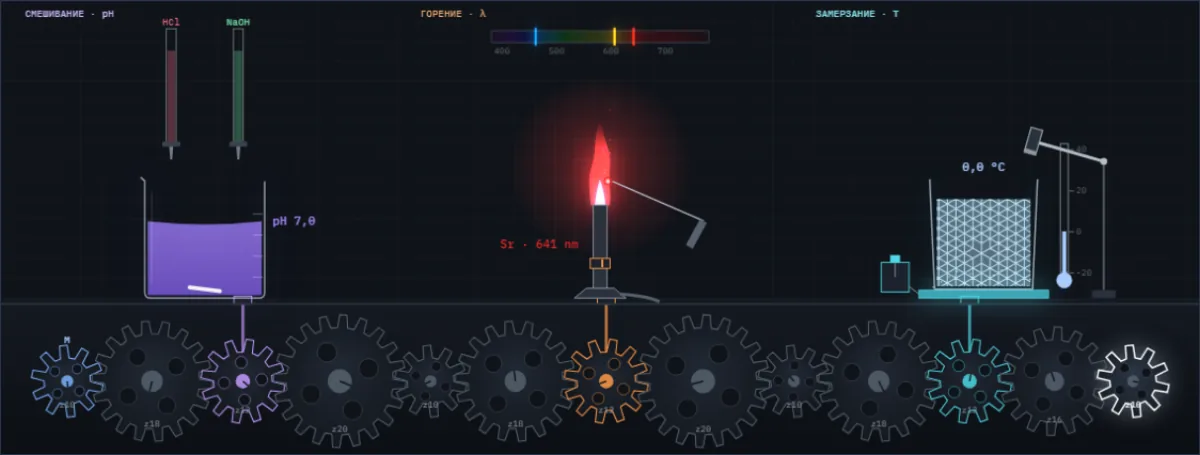
A drop of acid changes the colour of the juice, salt colours the flame, water freezes at a tap. Below them are all Simetrium sheets, by discipline and alphabetically.
Open the index →