Carbon in the unit is written with a capital C after the number of grams: g C/m². These are grams of carbon, not grams of sugar or of dry mass. The flux per year is written g C/(m²·a), where a stands for year. The share is written as a percentage of NPP, the primary production left after the plant's own respiration.
Do not confuse the share of NPP with the share of total photosynthesis, GPP: the second is half as large. Do not confuse grams of carbon with grams of CO₂: one gram of carbon is 3.67 grams of CO₂. And do not confuse a flux over a year with a stock: the mycelium may weigh less than the carbon that passed through it in one season.
The sun pulses above the spruce. Amber drops of sugar run down the trunk and root into the letter C. The letter is the fungal sheath around a root tip. From its open side the drops go on along the hyphae into the soil. Coming the other way along the same hyphae, green particles of nitrogen rise to the tree. On the right a mark on the scale climbs to 16.7 % and flashes. The recording indicator blinks.
Quantity data sheet
mycology rev. 2026-10Mycorrhiza %, g C/(m²·a)
SI derived unit · quantity: the flux of carbon from a plant to a fungus per unit area and its share of production
The spruce pays the fungus in sugar
In 2001 Swedish foresters removed a narrow ring of bark from pines. The trees did not die at once: water still rose to the needles. But sugar from the needles no longer reached the roots. Two months later the soil under these pines gave off almost half as much carbon dioxide as under their neighbours.
Roots, together with the fungi on them, breathed out half of that gas. The root tips of spruce and pine are clothed in a fungal sheath. Hyphae lead from it into the soil. The fungus gets sugar from the tree and in return brings nitrogen, phosphorus and water, which it gathers from an enormous volume of soil. Such a partnership is called mycorrhiza.
The price of the partnership is measured with two numbers. The first is the share: what percentage of the tree's net production goes to the fungus. The second is the flux: how many grams of carbon per year the fungus receives from a square metre of forest. In a spruce forest it is about a sixth of production, around 90 g C per square metre per year.
01 · Definition
photosynthesis · respiration · fungal shareOver a year a forest takes up a lot of carbon from the air. This gross photosynthesis is called GPP. The tree at once spends roughly half of it on its own respiration. The remainder, net primary production NPP, goes into growth of wood, needles and roots, and into paying the fungi.
The mycorrhizal share is the flux of carbon to the fungi divided by NPP. It is expressed in percent. The flux itself is expressed in grams of carbon per square metre per year. Carbon is counted separately from the other atoms so that sugar, wood and exhaled gas can be added up in the same units.
The share is not constant. If the soil holds plenty of available nitrogen, the tree takes it up itself and pays the fungus less. If nitrogen is scarce, the share grows. That is why fertilizer and nitrogen deposition reduce mycorrhiza, while on poor northern soils it is at its most generous.
How much the tree pays the fungus
At the top is the plant and the soil in cross-section. Amber drops are sugar going from the leaves to the roots and on to the fungus. Green particles are nitrogen that the fungus gives to the plant. The fungus is shown in violet: sheaths on the root tips and hyphae in the soil. Use the sliders to set light, soil nitrogen and moisture. “Girdling” removes a ring of bark: sugar stops at the cut. “¹³C label” releases a portion of labelled carbon, and you can see how fast it reaches the fungus. Below are three views. “Flux” shows where the carbon goes. “¹³C label” shows where the label is, day by day. “Nitrogen” shows how the fungal share falls as soil nitrogen rises.
A hypha is a hundred times thinner than a root
A fine spruce root is about half a millimetre thick. A hypha is about three micrometres. From the same amount of carbon the fungus grows far more length and covers a far greater volume of soil. So it pays the tree to pay the fungus rather than build roots itself, as long as nitrogen is scarce. Add nitrogen with the “×2 nitrogen” button: the fungal share will fall, because the tree starts taking nitrogen directly.
02 · Conversion
carbon · CO₂ · sugar · planet scaleFrom grams of carbon to tonnes of CO₂
Enter the flux to the fungus in any unit. The first tab converts it to carbon, CO₂, glucose and the share of spruce-forest production. The second shows share and flux in different forests by the sheet model. The third scales the flux from one square metre up to a hectare, a country and the planet.
A lot of carbon passes through fungi, but little stays. The fungus breathes most of it back out within days and weeks; part goes into soil organic matter. So 90 g C per year does not mean that the soil gains 90 g C every year.
| {k} | {v} | {note} |
{text}
04 · Measuring instruments
¹³C chamber · mass spectrometer · girdling · minirhizotronLabel the carbon, then look for it
¹³C label chamber
A young tree is covered with a transparent chamber and for several hours is supplied with air whose carbon dioxide contains the heavy isotope ¹³C. The tree fixes it just like ordinary CO₂. Then, at equal intervals, samples are taken of needles, roots, hyphae and the gas the soil breathes out. From where and when the label appears one can see what share of the carbon went to the fungi and in how many days.
Isotope-ratio mass spectrometer
The sample is burned and all its carbon turns into CO₂. The molecules are accelerated and passed through a magnet. Heavy molecules with ¹³C are deflected slightly less and land in the neighbouring detector. From the ratio of the currents in the detectors the instrument calculates how many times more heavy carbon the sample holds than the standard. This number is written in per mil as δ¹³C.
Girdling
Sugar travels down a thin layer under the bark, while water rises through the wood. If a ring of bark is removed from a trunk, sugar stops at the cut while water keeps flowing. The tree is still alive, but roots and fungi stop receiving carbon. From how far soil respiration fell, one learns what part of it the roots and fungi supplied.
Minirhizotron
A transparent tube is buried in the soil at a slant. A small camera travels inside it and once a week photographs the wall at the same depths. The pictures show how roots grow and die and how hyphae sprout. From the number and length of hyphae in the pictures one estimates how much carbon the fungus puts into growth and how fast it loses it.
05 · Writing rules
carbon · period · base of the shareState that it is carbon, over what period, and the share of what
Write the flux in grams of carbon, with the letter C after the gram, and give the period. Write the share together with what it is taken of: NPP, GPP, or the photosynthesis of the day of the label.
Without the letter C and without a period it is unclear grams of what and over what time. “Percent of carbon” does not say what quantity it is taken of. 91 g of carbon is 334 g CO₂, not 91. A deviation in isotopic composition is written in per mil, not in percent, and the standard is given. And a share of GPP is about half of the same share of NPP.
06 · Neighbouring units
mycologyThe carbon the tree gives to the fungus turns into mycelium; its mass per hectare is counted by the neighbouring sheet. How fast hyphae sprout is shown by the sheet on mycelial growth. And the measure of carbon as a substance, the mole, is covered by the SI base unit.
Where the paid carbon goes.
K_rColony edge, mm/d.
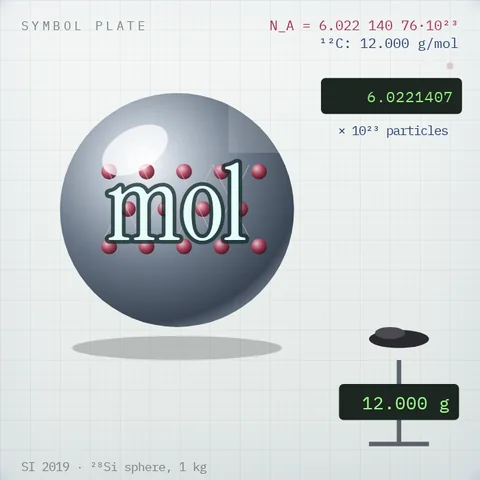
mol12 g of carbon is one mole of atoms.
07 · Historical section
archive · from “fungus-root” to 13 gigatonnesHow the price of the partnership was worked out
{title}
{text}
A gram of carbon is not a gram of sugar
The sugar glucose consists of carbon, hydrogen and oxygen. Carbon makes up 72 parts out of 180. So one gram of carbon is two and a half grams of glucose. And if fungi breathe out that same carbon, it makes 3.67 grams of CO₂.
To avoid confusion, ecology expresses all carbon in a single measure, grams of carbon itself. A sample of needles, root or soil is wrapped in a tin capsule and burned at a thousand degrees. All the carbon goes into CO₂, and the instrument counts its amount. This is how the standard ISO 10694 determines carbon in soil.
On the right is the same idea on a balance. On the left pan are 2.5 grams of sugar, on the right 1 gram of carbon that it contains. The balance is not level, yet the count in grams of carbon adds up.
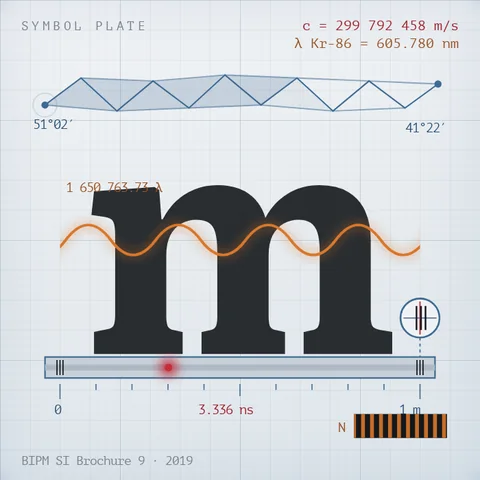
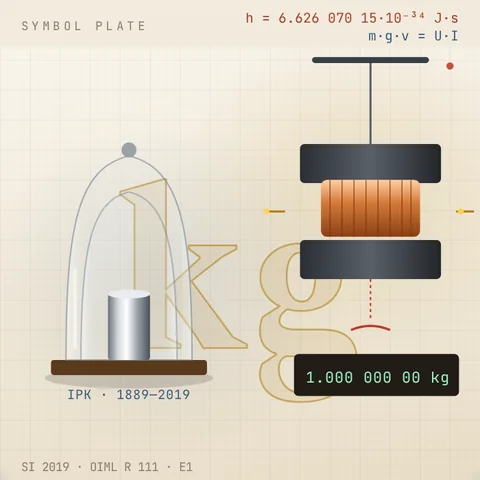
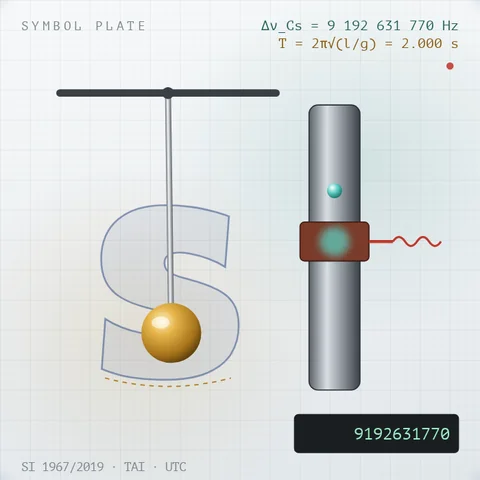
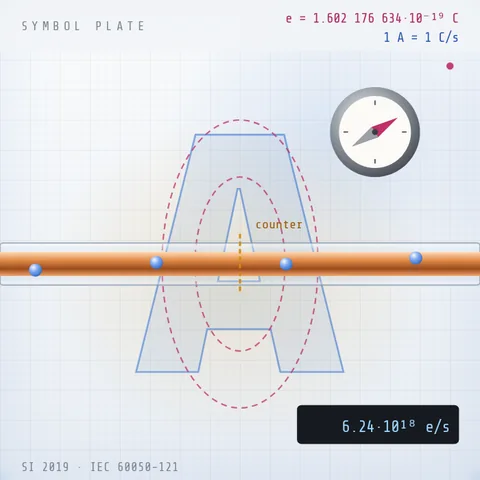
The seven SI base units
Catalogue of quantities
Mycology and carbon · 12 passports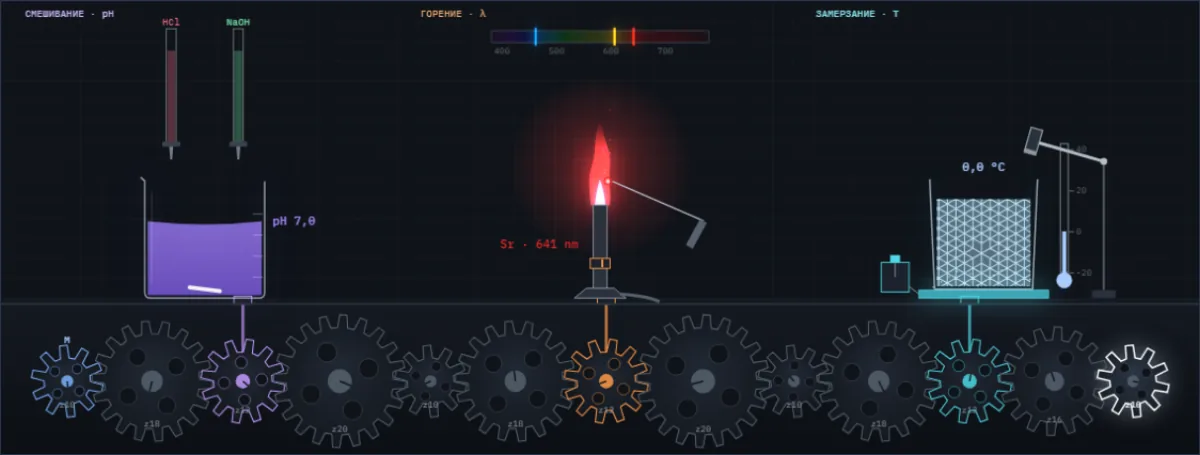
A drop of acid changes the colour of the juice, salt colours the flame, water freezes at a tap. Below them are all Simetrium sheets, by discipline and alphabetically.
Open the index →